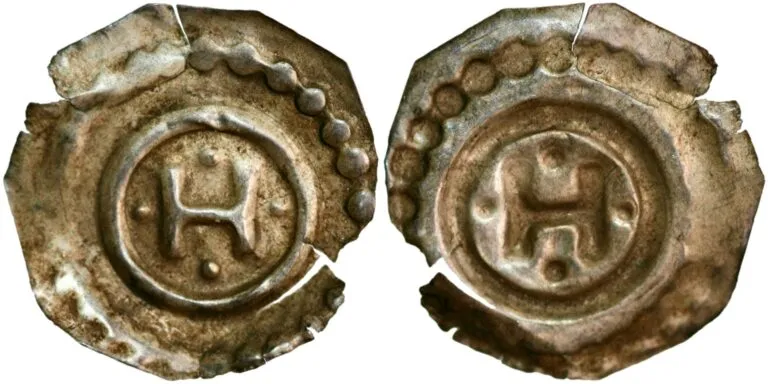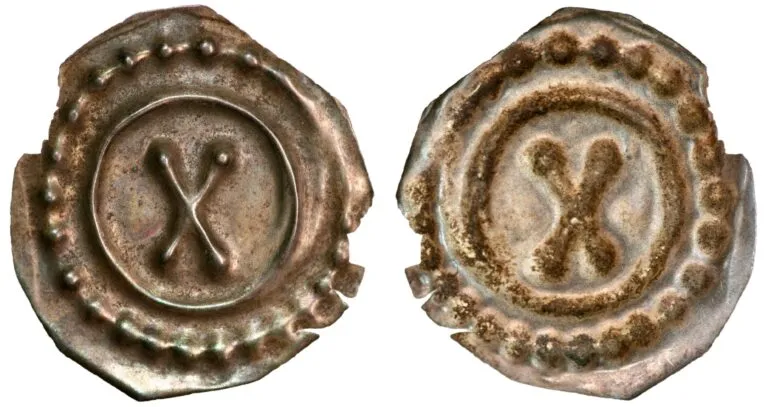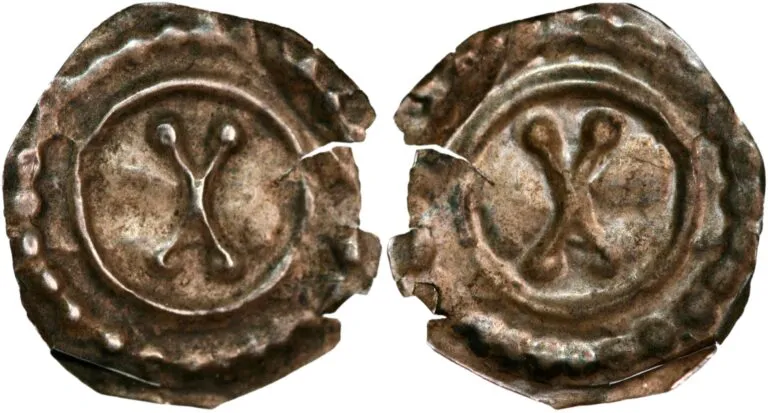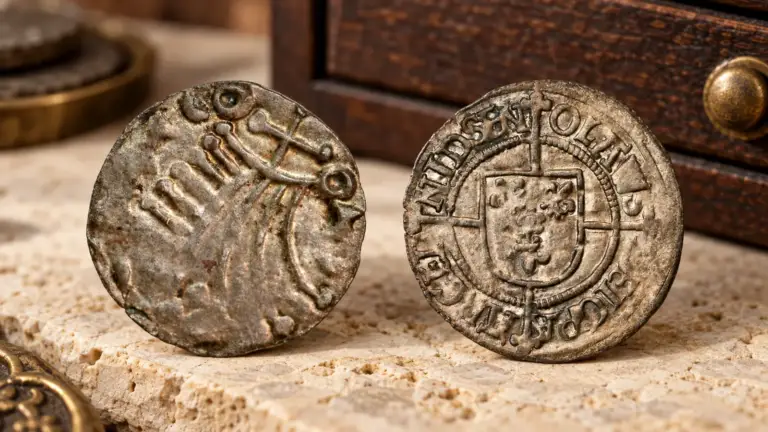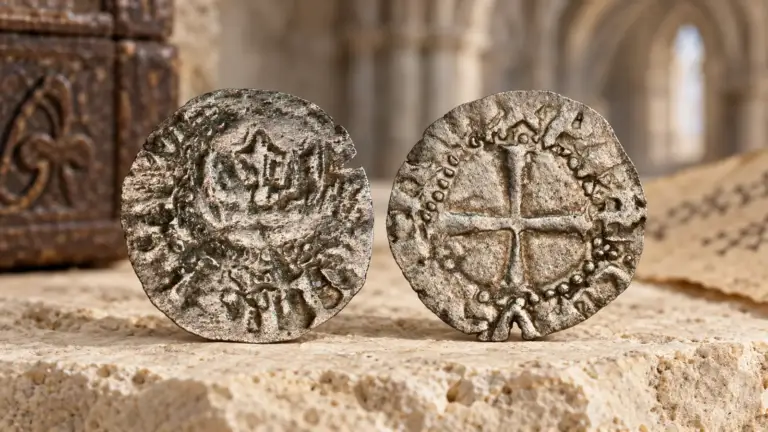
King Sverre’s coins are known to us mainly from four important coin finds from his reign. Sverre Sigurdsson was king of Norway from 1177 to 1202, and the largest find, the treasure from Dæli farm in Nes, Hedmark, is probably the most important coin find in Norwegian history. Here we take a closer look at three of the finds.
Contents
The finds that reveal King Sverre’s coins
Around the year 1700, a hoard of about 60 small pieces of silver was found. The coins are believed to come mainly from King Sverre’s production of quarter pennies.
The third-largest hoard from Sverre’s time was found at Bryggen in Bergen in 1968. A lump of coins was discovered there and later separated, and 94 quarter pennies were saved from it.
What is a bracteate?
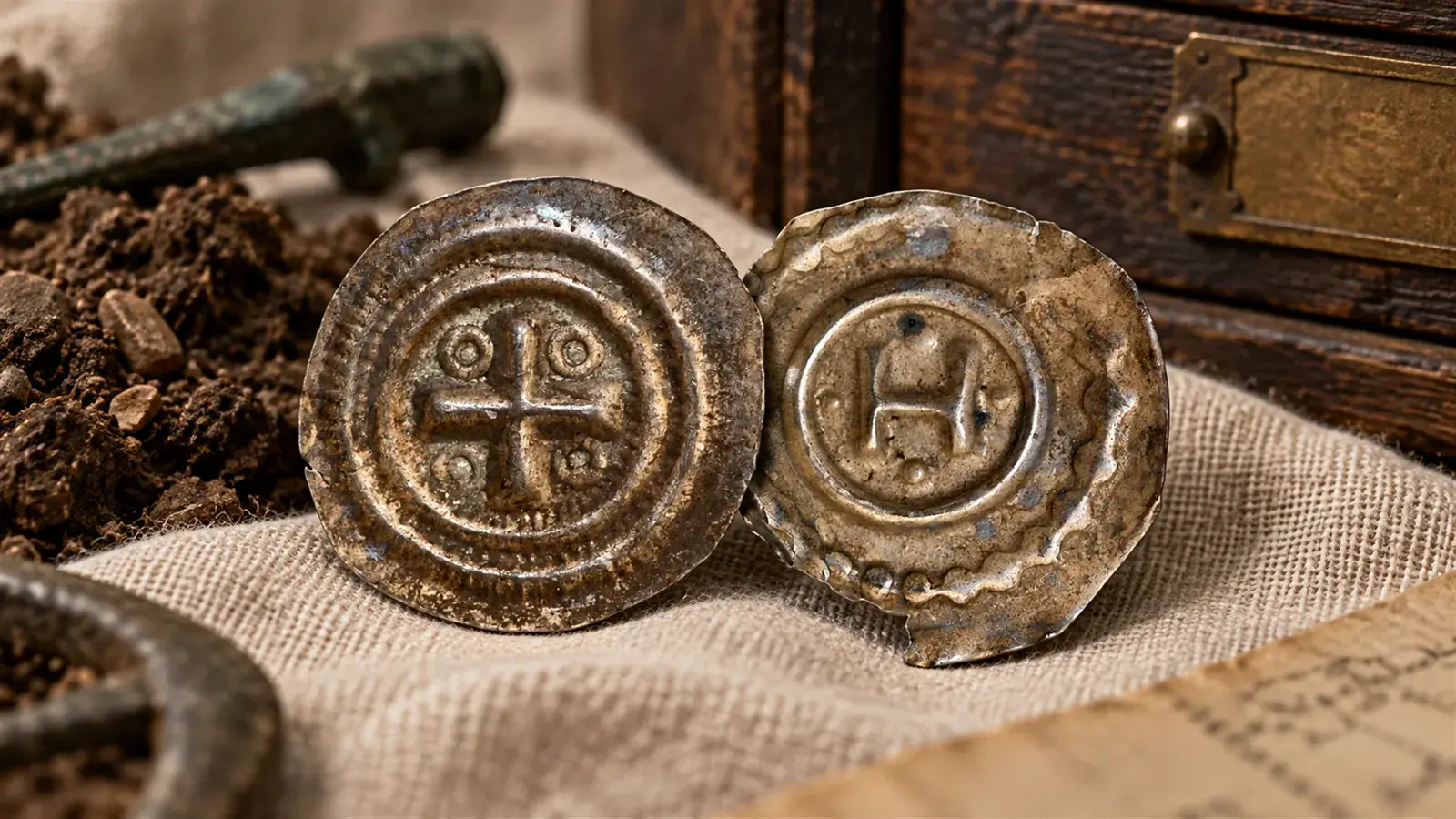
The quarter penny is also known as a bracteate. The technique originally came from the German lands and was first used in Norway around 1110. In short, bracteates are coins struck on blanks so thin that the design goes through the metal and shows in negative on the other side. According to the University of Oslo Coin Cabinet, it took about twenty of these bracteates to make one gram.
The Dæli farm treasure
The largest find was made at Dæli farm in Nes, Hedmark. In May 1840 Anders Andersen found a hoard of around 5,000 silver coins. In addition to Norwegian coins, it contained coins from Sweden, Denmark, Germany, England and Scotland.
It is a German coin that dates the find. The youngest coin was probably struck for Archbishop Ludolf of Magdeburg, so the hoard was deposited after 1194 (terminus post quem). Because so many of the coins are King Sverre’s, it is also assumed that the hoard was buried in 1202 or earlier.
Besides a few dozen pennies of types inspired by English sterling coins, the hoard held many quarter pennies, or bracteates, with a great variety of designs. Several of them bear only a single letter. What the letters mean is hard to know. It has been suggested that E may refer to Elvesyssel (Bohuslän, which then belonged to Norway), while B and T may stand for the mints of Bergen and Tunsberg (Tønsberg).
Anders Andersen handed the entire hoard over to the authorities. As the dutiful citizen he was, he was allowed to keep about 300 grams of raw silver that was also part of the find. The museum and its director, Christopher Andreas Holmboe, saw an opportunity to expand the coin collection by selling some of the duplicates from the Dæli find. Coins from the hoard can therefore be found in major museums in Europe and the USA, and Holmboe also sold some coins to private collectors.
To read more about the king’s coinage, see the Coin Cabinet’s page on Sverre Sigurdsson’s coinage.
Bracteates from Sverre’s time at Denarius
When this article was first published on 11 March 2019, Denarius had four bracteates available: one with the letter B, one with H, one with E and one with a cross.
Our stock changes over time. You will find our current selection of King Sverre’s coins under Sverre Sigurdsson, for example this one: Norway, brakteat 1177-1202.
Some bracteates have a long documented history, such as Norway, brakteat 1177-1202 – Ex. Ahlström 1975.
German bracteates from the same period are listed under Preussen, Germany & Austria. Every object at Denarius is examined, photographed and described, and has its own protocol number.