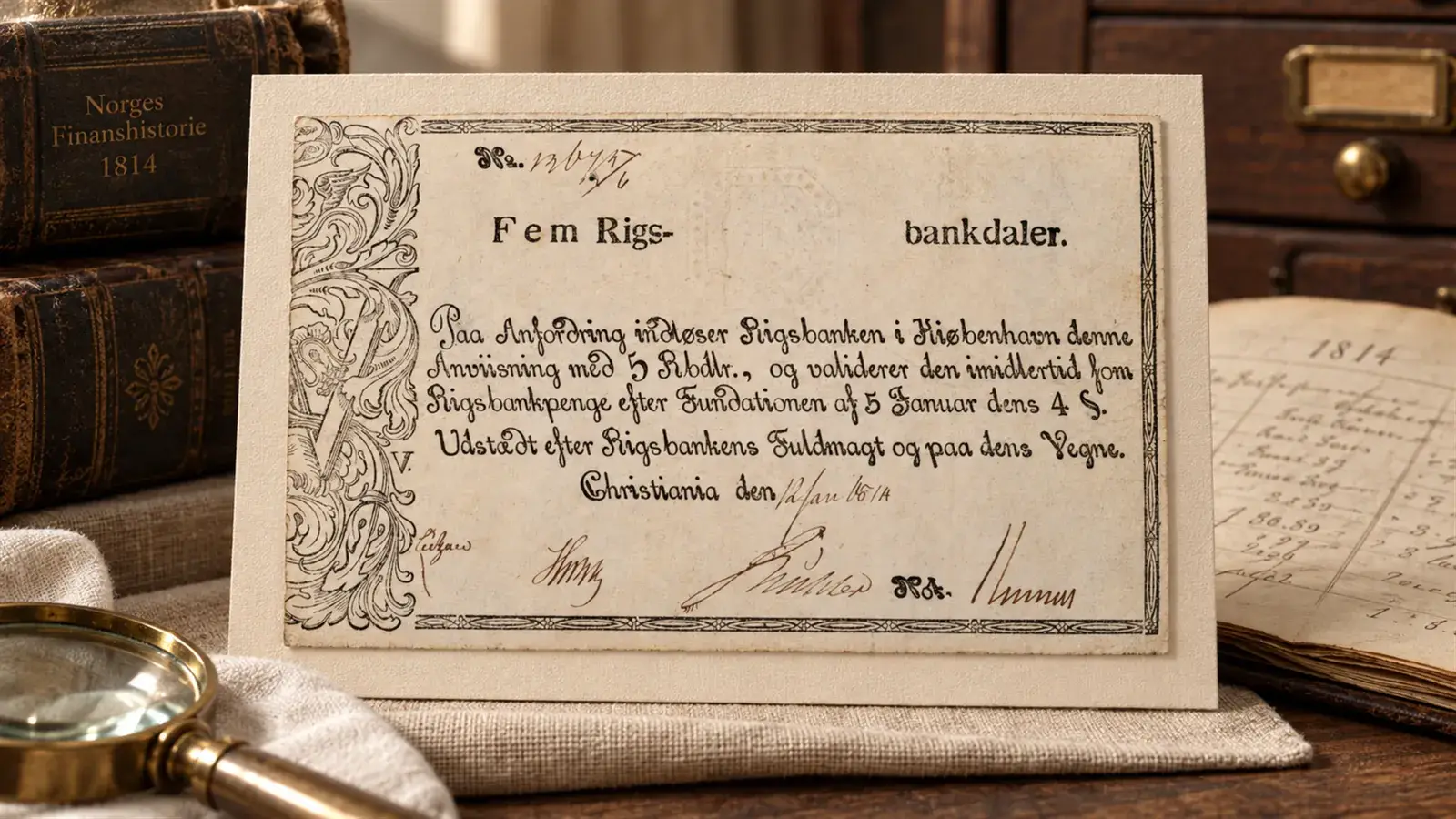
Norwegian banknotes have a history of more than 300 years. The first were issued by the Bergen merchant Jørgen thor Møhlen in 1695, Danish-Norwegian rigsdaler notes followed, and since 1816 Norges Bank has had the sole right to issue banknotes in Norway. Since the krone was introduced, Norges Bank has issued eight series of notes, from the Oscar II notes of 1877 to today’s series with the sea as its theme.
In short
- The first Norwegian banknotes appeared in 1695, but the experiment lasted only about a year.
- Norges Bank was founded in 1816, with its head office in Trondheim and the speciedaler as currency.
- Krone notes are divided into eight series, from Series I (1877–1901) to Series VIII (from 2017).
- Collectors focus on condition, dates and serial numbers, replacement notes and specimens.
- Series IV–VII can still be exchanged at Norges Bank with no deadline. Series I–III cannot.
Contents
Who made the first Norwegian banknotes?
The first Norwegian banknote was issued in 1695 by Jørgen thor Møhlen, one of Bergen’s leading merchants and shipowners. After heavy losses he obtained permission from King Christian V to issue paper notes worth up to 100,000 rigsdaler in total. Each note had a counterfoil that was torn off when it was issued.
The experiment failed. People did not trust the new money, many demanded that their notes be redeemed, and the king withdrew the privilege the following year. Norges Bank still describes the thor Møhlen notes as the first Norwegian banknotes.
Old Norwegian banknotes from the Danish-Norwegian era
In 1736 the Kurantbank was founded in Copenhagen as the first Danish-Norwegian note-issuing bank. Its notes, in rigsdaler courant, were meant to be exchangeable for silver coin at face value. During the Seven Years’ War the bank was used to finance the state, and in 1757 the promise of redemption was dropped. The notes became forced legal tender and lost value, and good silver coin disappeared from circulation.
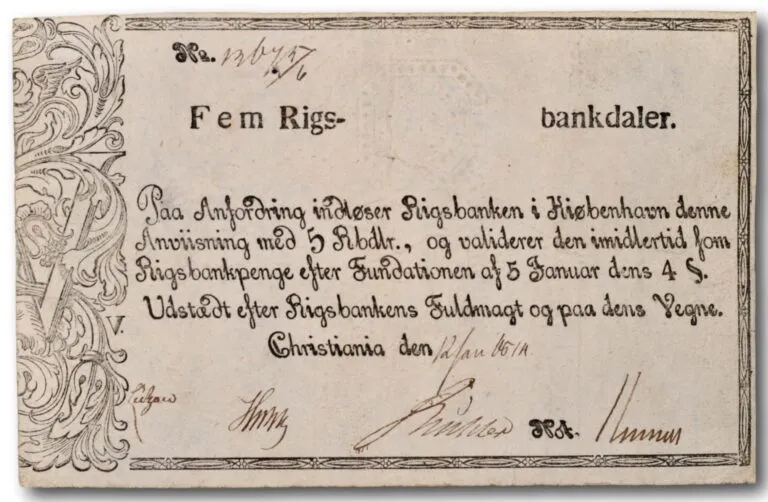
The turmoil continued through the Napoleonic Wars and ended with the state bankruptcy of 1813. The rigsbankdaler became the new unit, and it was still the currency in Norway in 1814, when the constitutional assembly at Eidsvoll postponed the question of a bank. A reminder of that year is the 5 rigsbankdaler 1814, offered by Denarius at the time of writing for NOK 15,000 (protocol no. 5992, Very Fine).
Norges Bank and the speciedaler from 1816
After almost two years of legislative work, the Storting passed the laws on Norges Bank and the monetary system in 1816. The bank was given its head office in Trondheim, and the new currency unit was the speciedaler. Old notes were exchanged for Norges Bank notes, and the Storting promised that they could be redeemed in silver at par. That promise was only fulfilled in 1842.
The coinage law of 1875 replaced the speciedaler and skilling with kroner and øre, and Norway moved to a gold-based krone. New banknotes were needed.
Norway banknotes, series by series
Norges Bank divides its krone notes into eight series. The table gives the main features:
| Series | Years | Key features |
|---|---|---|
| I | 1877–1901 | King Oscar II on every denomination, the only series with the monarch’s portrait on the front. |
| II | 1901–1945 | Artistic design by Oluf Wold-Torne. From 1907 all notes were printed in Norway. |
| III | 1945–1955 | The “exchange notes”, a crisis issue put into circulation on 9 September 1945. No 500-krone note. |
| IV | 1948–1976 | Prominent Norwegians on the front: Nansen, Michelsen, Bjørnson, Wergeland, Abel and Ibsen. |
| V | 1962–1987 | New designs with Nansen, Bjørnson, Wergeland, Abel and Ibsen. The 5-krone note was replaced by a coin in 1963. |
| VI | 1979–2001 | Camilla Collett on the 100-krone note, the first woman on a Norwegian banknote. The 10-krone note was replaced by a coin in 1983. |
| VII | 1994–2020 | New security features and a new denomination: 200 kroner. |
| VIII | 2017– | Today’s notes, themed on the sea, issued between 2017 and 2019. |
The war years and the London notes
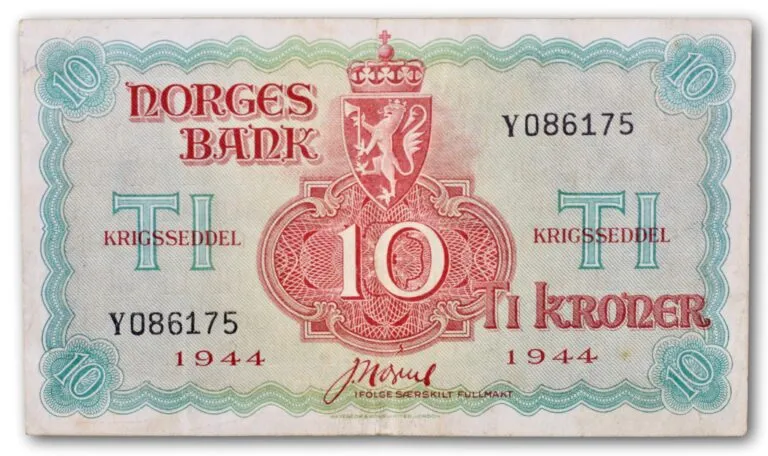
During the Second World War, the Norwegian government in exile had notes printed by Waterlow & Sons in London, intended for use after liberation. These London notes are now a collecting field of their own. At the time of writing, Denarius offers a 10 kroner 1944 (London issue) for NOK 2,650 (protocol no. 5617, Fine).
On 9 September 1945, Series II notes ceased to be legal tender and Series III was put into circulation. Work on the new notes had begun in secret in 1944, and they were intended as a crisis issue to be replaced quickly by notes of higher quality.
Series IV: the great portraits
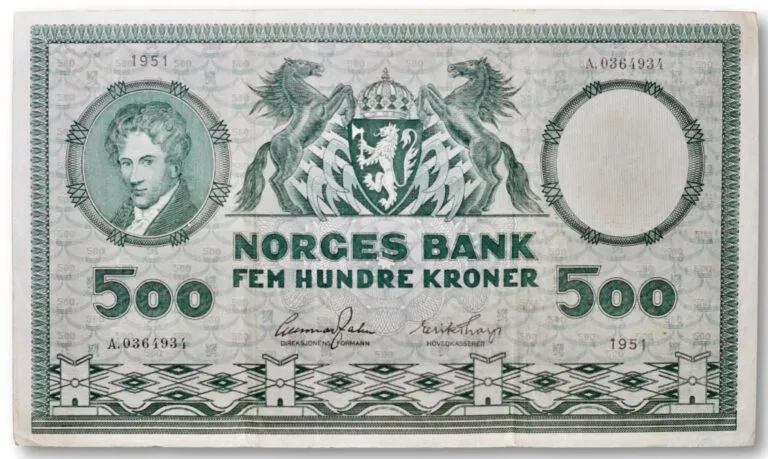
Series IV was planned before the war, with an art competition held in 1930. The idea was to show prominent Norwegians on the front and the country’s main industries on the back. The 500-krone note, with the mathematician Niels Henrik Abel and an industrial scene by Reidar Aulie, was issued from 1948 to 1976. At the time of writing, Denarius offers a 500 kroner 1951 for NOK 3,000 (protocol no. 6059, Very Good to Fine).
From Series VI to today
In Series VI, the 50-krone note of 1985 carried text in Nynorsk, with the bank’s name as NOREGS BANK. Series VII introduced a new 200-krone note in 1994, and its last denomination, the 1000 kroner, followed in 2001. Today’s Series VIII began with the 100 and 200 kroner on 30 May 2017, followed by the 50 and 500 kroner on 18 October 2018 and the 1000 kroner on 14 November 2019.
What do collectors look for in old Norwegian banknotes?
Condition
Condition matters most. Folds, stains, tears, pinholes and soiled edges all lower the value, and a single fold is enough for a note to no longer count as uncirculated. Scandinavian dealers often use a numeric scale where 0 means uncirculated, 01 is close to Extremely Fine, 1+ is Very Fine and 1 is Fine.
Dates, series letters and serial numbers
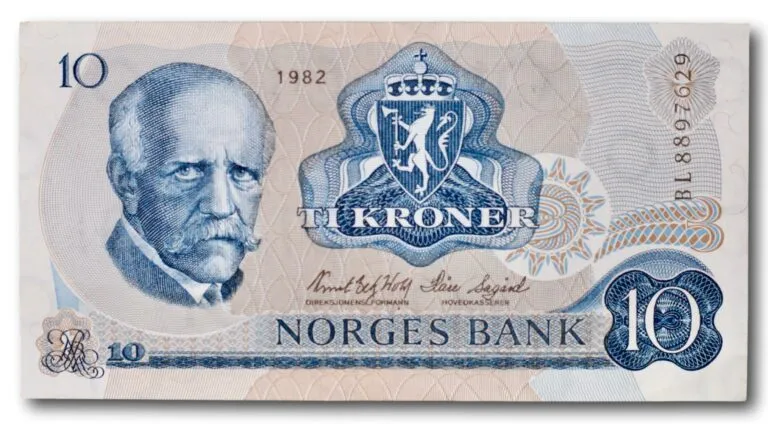
Many denominations were printed over several years, and both the date and the series letter vary. Some combinations were printed in small numbers and are far harder to find than others. Print runs matter: in Series III, 228.7 million 10-krone notes were printed, but only 504,000 of the 1000 kroner. Some collectors look for notes in consecutive order, like these two 10-krone notes of 1982 in consecutive order for NOK 275 (protocol no. 53812, good Very Fine).
Replacement notes
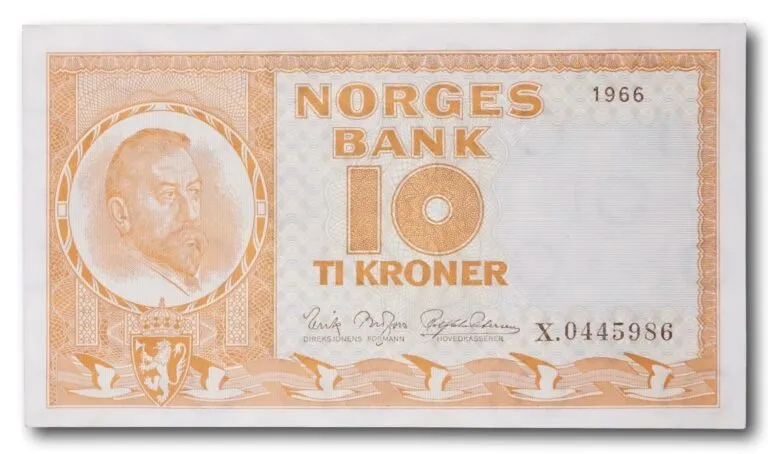
Replacement notes were printed to replace notes rejected during production, and they differ from regular notes in their serial numbers. The exact markings vary between series and denominations, so check a catalogue. At the time of writing, Denarius offers a 10 kroner 1966 replacement note for NOK 550 (protocol no. 4737, Extremely Fine to Uncirculated).
Signatures
Norwegian notes carry signatures from Norges Bank, and these changed over time. Catalogues therefore often distinguish between varieties of the same denomination and year, and some combinations are scarcer than others.
Specimen notes
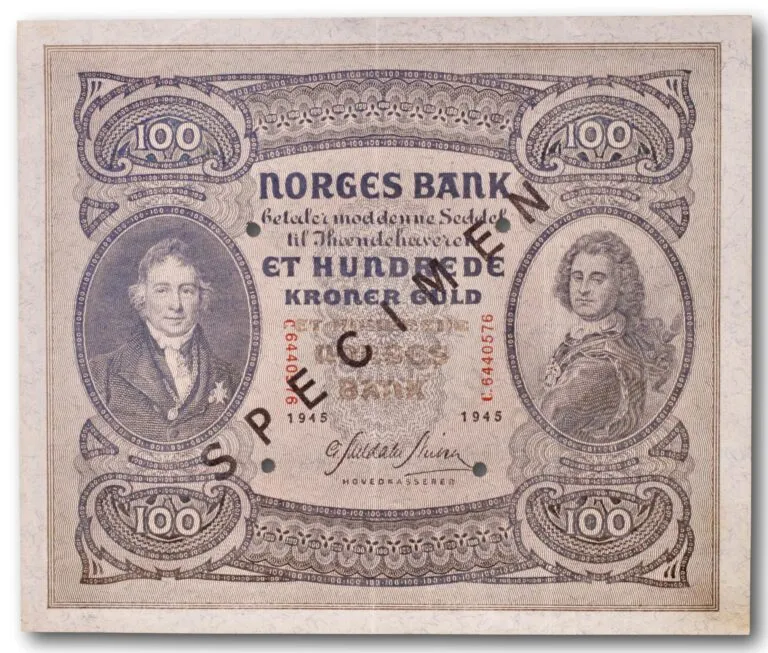
Notes marked SPECIMEN were made to present new designs, not to circulate as money, and far fewer exist than regular notes. At the time of writing, Denarius offers a 100 kroner SPECIMEN 1945 for NOK 5,750 (protocol no. 5760, Extremely Fine).
What are old Norwegian banknotes worth?
Norges Bank itself says that older series can have collector value above face value. How much depends on series, denomination, date, series letter and condition. Here are indicative price levels from Denarius’s own stock as of October 2026:
| Note | Condition | Price at Denarius |
|---|---|---|
| 5 rigsbankdaler 1814 | Very Fine | NOK 15,000 |
| 100 kroner SPECIMEN 1945 | Extremely Fine to about Uncirculated | NOK 5,750–6,500 |
| 500 kroner, Series IV (1951–1976) | Very Good to Very Fine | NOK 1,975–3,000 |
| 10 kroner 1944 (London issue) | Fine | NOK 2,650 |
| 10 kroner 1966, replacement note | Extremely Fine to Uncirculated | NOK 550 |
| 50 kroner 1984 | Extremely Fine to Uncirculated | NOK 300 |
| 10 kroner 1982, two in consecutive order | Very Fine | NOK 275 |
These are Denarius’s retail prices and may change. The table shows that age alone does not decide value: condition, rarity and special features matter at least as much.
Can old Norwegian banknotes still be exchanged?
Yes, many of them. Norges Bank exchanges notes from Series IV (1948–1976), V (1962–1987), VI (1979–2001) and VII (1994–2020) at face value. There is no deadline and no fee. Notes from Series I, II and III cannot be exchanged, and neither can the small-change notes.
You can send notes by post or hand them in in Oslo, with a form and ID, and the money is paid into a bank account. Series VII notes can also be exchanged over the counter at some Norges Bank offices, up to a limited amount. Check Norges Bank’s own pages for the current rules before sending anything.
Before you exchange, note that Norges Bank itself points out that some withdrawn notes can have a collector value higher than their face value. This applies especially to notes in good condition and to scarce varieties.
Frequently asked questions
When were the first Norwegian banknotes issued?
The first Norwegian banknotes were issued in 1695 by the Bergen merchant Jørgen thor Møhlen, with permission from King Christian V. People did not trust them, and the privilege was withdrawn the following year. Norges Bank has had the sole right to issue banknotes in Norway since 1816.
Can I exchange old Norwegian banknotes?
Notes from Series IV, V, VI and VII are exchanged at face value by Norges Bank, with no deadline and no fee. Notes from Series I, II and III and the small-change notes cannot be exchanged. See Norges Bank’s website for how to send or hand in notes.
What are old Norwegian banknotes worth?
It depends on series, denomination, date, series letter and above all condition. Common notes in used condition are often worth little more than face value, while scarce varieties, specimens and uncirculated notes can cost several thousand kroner. The price table above gives indicative levels from Denarius’s stock.
What is a replacement note?
A replacement note was printed to replace a note rejected during production, and it differs from regular notes in its serial number. They were printed in smaller numbers and are popular with collectors. Catalogues show which markings apply to each series.
Who was the first woman on a Norwegian banknote?
The writer Camilla Collett was the first woman on a Norwegian banknote. She appears on the 100-krone note of Series VI, issued by Norges Bank from 1979.
Why do some notes say NOREGS BANK?
The 50-krone note introduced in 1985, part of Series VI, had its text in Nynorsk, one of the two written forms of Norwegian. That is why the bank’s name appears as NOREGS BANK on this note.
Browse all Norwegian banknotes currently in stock, or explore our full range of banknotes from around the world. For further reading, see the reference works and catalogues under literature. We ship worldwide.