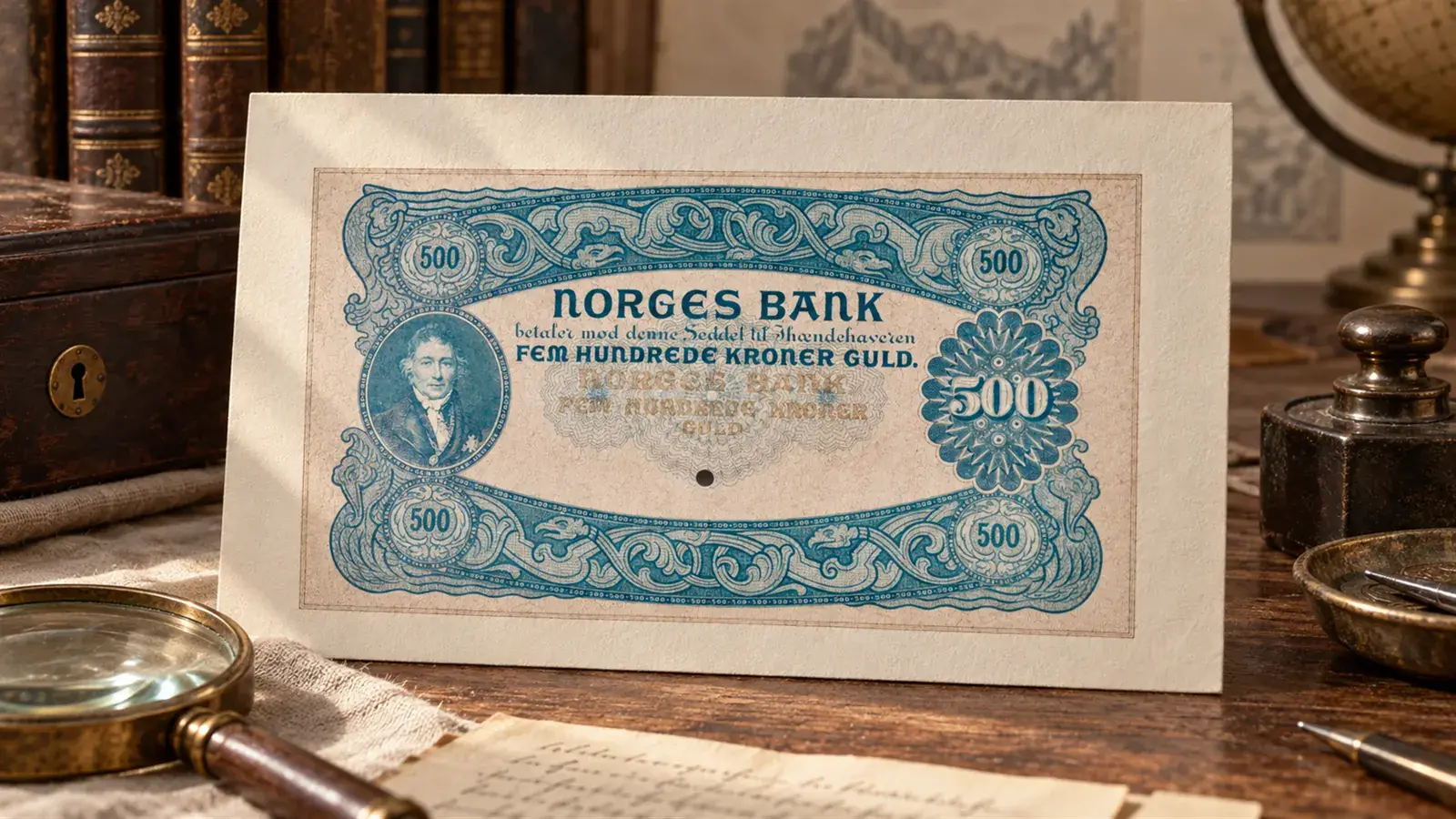
In 2021 Denarius presented a very rare Norwegian 500 kroner proof, dated c. 1900. The second edition banknotes that circulated until the end of the Second World War were grey-blue, but this proof is green. It has a cancellation hole in the middle, and on the reverse the words “Printed sheet” are written in beautiful 19th-century handwriting.
Contents
A 500 kroner proof in exceptional condition
The 500 kroner proof is in exceptional condition. It has two very small pinholes at the edge, suggesting it may have been displayed for Bradbury Wilkinson’s client. At the bottom there are two minor tears measuring 4 mm. Their position and clean cut suggest they arose during printing, perhaps when the notes were separated from the sheet.
Collectors of Norwegian banknotes know that the 500 kroner is the rarest denomination of the second edition. According to Norges Bank, only 524,000 were issued, fewer than any other denomination in the series. With that in mind, one can only speculate how rare a 500 kroner proof is. When the note was offered in 2021, Denarius described it as possibly a once-in-a-lifetime opportunity.
The second edition 500 kroner (1901-1945)
The plates for Norway’s second banknote edition were engraved by Bradbury Wilkinson & Co. Ltd. in London. The designs were drawn by the artist Oluf Wold-Torne, who based all his drawings on photographs of his subjects. They were approved by a committee of five: one representative from Bradbury Wilkinson, one from Norges Bank, the architect Eilif Christie and the artists Gerhard Munthe and Erik Werenskiold.
The front shows Wilhelm Frimann Koren Christie, President of the Storting. He was secretary of the constituent assembly at Eidsvoll and one of those who worked on and signed the Norwegian Constitution in 1814. Christie was elected President of the Storting in the autumn of 1814 and presided again in 1815 and for part of 1818. The reverse shows Akershus Castle in Oslo in the centre, with a stylised Viking king on one side and the national coat of arms, ringed by the arms of the diocesan towns, on the other.
From London to Trondheim and Kristiania
Bradbury Wilkinson printed banknotes for Norway in 1900 and 1901. Until 1906 the notes were otherwise produced in Trondheim, and in 1907 production moved to Kristiania (Oslo). From 1907 all notes were printed in Norway. The whole edition ceased to be legal tender on 9 September 1945, according to Norges Bank’s page on banknote series II.
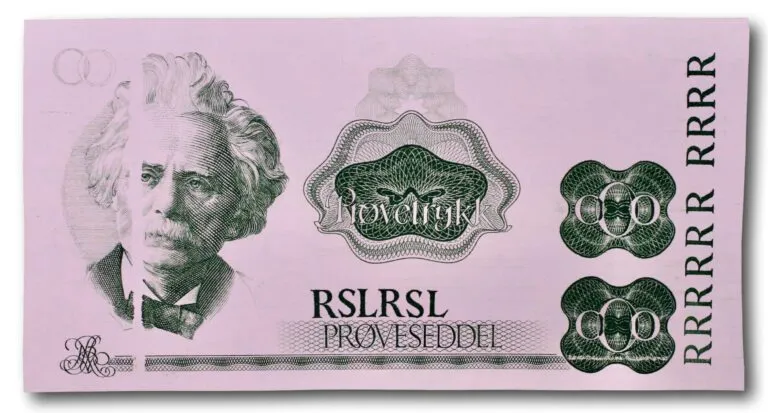
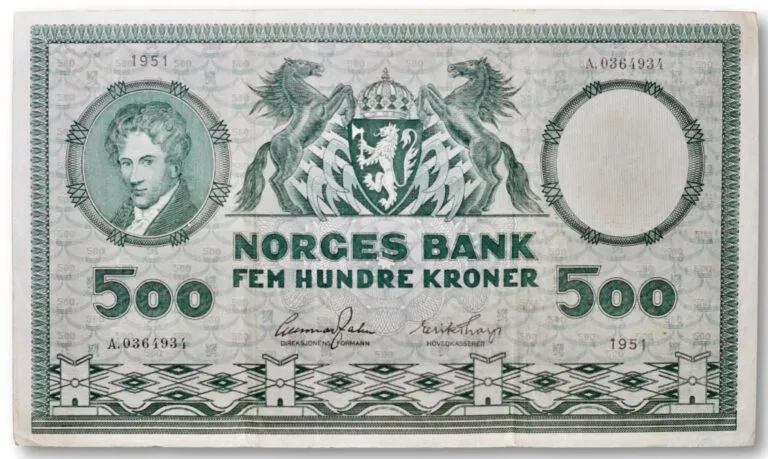
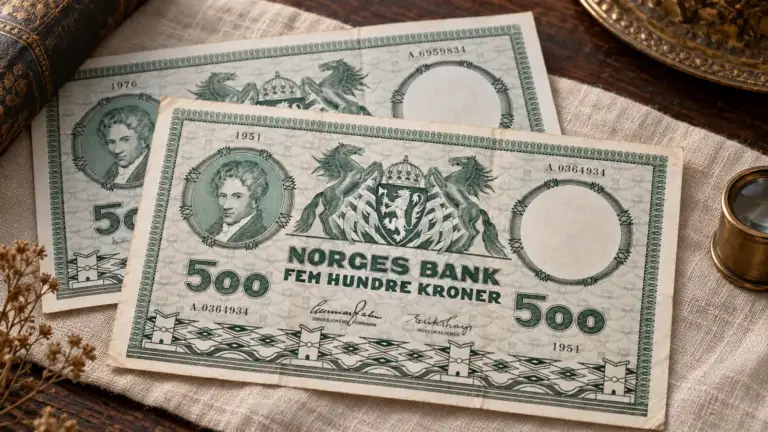
Later issues such as the Norway, 500 kroner 1951 and more recent proofs such as the Norway, Single-sided proof print (ca. 1980) show how the note developed. You will find more older notes among our Norwegian banknotes.