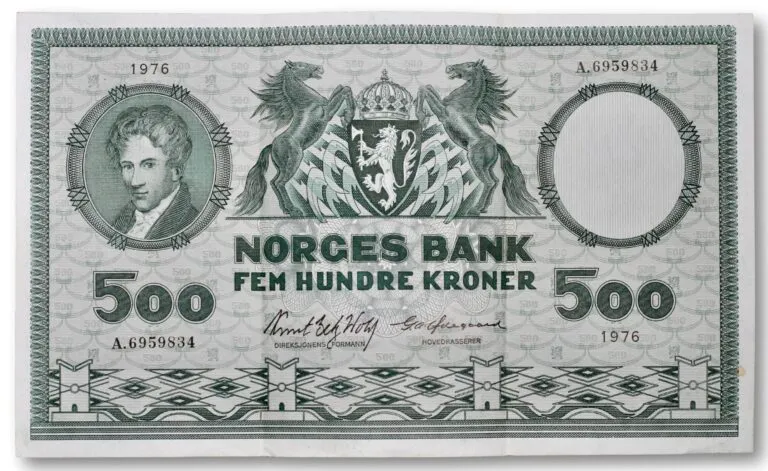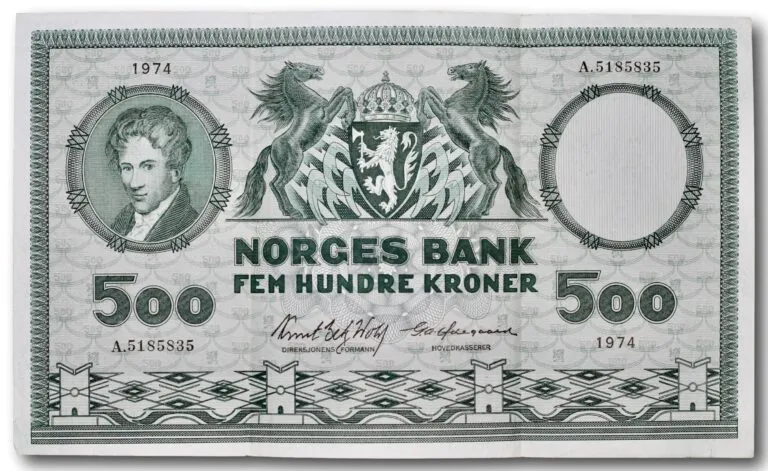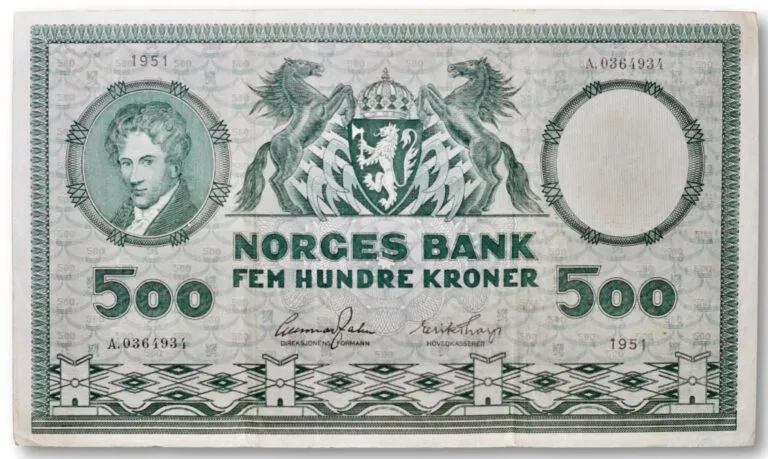
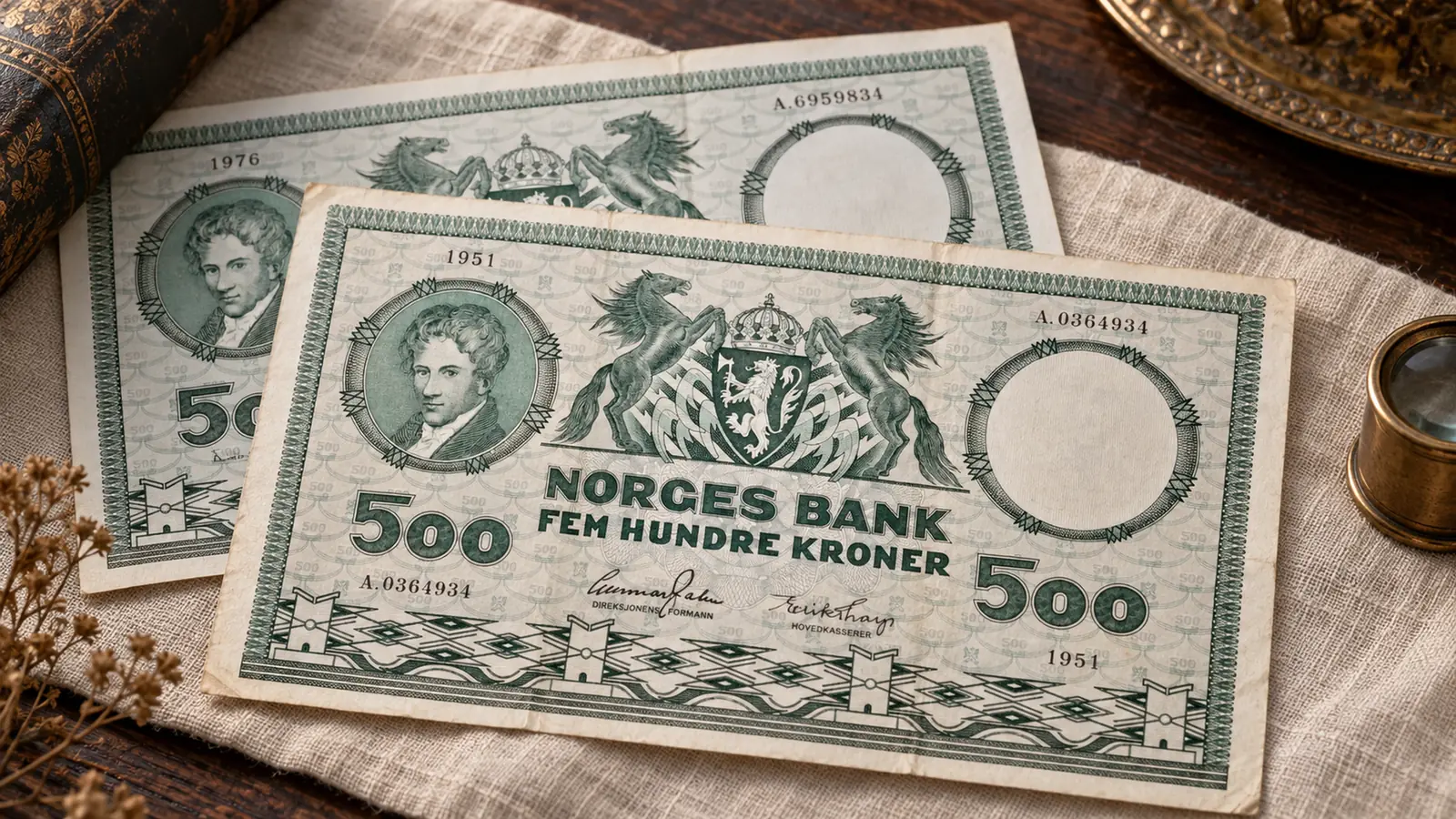
Old Norwegian banknotes from Series IV, V, VI and VII can still be exchanged at face value at Norges Bank, the central bank of Norway, with no deadline and no fee. Notes from Series I, II and III cannot be exchanged. Many withdrawn notes, such as the large 500-krone note with Niels Henrik Abel issued from 1948 to 1976, also have a collector value that can exceed their face value.
In short
- Norges Bank exchanges notes from Series IV (1948–1976), V (1962–1987), VI (1979–2001) and VII (1994–2020).
- There is no deadline and no fee. Notes can be posted or handed in at the head office in Oslo.
- Series I–III and the small-change notes (skillemyntsedler) cannot be exchanged.
- Just under 7 million of the old Abel 500-krone notes were issued.
- Condition matters most for collector value. Never fold, clean or tape a note.
Contents
Can old Norwegian banknotes be exchanged at Norges Bank?
Yes, most old Norwegian banknotes from after the Second World War can be exchanged. For old Norwegian banknotes, Norges Bank goes by series, not by the date printed on the note. This is the position as of October 2026:
| Series | Issued | Exchangeable at Norges Bank? |
|---|---|---|
| I | 1877–1901 | No |
| II | 1901–1945 | No |
| III | 1945–1955 | No |
| IV | 1948–1976 | Yes, at face value |
| V | 1962–1987 | Yes, at face value |
| VI | 1979–2001 | Yes, at face value |
| VII | 1994–2020 | Yes, at face value |
| Small-change notes | – | No |
Today’s Series VIII notes are legal tender, so Norges Bank does not exchange them. To work out which series your old Norwegian banknotes belong to, see our article on Norwegian banknotes through history.
How to exchange old Norwegian banknotes
Fill in Norges Bank’s exchange form, online or on paper, and either post the notes or hand them in at the head office in Oslo. The money is paid into a bank account. There is no upper limit when you post notes, but you send them at your own risk. For larger amounts you must include a certified copy of your ID or verify yourself with Norwegian BankID.
If you live abroad, Norges Bank can pay into a foreign account. You need the IBAN and SWIFT/BIC code, and the account must be in your name. Your own bank converts the kroner into your currency.
Series VII notes can also be exchanged over the counter in Oslo, Bergen, Trondheim and Tromsø, up to NOK 7,000. Since 29 May 2026 the Stavanger office no longer exchanges notes. Processing usually takes under three weeks for small amounts and several months for large ones. Always check Norges Bank’s exchange page before sending anything, as the rules can change.
The 500-krone note: old Norwegian banknotes of high value
Norway has had a 500-krone note since 1877, except in Series III, which had none. Because the value was high, far fewer were printed than of the 10- and 100-krone notes. That makes the early 500-krone notes some of the most sought-after old Norwegian banknotes.
| Series | Issued | Front | Number issued |
|---|---|---|---|
| I | 1877–1901 | King Oscar II | 500,000 |
| II | 1901–1945 | W.F.K. Christie, President of the Storting | 524,000 |
| IV | 1948–1976 | Niels Henrik Abel | 6,964,000 |
| V | 1978–1985 | Niels Henrik Abel | 8,400,000 |
| VI | 1991–2000 | Edvard Grieg | 40,902,000 |
| VII | from 1999 | Sigrid Undset | – |
| VIII | from 2018 | Rescue boat RS 14 Stavanger | – |
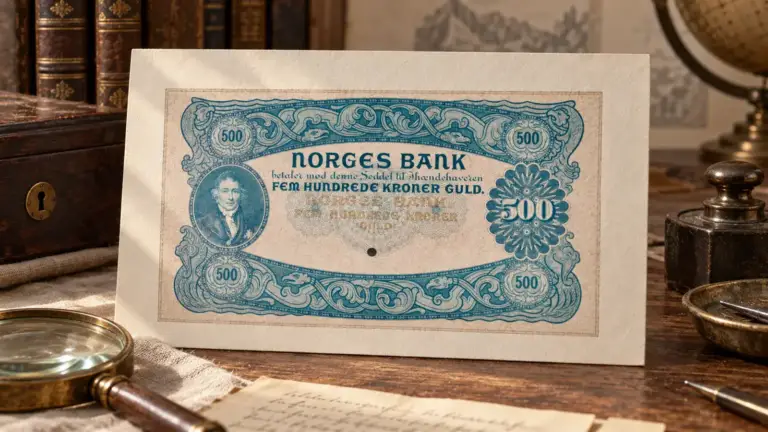
The 500-krone notes of Series I and II are rare old Norwegian banknotes today, and they cannot be exchanged. Proofs also survive from around 1900, such as this 500-krone proof banknote.
The large Abel note of 1948–1976
The Series IV 500-krone note is the best known. The front shows the mathematician Niels Henrik Abel after a drawing by Johan Gørbitz, and the back has an industrial scene designed for the note by Reidar Aulie. At 216 x 127 mm it is one of the largest Norwegian notes. It ceased to be legal tender on 13 July 1999 but can still be exchanged.
The note was printed over many years, and the year appears on each note. At the time of writing, Denarius has several dates in stock:
| 500 kroner, Series IV | Price at Denarius |
|---|---|
| 1951 | NOK 3,000 |
| 1966 | NOK 2,900 |
| 1968 | NOK 2,350 |
| 1970 | NOK 2,500 |
| 1971 | NOK 2,350 |
| 1974 | NOK 2,400 |
| 1976 | NOK 1,975–2,750 |
The oldest is a 500 kroner 1951 at NOK 3,000 (protocol no. 6059). There is also a 500 kroner 1974 at NOK 2,400 (protocol no. 6066) and a 500 kroner 1976 from the final year at NOK 2,750 (protocol no. 6060). These are retail prices for selected notes and may change.
Abel, Grieg and Undset
Abel appeared again on the Series V 500-krone note (1978–1985), now with the University of Oslo on the back. That note ceased to be legal tender on 21 June 2002. The Edvard Grieg note of Series VI followed on 17 April 2011, and the Sigrid Undset note of Series VII on 18 October 2019. All three can be exchanged at Norges Bank.
Other old Norwegian banknotes collectors look for
The 1000-krone notes
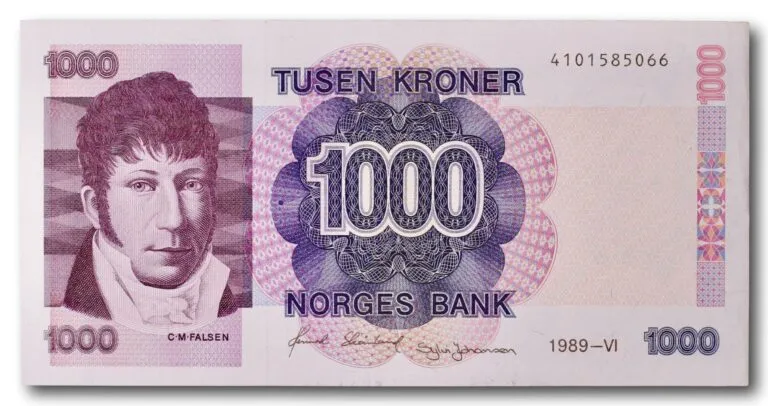
The 1000-krone note is the highest denomination, and the older series were printed in small numbers. Only 504,000 were printed in Series III. Series IV had a vignette of Henrik Ibsen on the front and Edvard Munch’s painting “History” on the back. In Series VI the note showed Christian Magnus Falsen. At Denarius, a 1000 kroner 1989 costs NOK 1,950 at the time of writing (protocol no. 3827).
London notes and specimens
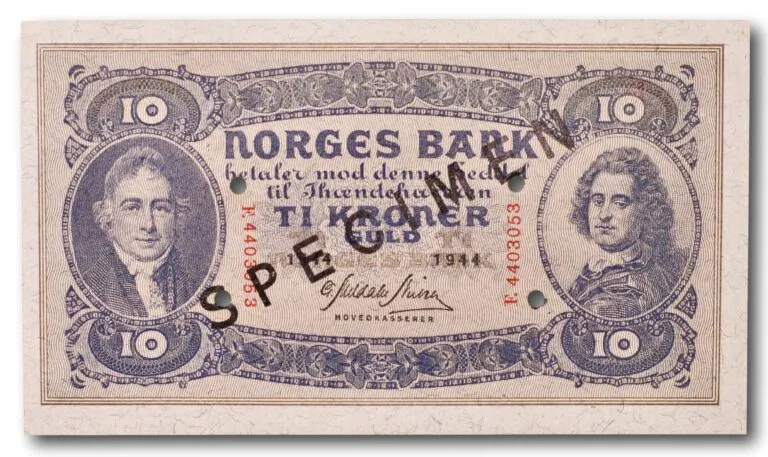
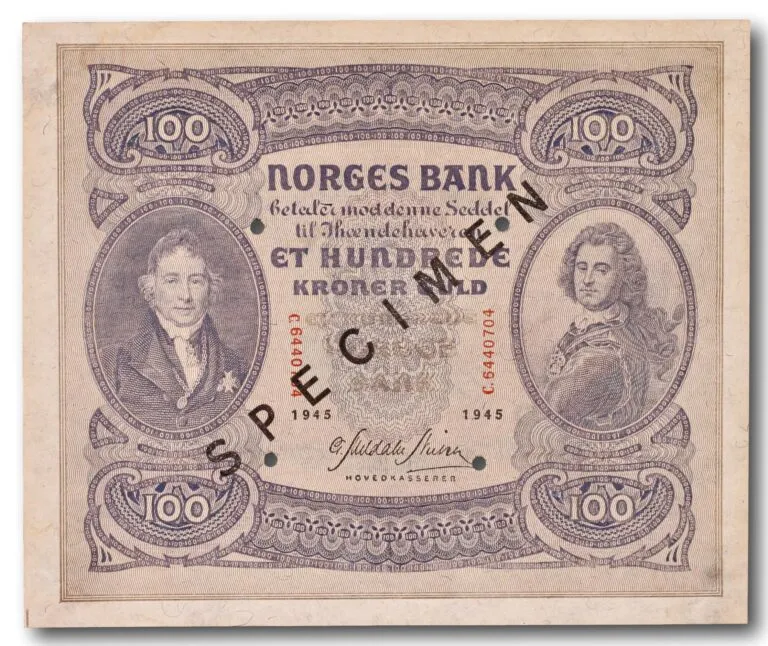
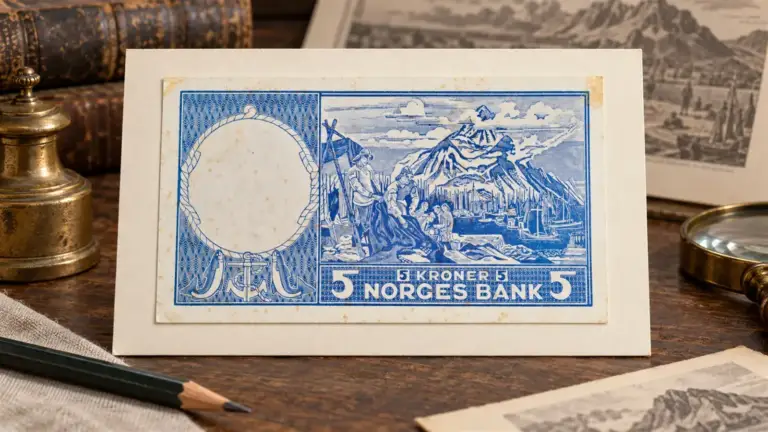
During the war, Norwegian notes were printed in London for use after the liberation. Specimen notes, marked SPECIMEN, were made to show new designs and were never meant to circulate. At Denarius, a 10 kroner 1944 SPECIMEN costs NOK 6,950 (protocol no. 5633) and a 100 kroner SPECIMEN 1945 NOK 6,500 (protocol no. 5864) at the time of writing. You can also read about the final proof of the 5-krone note.
What are old Norwegian banknotes worth?
Norges Bank pays face value for notes from Series IV–VII. The bank itself points out that some withdrawn notes may have a collector value above face value. For old Norwegian banknotes from Series I–III, collector value is the only value.
What collectors pay depends above all on condition. The Norwegian grading scale runs from 0 (uncirculated) through 01 and 1+ to 1 and lower. A single fold is enough to lose uncirculated status. After that come series, denomination, date, serial letter and special features such as replacement notes and consecutive serial numbers.
The retail prices above show what fine examples cost from a dealer, not what a used note is worth. To estimate the value of your own old Norwegian banknotes, look them up in a catalogue such as Norges mynter og pengesedler etter 1874 or the Standard Catalog of World Paper Money, compare recent auction results for similar notes, or ask the Norwegian Numismatic Society (Norsk Numismatisk Forening).
How to look after old Norwegian banknotes
- Do not fold, iron or wash notes, and never repair tears with tape.
- Store them flat in acid-free sleeves made for banknotes.
- Keep them away from sunlight, damp and heat.
- Handle them with clean, dry hands and by the edges only.
Frequently asked questions
Can I still exchange old Norwegian banknotes?
Yes, if they belong to Series IV, V, VI or VII. Norges Bank exchanges these old Norwegian banknotes at face value, with no deadline and no fee. Notes from Series I, II and III cannot be exchanged.
Can I exchange old 500-krone notes?
Yes. The 500-krone notes with Niels Henrik Abel (1948–1976 and 1978–1985), Edvard Grieg and Sigrid Undset all belong to Series IV–VII and can be exchanged at Norges Bank at face value.
Can I exchange old Norwegian notes from abroad?
Yes. You can post the notes to Norges Bank in Oslo with its exchange form, and the bank can pay the amount into a foreign account. You need the IBAN and SWIFT/BIC code, and the account must be in your own name.
Is there a deadline for exchanging old Norwegian banknotes?
No. Norges Bank states that there is no deadline for exchanging notes from Series IV–VII and no fee. Your own bank may still charge for receiving the payment.
What is an old 500-krone note worth?
At Norges Bank, a note from Series IV–VII is worth its face value of 500 kroner. Among collectors the price depends on the series, the date and above all the condition. At Denarius, Series IV 500-krone notes from 1951–1976 cost NOK 1,975–3,000 at the time of writing.
What does SPECIMEN mean on a banknote?
SPECIMEN marks a sample note, made to show a new design to banks and authorities. Specimens were never meant to circulate, exist in small numbers and are sought after by collectors.
Browse all Norwegian banknotes currently in stock, or explore our full range of banknotes from around the world. Catalogues and reference books are under literature. We ship worldwide.