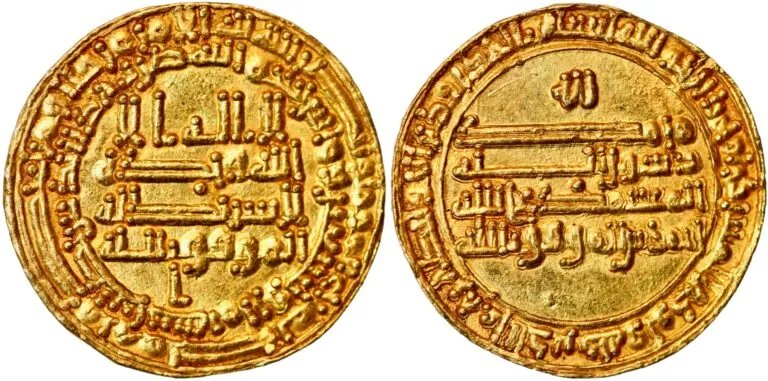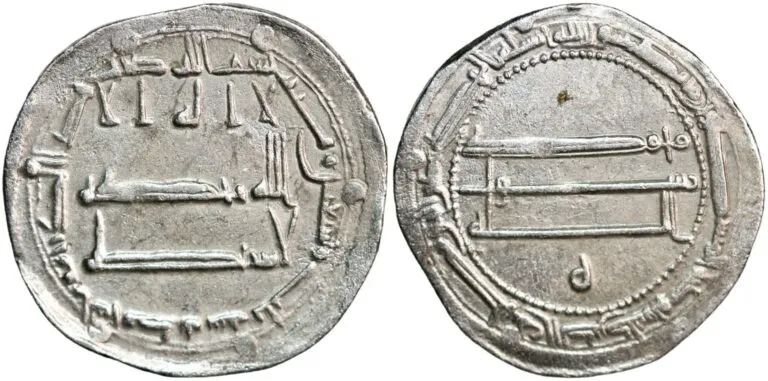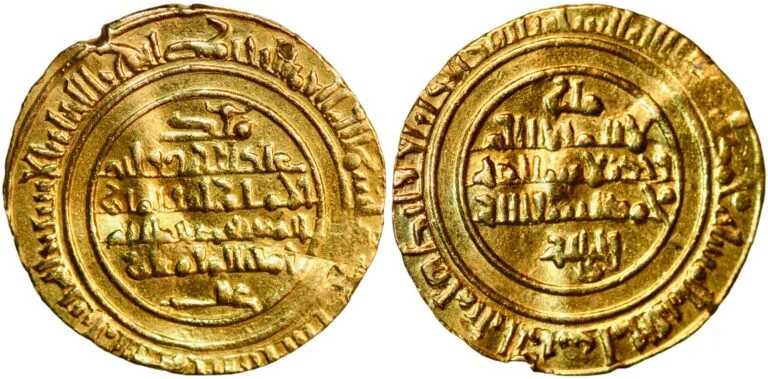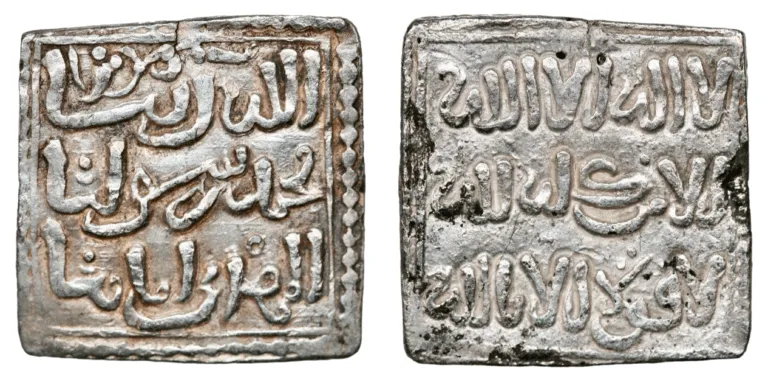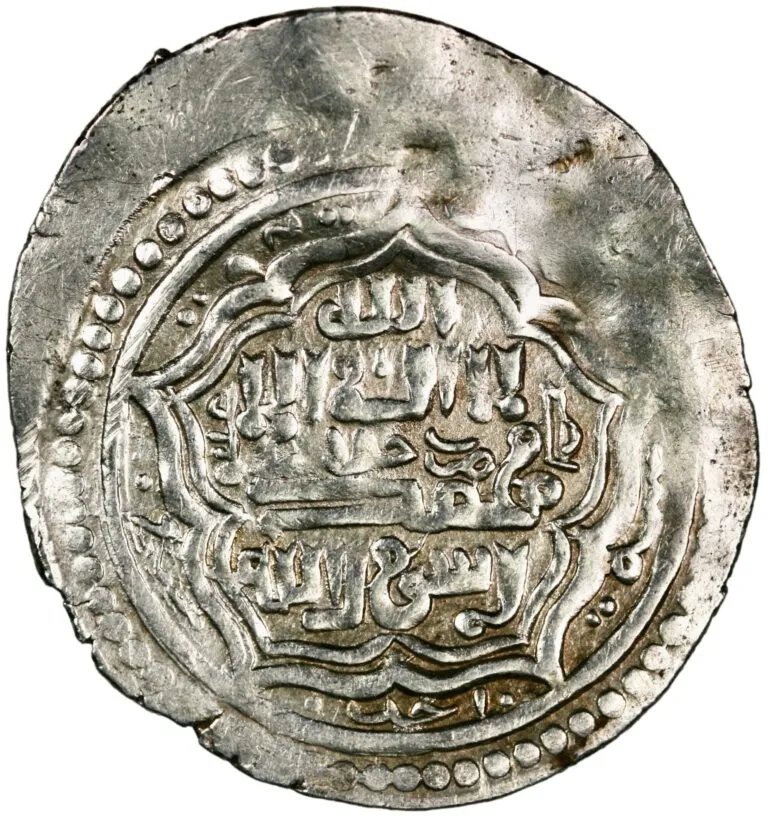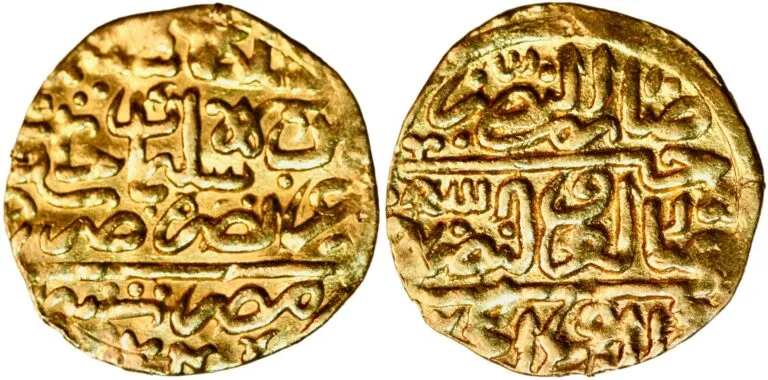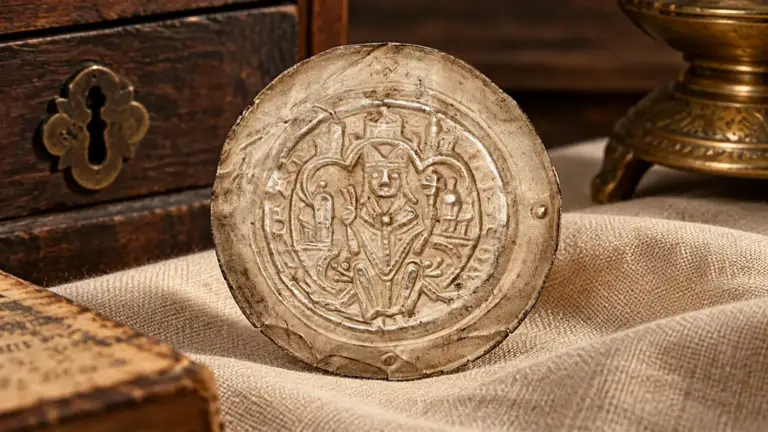
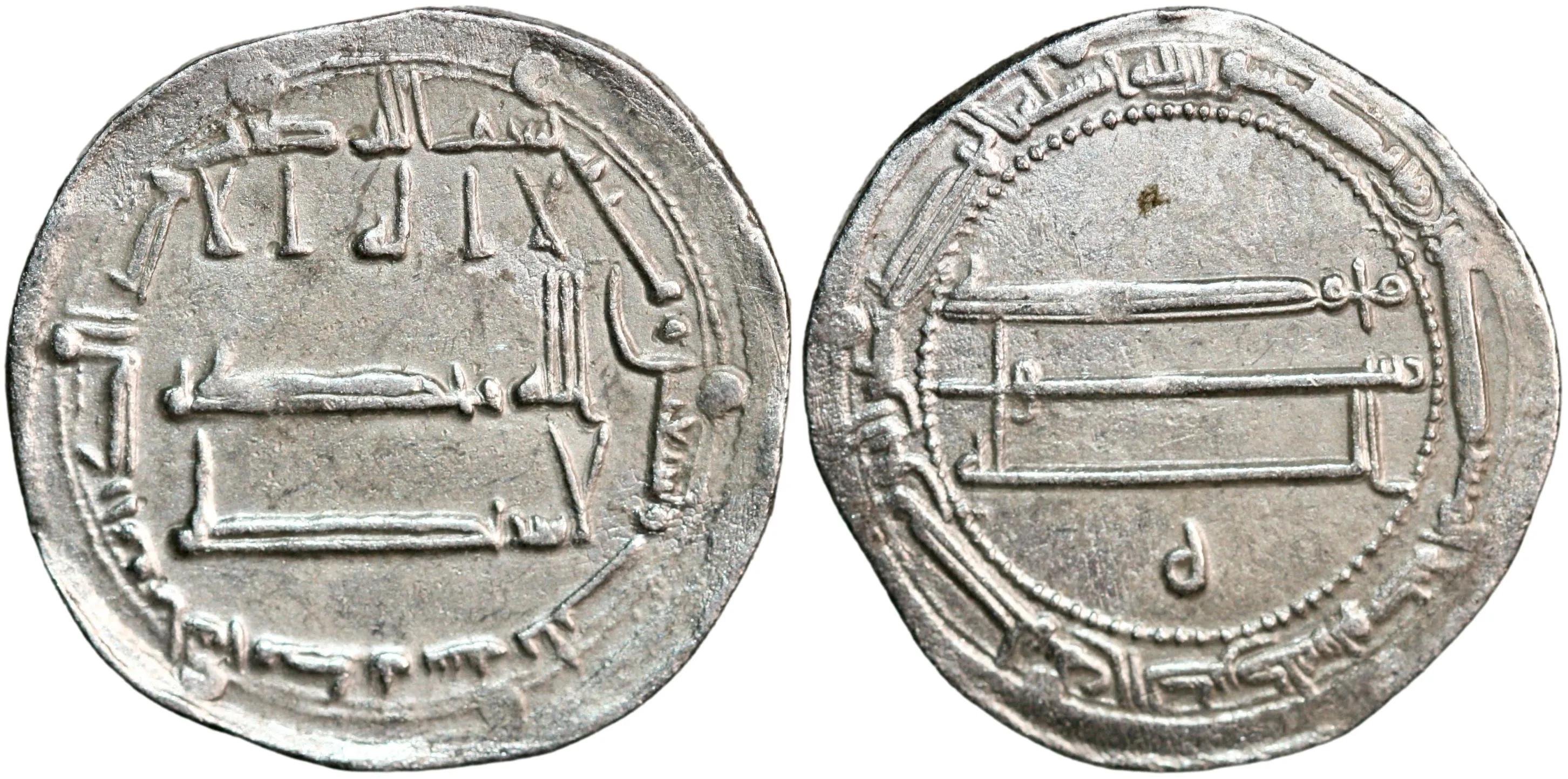
Islamic coins are the coins struck under Muslim rulers from the late 7th century onwards. The classic types are the gold dinar and the silver dirham introduced by Caliph Abd al-Malik between 696 and 699, which carry Arabic inscriptions instead of portraits: the profession of faith, verses from the Qur’an and, often, the mint and the year. For collectors, Islamic coins are one of the most affordable ways to own genuine medieval money, as common silver dirhams often cost only a few hundred kroner.
In short
- The gold dinar appeared in 696/697 and the silver dirham soon after, both under the Umayyad caliph Abd al-Malik.
- The names are borrowed: dinar from the Roman denarius, dirham from the Greek drachm and the copper fals from the Byzantine follis.
- Most Islamic coins carry only text, which tells you who struck the coin, where and when.
- Dates follow the Hijri calendar, which counts from AD 622.
- About a third of the more than 250,000 Viking Age coins found in Scandinavia came from the East, mostly Abbasid dirhams.
Contents
What are Islamic coins?
The term covers the coinage of the caliphates and of the many dynasties that followed them, from Spain and Morocco in the west to Iran, Central Asia and India in the east. The time span is long, from the first Arab issues of the 7th century to Ottoman, Persian and Indian coins of the 19th century.
This guide covers the Islamic coins collectors meet most often: dinars and dirhams of the caliphates, some later dynasties and the Ottoman sultani.
How did Islamic coinage begin?
When Arab armies took Syria, Egypt and Persia in the 630s and 640s, they kept using the money already in circulation: Byzantine gold and bronze in the west, Sasanian silver drachms in Iran. According to the Encyclopaedia Iranica, Sasanian-style drachms went on being struck after the conquest, at first with no sign of Arab rule and later with a short Arabic phrase such as bism Allah (“in the name of God”) in the margin. Collectors call these Arab-Sasanian coins, and the copies of Byzantine types Arab-Byzantine.
Under Abd al-Malik (685–705) came the first attempts at a distinct design. Gold coins of about 693–695 show a standing figure, probably the caliph himself, and are known as the “standing caliph” type.
The reform of 696–699
In the Hijri year 77 (696/697) came the decisive change. The new dinar had no images at all, only Arabic text. One side reads “There is no god but God alone, He has no associate”, the other carries a verse from Sura 112 on the oneness of God, and the margin records that the dinar was struck in the year 77.
The dinar was set at 4.25 grams, a weight known as the mithqal. The silver dirham followed in 697–699 with the same layout and a weight of just under 3 grams. This became the model for Islamic coins for centuries.
Why do Islamic coins have no pictures?
After the reform, religious inscriptions replaced rulers’ portraits and other images. The words were the message: every coin carried the profession of faith across the empire. The rule was not absolute, though. Some later dynasties, such as the Artuqids of Anatolia in the 12th and 13th centuries, struck large bronze coins with figures.
Dinar, dirham and fals: what is the difference?
The three basic denominations were gold, silver and copper, and their names show how closely they were tied to older systems. The dinar takes its name from the Roman denarius, which was itself a silver coin.
| Coin | Metal | Name derived from | Typical weight |
|---|---|---|---|
| Dinar | Gold | Latin denarius | About 4.25 g (mithqal) |
| Dirham | Silver | Greek drachm, via Persian | Just under 3 g |
| Fals (plural fulus) | Copper/bronze | Byzantine follis | Varies widely |
Islamic coins of the caliphates
The Umayyads (661–750)
The Umayyads ruled from Damascus and created the reform coinage. Their gold dinars usually name only the year, not the mint, while their dirhams name both. That makes Umayyad dirhams popular with collectors who enjoy assembling coins from many different mints.
The Abbasids (from 750)
The Abbasids took power in 750 and founded Baghdad in 762, which appears on the coins as Madinat al-Salam, “the City of Peace”. The caliphate lasted until the Mongols sacked Baghdad in 1258, although real political power had long since passed to local rulers.
The best-known caliph is Harun al-Rashid (786–809), familiar from the tales of the Thousand and One Nights. At Denarius, a dirham of Harun al-Rashid currently costs NOK 400 (protocol no. 6163). From the late 9th century there is a gold dinar of Caliph al-Mu’tamid, struck in 891/2, at NOK 11,000 (protocol no. 5749).
The Fatimids (909–1171)
The Fatimids were a Shi’a caliphate that rose in North Africa, conquered Egypt in 969 and founded Cairo. Their dinars are easy to recognise: the inscriptions run in concentric rings around a central dot. Fatimid gold had a good reputation among merchants.
Al-Mustansir (1036–1094) reigned for almost sixty years, and his dinars are among the more frequently seen Fatimid gold coins. At Denarius, a dinar of al-Mustansir currently costs NOK 8,500 (protocol no. 6267).
Later dynasties: Almohads, Ilkhanids and Ottomans
- The Almohads ruled Morocco and much of Spain in the 12th and 13th centuries. They are known for small square silver dirhams, usually without a ruler’s name or date. A half dirham of the Almohads costs NOK 500 (protocol no. 4265).
- The Ilkhanids were the Mongol rulers of Iran. Ghazan Mahmud converted to Islam and reformed the coinage around 1300. A double dirham of Ghazan Mahmud costs NOK 1,200 (protocol no. 4408).
- The Ottomans struck their first gold coin, the sultani, under Mehmed II in 1477/78. It followed the standard of the Venetian ducat, about 3.45 grams, and names the sultan and his titles. A sultani of Selim II (1566–1574) costs NOK 7,350 (protocol no. 6269).
Islamic coins in Viking Age Scandinavia
Islamic coins have a special place in Scandinavian history. Through trade along the rivers of what is now Russia, huge quantities of silver reached the north in the 9th and 10th centuries. According to CoinWeek, about 35 per cent of a sample of more than 250,000 Viking Age coins found in Denmark, Norway and Sweden came from the East, mainly Abbasid dirhams.
The Vikings used them by weight, often cut into pieces. Read more in our guide to Viking coins, from hacksilver to Olav Kyrre.
How do you read Islamic coins?
- The margin legend on dirhams usually begins “In the name of God, this dirham was struck in …”, followed by the mint and the year. Numbers are written out in words, not digits.
- The script on the earliest coins is Kufic, an angular style. Rounder scripts became common later.
- The ruler’s name appears on many Abbasid and later coins, often alongside an heir or a governor.
How do you convert a Hijri date?
The Hijri calendar counts from the Prophet Muhammad’s emigration to Medina in 622. A lunar year is about eleven days shorter than ours, so you cannot simply add 622. A handy rule of thumb: year AD ≈ AH − AH/33 + 622. AH 77 then gives about 696/697, and AH 882 about 1477.
For exact attribution, collectors use reference works such as Stephen Album’s Checklist of Islamic Coins and Michael Mitchiner’s The World of Islam.
How much are Islamic coins worth?
Price depends on metal, dynasty, the rarity of the mint and year, and condition. Common Abbasid and Umayyad dirhams are among the least expensive medieval silver coins. Gold dinars cost more, both for their metal and because fewer survive. Here is a selection of Islamic coins at Denarius at the time of writing:
| Coin | Date | Price at Denarius |
|---|---|---|
| Dirham, Harun al-Rashid (protocol no. 6163) | 786–809 | NOK 400 |
| Half dirham, Almohads (protocol no. 4265) | 12th–13th century | NOK 500 |
| Double dirham, Ghazan Mahmud (protocol no. 4408) | Around 1300 | NOK 1,200 |
| Gold sultani, Selim II (protocol no. 6269) | 1566–1574 | NOK 7,350 |
| Gold dinar, al-Mustansir (protocol no. 6267) | 1036–1094 | NOK 8,500 |
| Gold dinar, al-Mu’tamid (protocol no. 5749) | 891/2 | NOK 11,000 |
Prices may change. If you are comparing gold coins across countries and periods, see our guide to buying gold coins as a collector.
Tips before you buy Islamic coins
- Authenticity: Gold dinars are forged. Compare weight, size and the style of the script with published examples, and buy from a seller who guarantees authenticity.
- Condition: Many dirhams come from hoards and may be clipped, bent or peck-marked. That is part of their history, but it affects the price.
- Provenance: Ask where the coin has been. Many countries have strict rules on the export of cultural objects.
At Denarius every object is examined, photographed and described, and has its own protocol number. Denarius guarantees that everything it sells is genuine and as described.
Frequently asked questions
What are Islamic coins?
Islamic coins are coins struck under Muslim rulers, from the caliphates of the 7th century to Ottoman and Persian coins of the 19th century. The classic types are the gold dinar and the silver dirham, which usually carry only Arabic text: the profession of faith, Qur’anic verses, the mint and the date.
What is the difference between a dinar and a dirham?
The dinar is the gold coin and the dirham the silver coin of the Islamic monetary system. After the reform of 696/697 the dinar weighed about 4.25 grams and the dirham just under 3 grams. Dinar comes from the Roman denarius, dirham from the Greek drachm.
Why are there no faces on Islamic coins?
After Abd al-Malik’s reform of 696/697, images were replaced by religious inscriptions, so the coins themselves carried the profession of faith. Some later dynasties, such as the Artuqids of Anatolia, still struck bronze coins with figures.
How do I find the date on an Islamic coin?
The date is usually in the margin legend, written out in Arabic words using the Hijri calendar. That calendar counts from 622 and has shorter years than ours. A rough rule: year AD ≈ AH − AH/33 + 622.
What is an Ottoman sultani?
The sultani was the first Ottoman gold coin, introduced by Mehmed II in 1477/78. It followed the weight standard of the Venetian ducat, about 3.45 grams, and was for a long time the empire’s only gold coin.
Browse Islamic coins at Denarius
You will find dinars, dirhams and other Islamic coins in The Middle East, with separate sections for gold coins and silver coins. Most objects are unique pieces, and Denarius ships worldwide. Questions can be sent to kundeservice@denarius.no.