Ancient Chinese coins have a history of more than 2,500 years. The earliest were cast bronze pieces shaped like spades and knives, and from around 350 BC China began making the round coins with a square hole that collectors call cash. That basic design survived, almost unchanged, until the last ones were made in 1912.
In short
- Ancient Chinese coins were cast in moulds, not struck, until the late 19th century.
- Knife money and spade money belong to the Zhou period, above all the Warring States period (475–221 BC).
- The Ban Liang became the standard coin in 221 BC. The Wu Zhu (from 118 BC) was cast for around 700 years.
- “Bridge money” is a collector’s name for what were probably ornaments.
- Genuine ancient Chinese coins can be bought for modest sums, but forgeries are everywhere.
Contents
How old are ancient Chinese coins?
China’s first metal money was shaped like tools. Forerunners of spade money, with a hollow socket like a real spade, have been found in Shang and Western Zhou tombs, and inscribed examples are dated to around 700 BC. Knife money appeared in the same era and was used mainly in the north-eastern states.
From around 350 BC several states began casting round coins. That is roughly when Alexander the Great was striking silver tetradrachms far to the west. But where Greek coins were struck between dies, ancient Chinese coins were poured into moulds.
Knife money: ancient Chinese coins shaped like blades
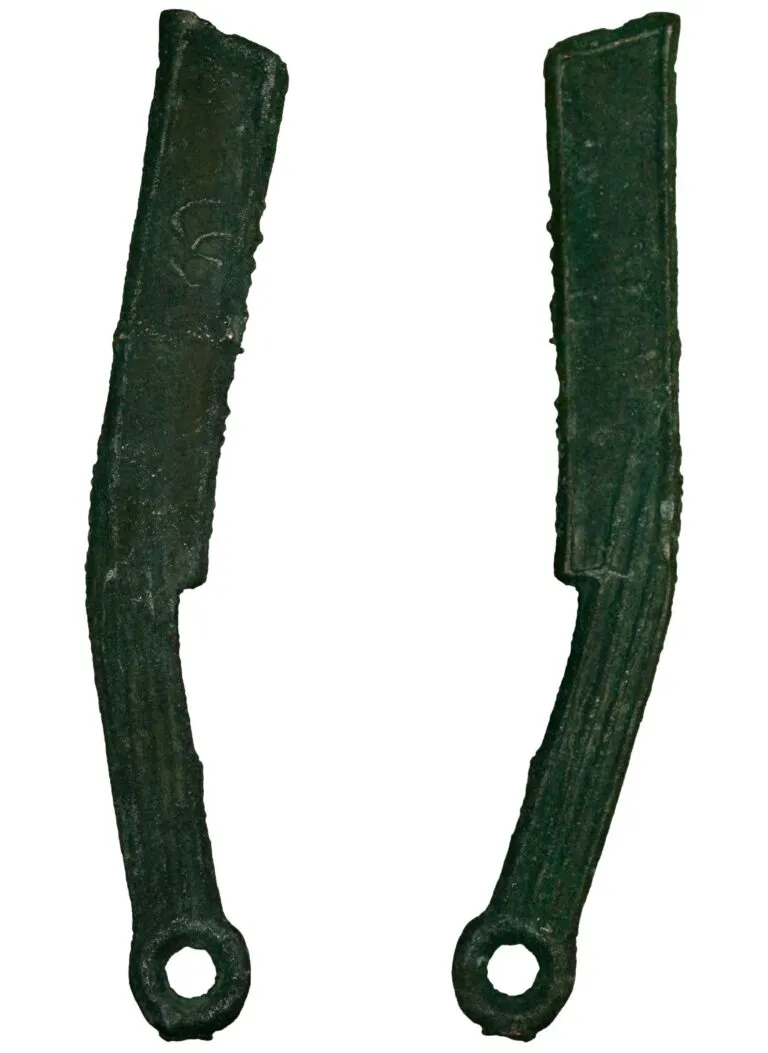
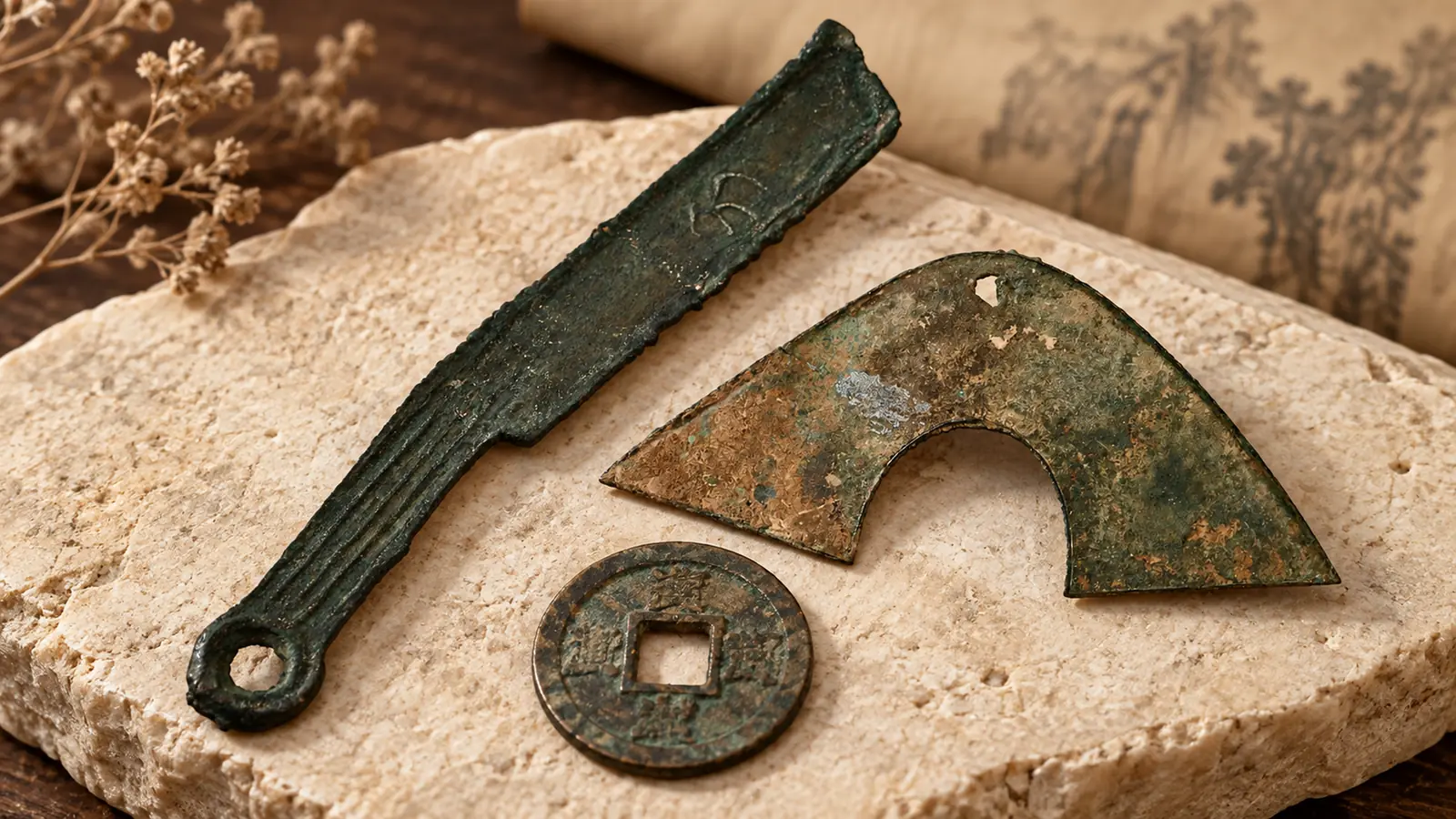
Knife money is probably the most distinctive of all ancient Chinese coins. Each piece is shaped like a small knife, with a blade, a handle and a ring at the end. The large knives of the state of Qi, in today’s Shandong, are the heaviest, while those of the state of Yan are smaller.
The most common type is the so-called Ming knife from Yan, weighing around 16 grams. It takes its name from the character on the front, traditionally read as ming, although the reading is debated. Ming knives have been found across northern China, often in large hoards. At Denarius, a Chinese knife coin from 400–220 BC costs NOK 1,150 at the time of writing (protocol no. 6011).
Spade money
Spade money was the other great family of ancient Chinese coins. The oldest pieces keep the hollow socket of a real tool, while the later, flat spades date from the Warring States period.
What is Chinese bridge money?
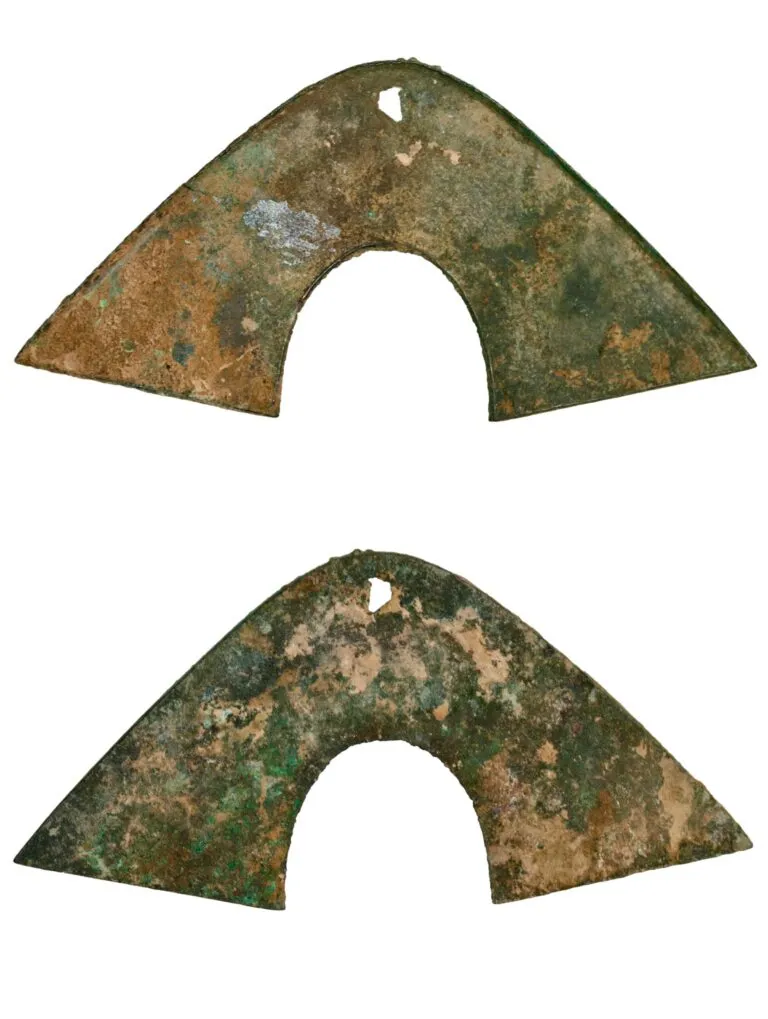
Bridge money is the name given to arched bronze pieces, sometimes with animal heads at the ends. The name comes from their shape, which recalls an arched bridge. The Penn Museum in Philadelphia catalogues its examples as Zhou-dynasty bridge money dated 770–255 BC.
Whether they were money at all is another matter. Qing-dynasty scholars described them as coins, but most researchers now think they are bronze versions of arched jade pendants (huang), used as decoration and in burials. Even so, bridge money is still sold alongside ancient Chinese coins. At Denarius, an example from the Zhou dynasty (c. 600–400 BC) costs NOK 1,200 at the time of writing (protocol no. 6017).
Ban Liang and Wu Zhu: the first round ancient Chinese coins
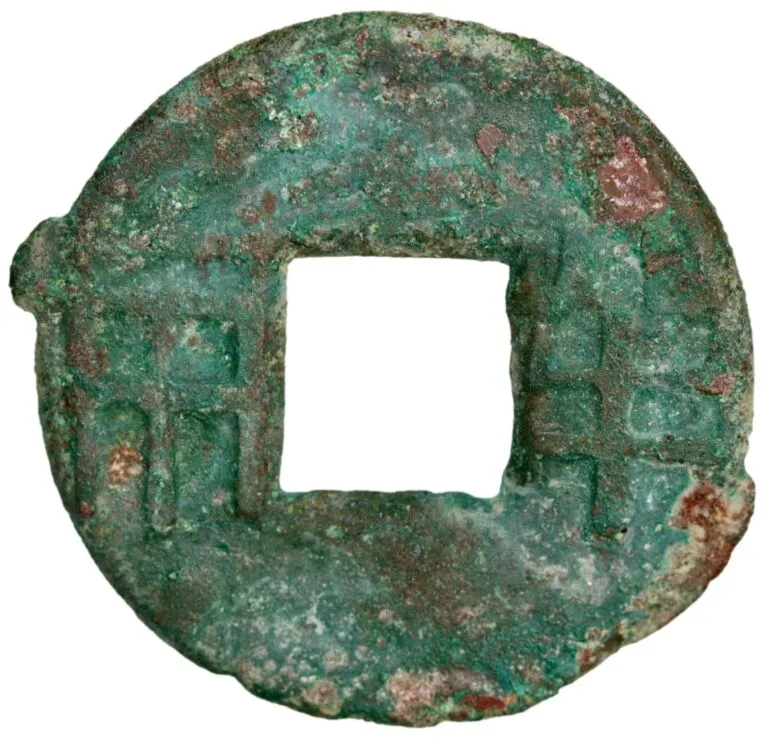
Ban Liang means “half a liang”, or 12 zhu. The coin is linked to Qin Shi Huang, who unified China in 221 BC and made it the coin of the whole empire. Archaeology shows, however, that the state of Qin was casting Ban Liang long before that, possibly as early as the 4th century BC.
Under the Han dynasty the Ban Liang grew smaller and lighter. At Denarius, a Ban Liang from 140–87 BC costs NOK 250 at the time of writing (protocol no. 4240), an easy way into ancient Chinese coins of the imperial era.
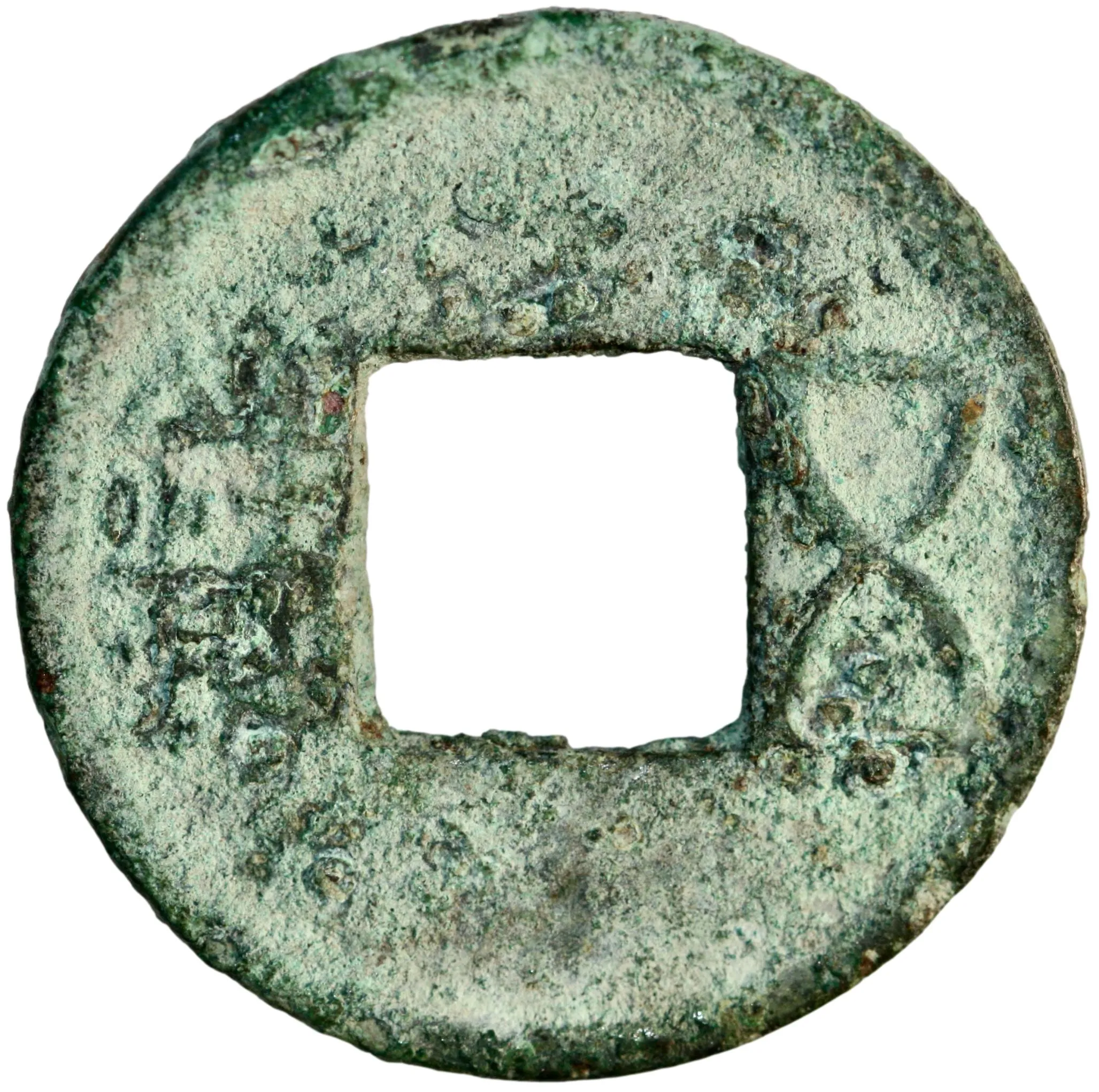
In 118 BC Emperor Wu of Han introduced the Wu Zhu (“five zhu”), a coin of about 3.25 grams. Successive dynasties went on casting it for around 700 years. At the same time, Rome was striking the silver denarius, with portraits and dies rather than moulds. A Wu Zhu from 73–49 BC costs NOK 600 at Denarius at the time of writing (protocol no. 3973 A).
The coin reforms of Wang Mang
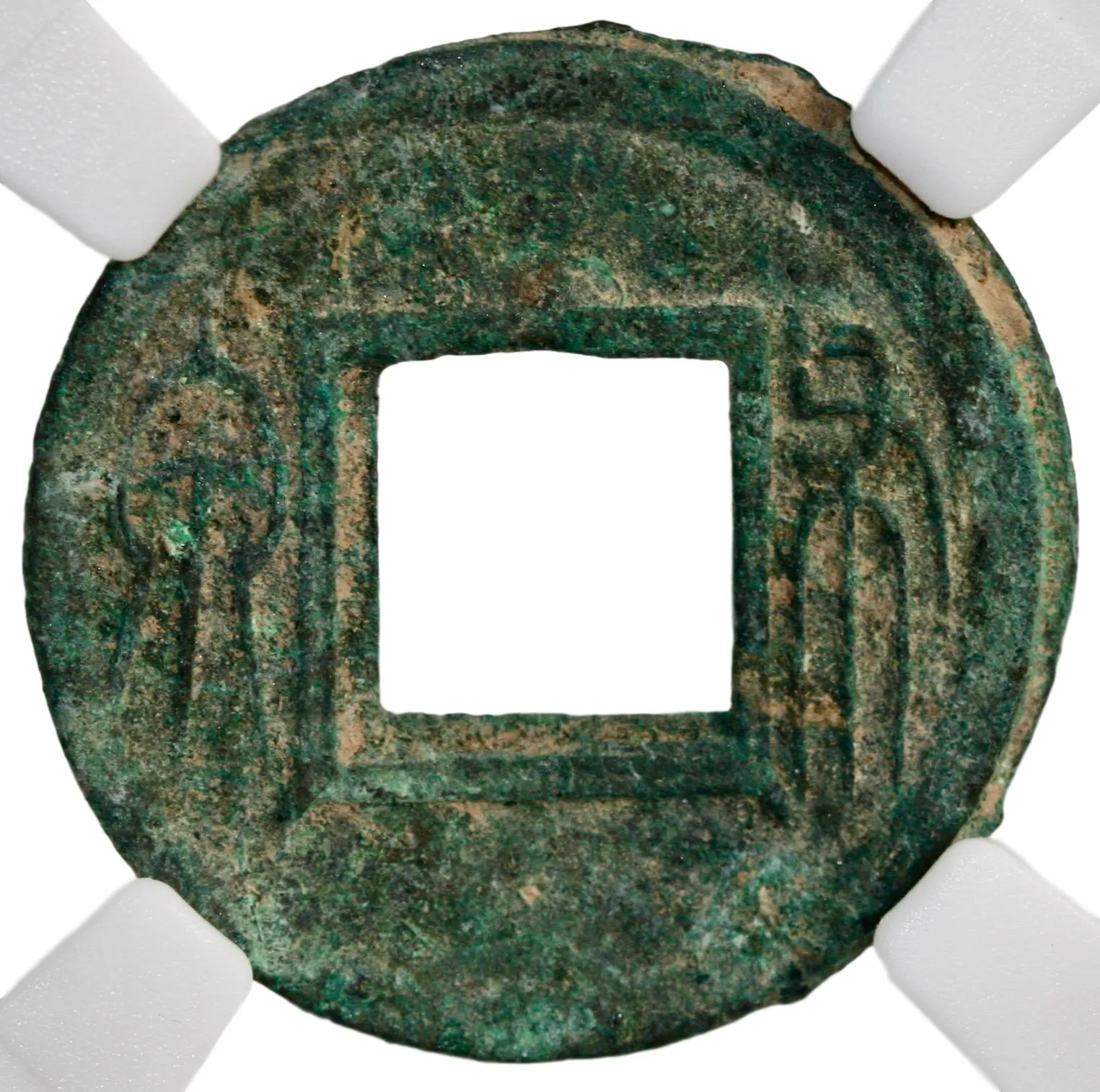
Wang Mang seized the throne in AD 9 and founded the short-lived Xin dynasty. From AD 7 he launched a series of coin reforms. He introduced large denominations such as the Da Quan Wu Shi, valued at 50 Wu Zhu, and revived the knife and spade shapes. In AD 14 new types followed, among them the Huo Quan and the Huo Bu.
The reforms caused confusion, and Wang Mang was killed by rebels in AD 23. Today his coins are among the most popular ancient Chinese coins, not least for their elegant script. The Bu Quan earned the nickname nan qian, “male coin”. At Denarius, a Bu Quan from AD 9–23 costs NOK 1,500 at the time of writing (protocol no. 3676).
Why do Chinese coins have a square hole?
The hole was practical. After casting, the coins were slid onto a square rod so the rough edges could be filed smooth without the coins turning. They were then threaded onto strings.
A string was meant to hold 1,000 coins and served as a unit of account. In practice, stringers often kept a few coins from every hundred as their fee, so a string of about 990 still counted as 1,000.
Cash coins from the Tang to the Qing
In 621 the Tang emperor Gaozu introduced the Kaiyuan Tongbao, which replaced the Wu Zhu system. It set the pattern for Chinese coinage for more than a thousand years. Later coins usually carried the emperor’s reign title and a word such as tongbao, “circulating treasure”.
The term cash came into English via Portuguese caixa from the Tamil kasu, and was first used by the British for small copper coins in India.
The Song dynasty and Emperor Huizong’s calligraphy
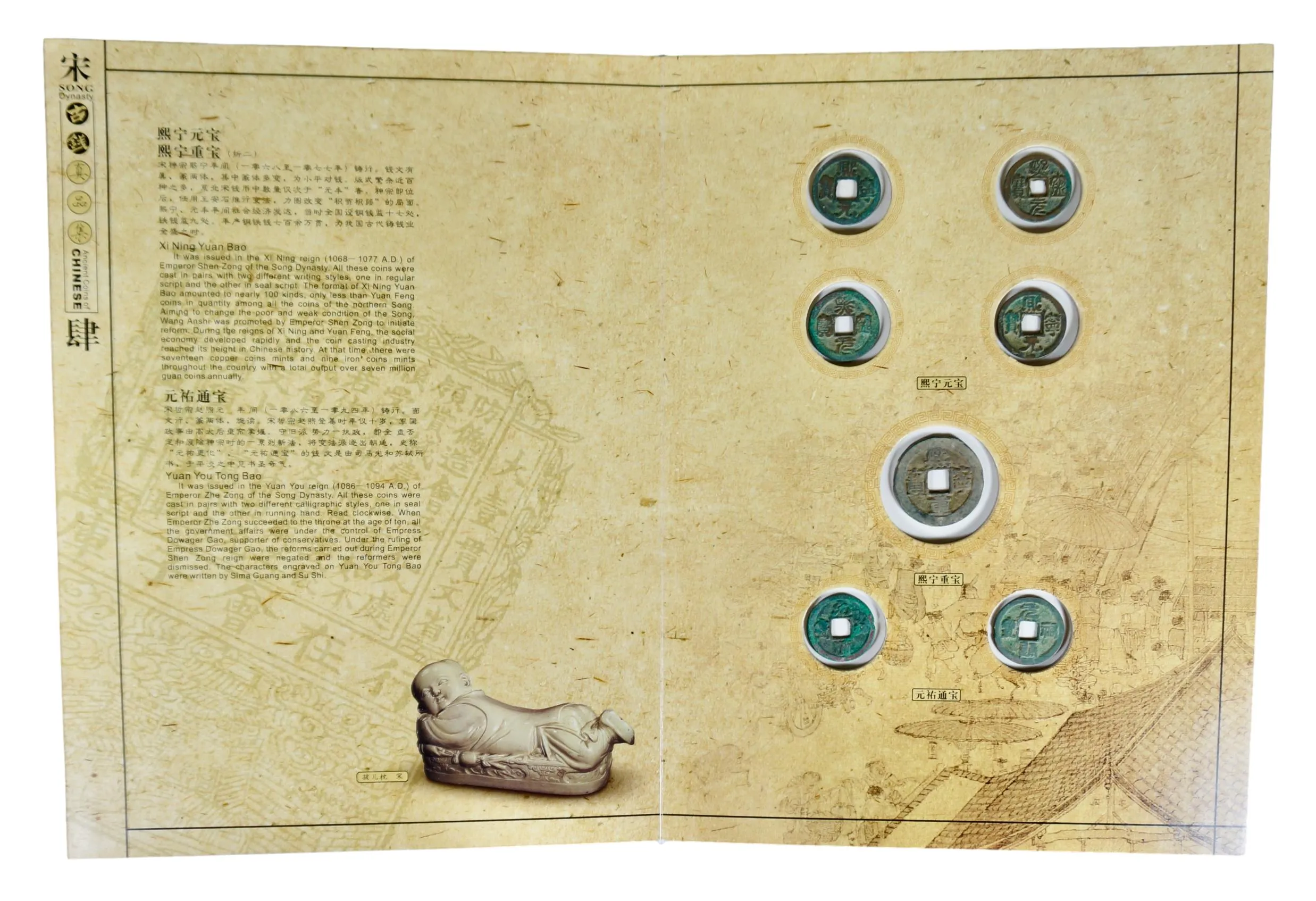
The Song dynasty (960–1279) cast enormous quantities of coins, and Song cash are among the easiest ancient Chinese coins to find today. Until 1180 the Northern Song often issued “matched coins” with the same inscription in different calligraphic scripts. Emperor Huizong (1101–1125) was himself a calligrapher, and his fine “slender gold” script appears on the Chongning and Daguan coins.
The Song period also saw the state take over jiaozi paper money in Sichuan in 1024. At Denarius, a collection of coins from the Song dynasty costs NOK 6,250 at the time of writing (protocol no. 3971).
The Qing dynasty and the end of cash
Under the Qing dynasty (1644–1912) cash coins were still cast, while silver was reckoned in taels of around 37.5 grams, a weight that varied from place to place. In 1889 a machine mint opened in Guangzhou, and the last cash coins were struck rather than cast, ending a tradition of more than 2,000 years.
Japan, Korea and Vietnam all cast their own coins on the Chinese model, and Vietnam kept doing so until the 1940s.
How do you read the inscription on ancient Chinese coins?
Most ancient Chinese coins from the Tang onwards have four characters around the hole. The usual reading order is top, bottom, right, left, although some coins read clockwise. The top and bottom characters often give the reign title, and the two at the sides are words such as tongbao or zhongbao.
On early coins the reverse is often blank. Qing coins usually name the mint on the reverse in Manchu, sometimes with Chinese as well. A good reference helps, and David Hartill’s Cast Chinese Coins (2005) is the standard catalogue used by many collectors.
What should you look for when buying ancient Chinese coins?
Forgeries are the biggest problem with ancient Chinese coins. Huge numbers of copies exist, some made as souvenirs and some to deceive. Knife money, spade money and Wang Mang’s coins are especially affected.
- Patina: Genuine bronze has an even, natural patina. Be wary of garish green colour, powdery coatings and loose “dirt”.
- Weight and size: Compare with catalogue figures. Many copies are too light or too heavy.
- Casting marks: Genuine coins show traces of casting and filing. Identical, razor-sharp details on several pieces can point to modern copies.
- Do not clean: The patina is part of the value. Read our guide on cleaning ancient bronze coins before you do anything.
At Denarius every object is examined, photographed and given its own protocol number, and we guarantee that everything we sell is genuine and as described.
A Norwegian link: the Schjöth collection of ancient Chinese coins
One well-known collection of Chinese coins is in Oslo. Fredrik Schjöth (1846–1935) spent 36 years in the Chinese Maritime Customs Service, and his collection ended up in the Coin Cabinet of the University of Oslo. It was published in 1929 as The Currency of the Far East.
The catalogue is still a reference for collectors of ancient Chinese coins. The Coin Cabinet is now part of the Museum of Cultural History in Oslo.
Frequently asked questions
How old are the oldest Chinese coins?
The oldest ancient Chinese coins are bronze spades from the Zhou period, with inscribed examples dated to around 700 BC. Knife money appeared in the same era, and round coins followed from around 350 BC.
Why do Chinese coins have a square hole?
It was practical. New coins were slid onto a square rod so the edges could be filed smooth without the coins turning, and then threaded onto strings of nominally 1,000 coins.
What is a Chinese cash coin?
Cash is the English name for the round copper-alloy coins with a square hole that China cast from around 350 BC until 1912. The word came into English via Portuguese caixa from the Tamil kasu, a South Indian money unit.
Is bridge money real money?
Probably not. Most scholars now see these arched bronze pieces from the Zhou period as ornaments or grave goods modelled on jade huang pendants, but the old name has stuck in the trade.
How much are ancient Chinese coins worth?
Common cash coins of the Han, Tang and Song dynasties are affordable, while knife money, Wang Mang’s coins and rare varieties cost more. At Denarius, a Ban Liang costs NOK 250 and a knife coin NOK 1,150 at the time of writing. For rare varieties, David Hartill’s Cast Chinese Coins and recent auction results are a good starting point.
How can I tell if a Chinese coin is genuine?
Look for natural patina, the correct weight and visible casting marks, and be wary of coins that look too perfect. Modern copies of ancient Chinese coins are extremely common, so choose a dealer who guarantees authenticity.
See all coins in our Asia category, where you will also find a 19th-century Chinese tael and Qing-dynasty cash coins. For more, browse the whole Worldwide range or our Asian banknotes. We ship worldwide.