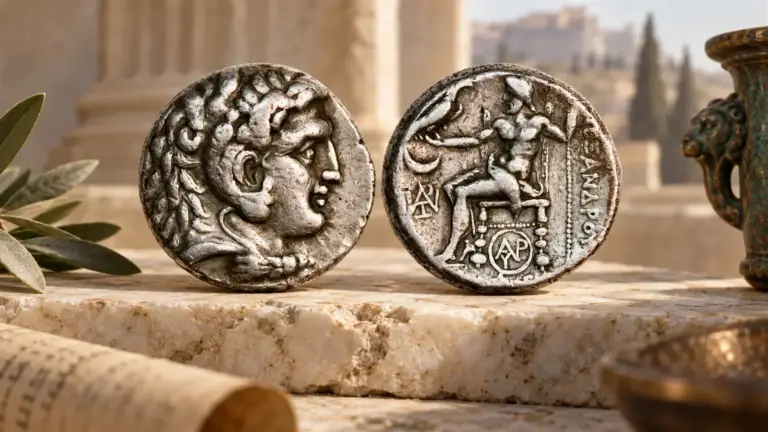
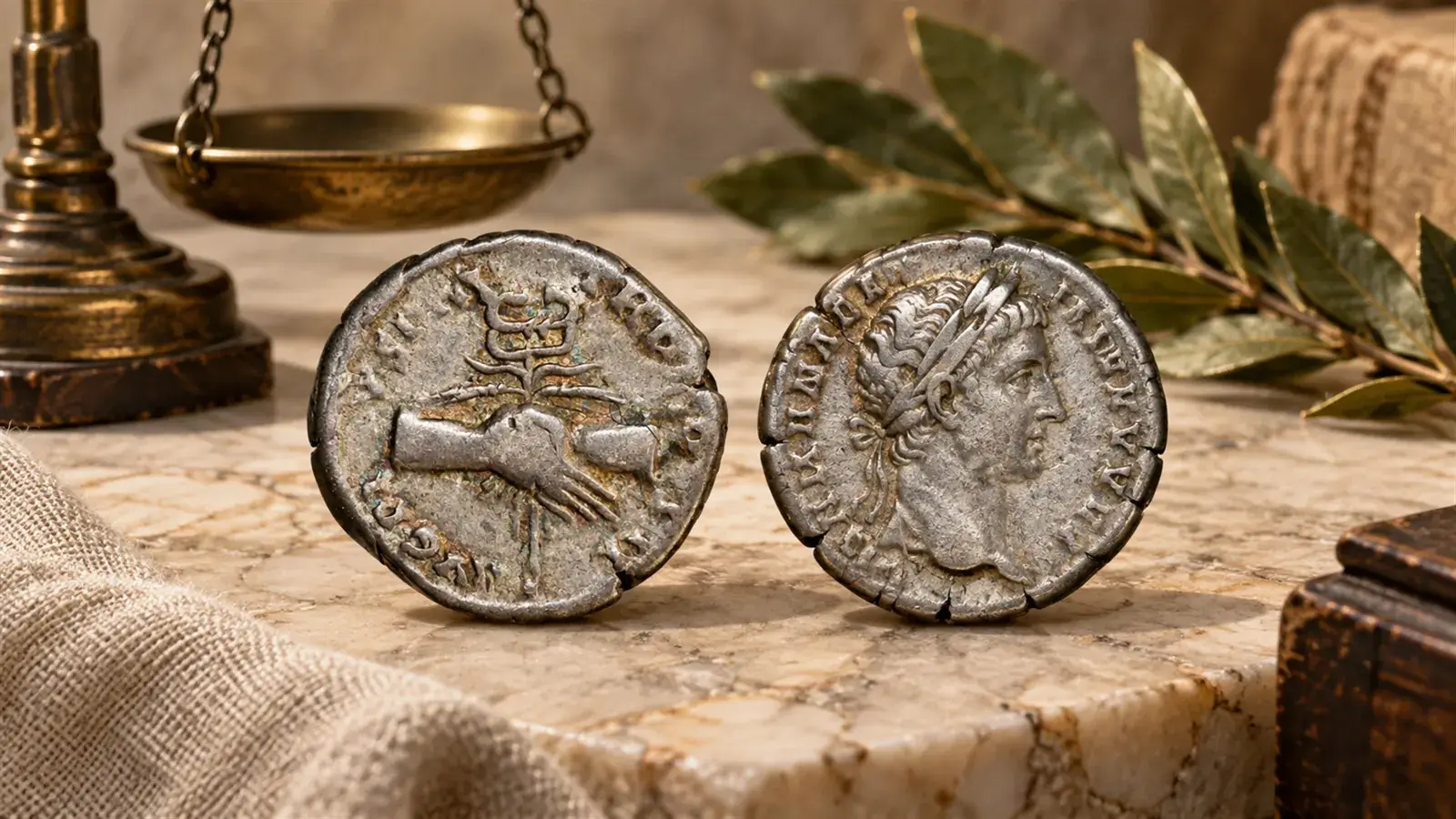
What is a denarius worth? A genuine Roman denarius of a common emperor in worn condition usually sells for well under 100 US dollars at auction, while well-preserved coins of famous rulers cost thousands and the rarest types have sold for hundreds of thousands. In ancient Rome, the same small silver coin was roughly a day’s pay for an ordinary labourer.
Below we explain what a denarius is, how its silver content changed, what it could buy, and how collectors judge its value today, with examples from the Roman coins currently in stock at Denarius.
In short:
- The denarius was introduced around 211 BC and was Rome’s main silver coin for more than four centuries.
- It started at about 4.5 grams of almost pure silver. By around AD 200 it was only about half silver.
- The New Testament gives a labourer’s daily wage as one denarius, and a legionary under Augustus earned 225 denarii a year.
- Today the price depends on ruler, rarity, condition and provenance, not on the silver.
- Denarius, the coin shop in Oslo, is named after the coin and has Roman denarii in stock from a few hundred kroner.
Contents
What is a denarius?
The denarius (plural denarii) was a small silver coin introduced by the Roman Republic around 211 BC, in the middle of the Second Punic War against Hannibal. The name comes from the Latin deni, “ten each”, because it was originally worth ten bronze asses. Many early denarii carry the numeral X behind the helmeted head of Roma to show that value. Around 141 BC the denarius was retariffed at 16 asses.
The first denarii weighed about 4.5 grams, struck at 72 to the Roman pound. For the next four centuries and more, this was the coin Rome used to pay its soldiers, collect taxes and settle larger transactions. Its gold counterpart, the aureus, was worth 25 denarii.
The name outlived the coin. The medieval French denier and the Arabic dinar both go back to the denarius, and in Britain the abbreviation “d” for pennies, used until decimalisation in 1971, stood for denarius.
Why our shop is called Denarius
Denarius, the coin dealer in Oslo, takes its name from this coin. The shop was founded by Marius Ringsrud, who trained in classical archaeology at the University of Oslo and Uppsala University, and Roman coins have a natural place in the range alongside Norwegian and world coins, banknotes and medals.
How much silver is in a Roman denarius?
It depends on when it was struck. The denarius was gradually made lighter and debased, especially when emperors needed money to pay their armies.
| Period | Approximate weight | Silver content |
|---|---|---|
| Around 211 BC | about 4.5 g | almost pure silver |
| Augustus (27 BC to AD 14) | about 3.9 g | still high-grade silver |
| Nero’s reform (AD 64) | about 3.4 g | roughly 90 to 95 % |
| Septimius Severus (193 to 211) | lighter still | roughly half to 60 % |
| AD 215: Caracalla’s antoninianus | about 5.1 g | about half silver, valued at two denarii |
The antoninianus, a “double denarius”, gradually took over during the 3rd century AD, and by the middle of that century the denarius was no longer struck in quantity. By the late 3rd century, Rome’s “silver” coins held only a few per cent silver.
For a collector the silver itself is a minor part of the value. Even an early, high-grade denarius contains only a few grams of silver, so its metal value is small compared with what collectors pay.
What was a denarius worth in ancient Rome?
Converting a denarius into modern money is guesswork, because wages, prices and everyday life were so different. The ancient sources do give some well-documented reference points:
- A day’s wage. In the parable of the workers in the vineyard (Matthew 20:2), the labourers agree to work for one denarius a day.
- A soldier’s pay. Under Julius Caesar and Augustus a legionary was paid 225 denarii a year, in three instalments. Domitian raised this to 300 denarii in AD 84.
- Grain in hard times. In Revelation 6:6 a single measure of wheat costs a denarius, a price meant to signal famine.
- The tribute penny. The coin shown to Jesus in Matthew 22 (“Render unto Caesar”) is usually identified as a denarius of Tiberius.
By the time of Diocletian’s Edict on Maximum Prices in AD 301, the denarius had become little more than a unit of account. The edict set a maximum of 8 denarii for a measure of ordinary wine that had once cost a fraction of a denarius, a clear sign of how far inflation had gone.
What is a denarius worth today?
The Roman denarius value that collectors pay today is set by four or five things that matter far more than the silver:
- Who struck it. Emperors with long reigns, such as Antoninus Pius, struck denarii in huge numbers. Short reigns, usurpers and less common empresses are scarcer and cost more.
- Condition. A sharp portrait, readable legends, good centring and an undisturbed surface can multiply the price. Ancient coins are usually graded F (fine), VF (very fine) and EF (extremely fine).
- Type. Reverses showing historical events, buildings or famous figures are more sought after than standard types.
- Provenance. A documented history, for example from an old collection or auction, adds confidence and value.
- Cleaning. A harshly cleaned or polished coin is worth noticeably less than one with its original surface.
Indicative prices (as of October 2026)
| Type of denarius | Condition | Indicative price |
|---|---|---|
| Common emperors, 2nd and 3rd century AD | worn to F | roughly 40 to 100 USD at auction; bulk lots can go lower |
| Common Republican denarii | F to VF | often around 80 to 100 USD at auction |
| Famous rulers such as Augustus, Nero or Caligula | VF and better | low thousands of USD and up; one dealer guide gives 2,000 to 30,000 USD |
| Historic rarities such as the EID MAR denarius | EF | 720,000 USD incl. buyer’s premium (Heritage, May 2023) |
These are guide figures based on published auction results and dealer guides from 2019–2026, not valuations of any particular coin. Auction results, retail prices and the price of a coin sold with a guarantee and a full description are not directly comparable, and the market moves. The EID MAR denarius, struck for Brutus to mark the murder of Julius Caesar on the Ides of March, is in a league of its own: an example graded EF by NGC sold for 720,000 dollars including buyer’s premium at Heritage Auctions in May 2023 (NGC).
Roman denarii at Denarius right now
Every coin at Denarius has been examined, photographed and described, and has its own protocol number. Most exist in a single example. These denarii are for sale at the time of writing; prices may change.
| Coin | Price | Protocol no. |
|---|---|---|
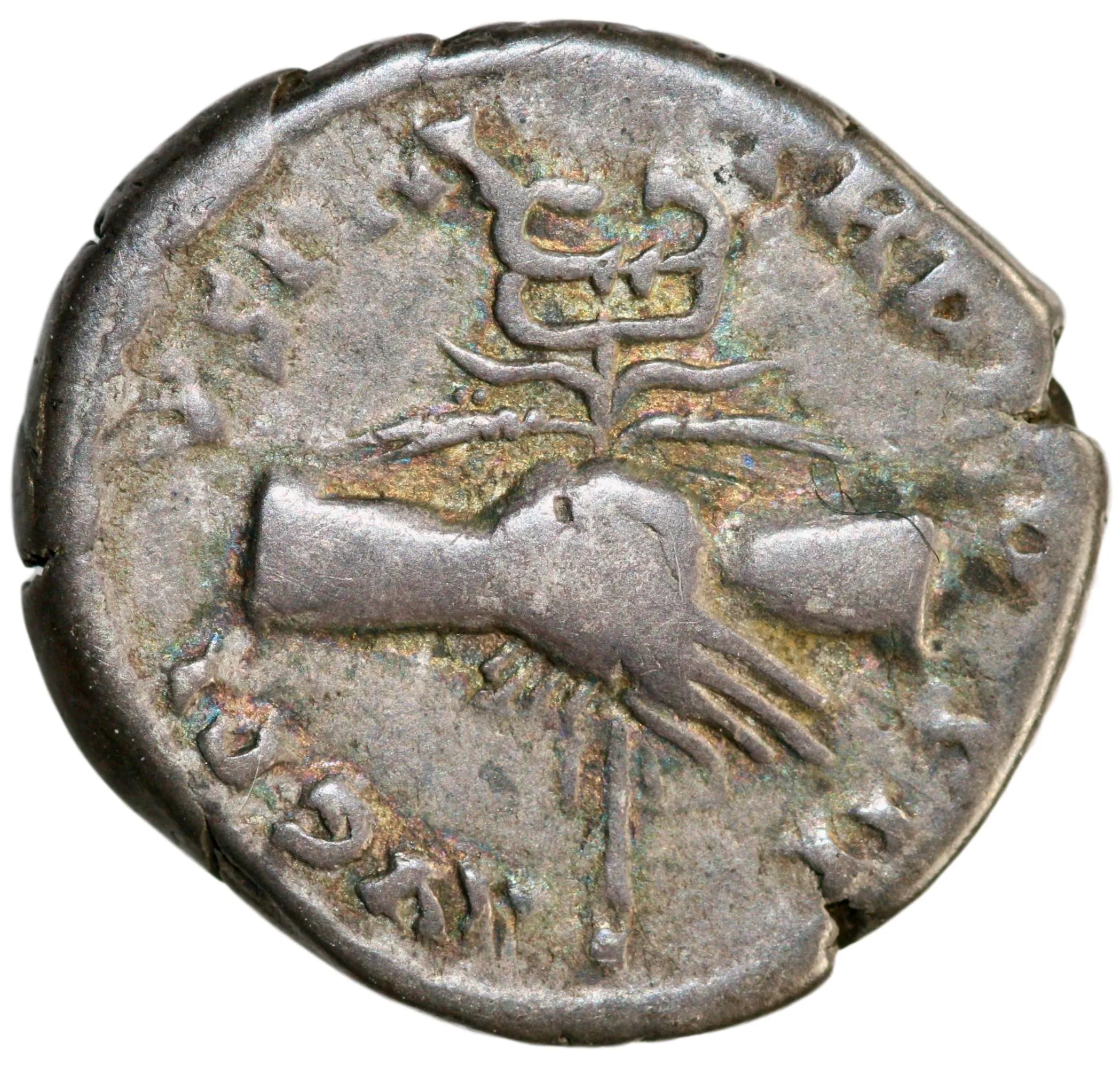
| Denarius from Emperor Antoninus Pius (138-161 AD) | 750 kr | 3374 |
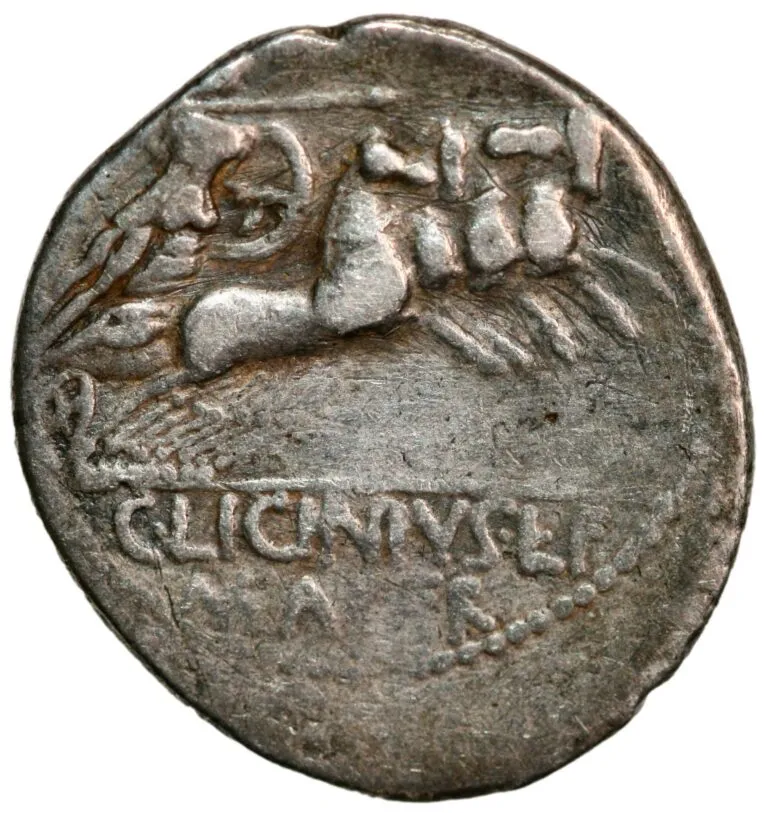
| Denarius 84 BC | 1,000 kr | 4584 |
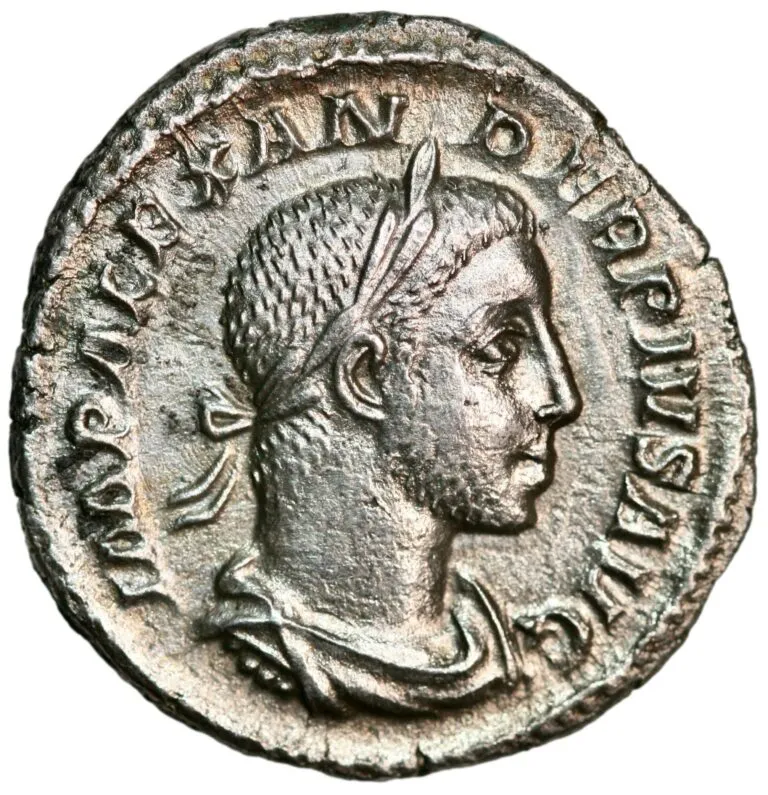
| Denarius from Emperor Severus Alexander (232 AD) | 1,500 kr | 1308 |
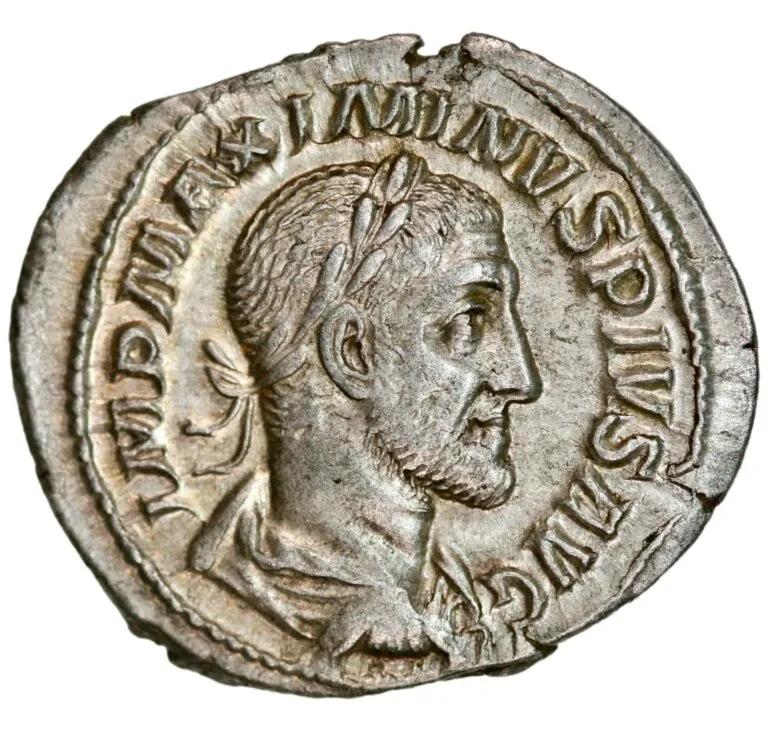
| Denarius from Emperor Maximinus I (236 AD) | 1,600 kr | 4556 |
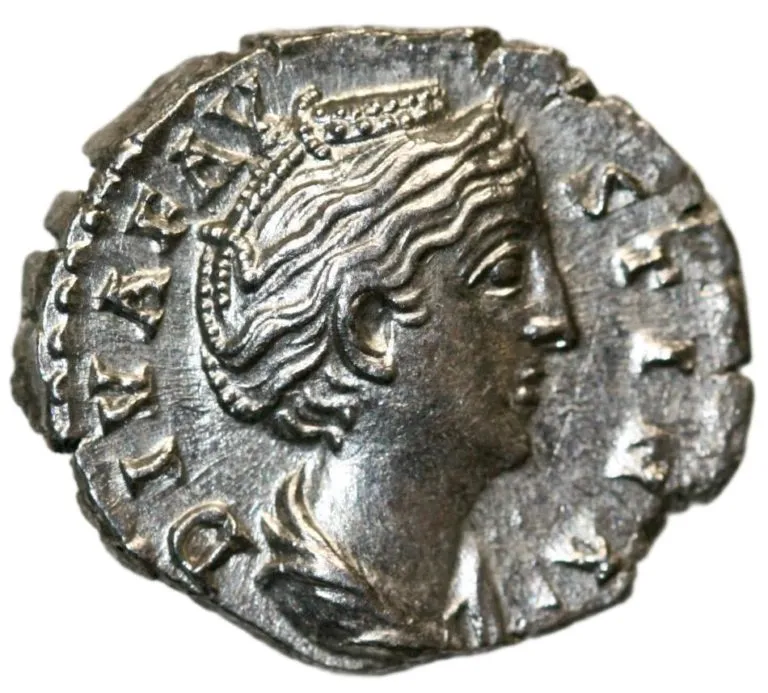
| Denarius from Augusta Faustina Sr. (147 AD) | 1,700 kr | 2804 |
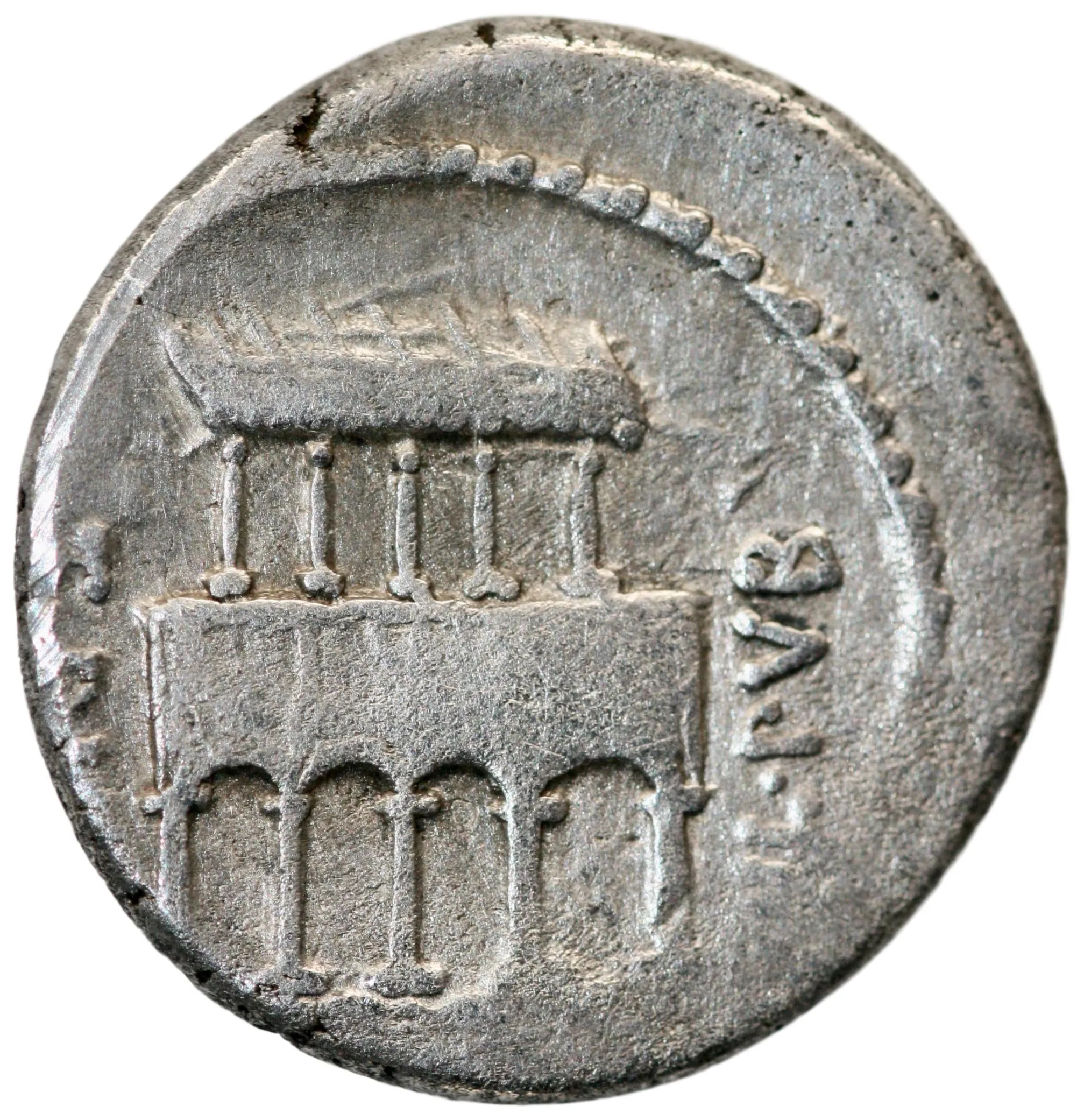
| Denarius from P. Fonteius P. f. Capito (ca. 55 BC) | 4,000 kr | 3643 |
The spread illustrates the points above. Antoninus Pius ruled for 23 years and his denarii are among the most common, which keeps the price modest. The Republican denarii were struck in the names of moneyers, officials who often chose designs celebrating their own families, and some moneyers and types are far more sought after than others. Severus Alexander and Maximinus I belong to the 230s, the last decades before the antoninianus took over for good.
How can you tell if a denarius is genuine?
Weight, style, metal and the way the coin was struck all matter. Ancient forgers made plated copies, known as fourrées, with a copper core under a thin silver skin, and modern cast and struck copies are common online. Buy from a dealer who guarantees authenticity and describes each coin properly. Denarius guarantees that everything it sells is genuine and as described.
Frequently asked questions
How much is a denarius worth?
A common Roman denarius in worn condition typically sells for under 100 US dollars at auction. Better-preserved coins and popular emperors cost more, and famous rulers and historic types reach thousands of dollars or more. At Denarius, Roman denarii are currently priced from a few hundred kroner.
What is a denarius?
The denarius was the standard silver coin of ancient Rome, introduced around 211 BC. It was first worth ten bronze asses, later sixteen, and remained Rome’s main silver coin until the antoninianus replaced it in the 3rd century AD.
How much silver is in a Roman denarius?
Early denarii weighed about 4.5 grams and were almost pure silver. The coin became lighter and more debased over time, and by around AD 200 it was only about half silver. The metal value is small compared with the collector value.
What was a denarius worth in Jesus’ time?
In the Gospel of Matthew a labourer is paid one denarius for a day’s work, and the tribute penny shown to Jesus is usually identified as a denarius of Tiberius. A Roman legionary at the time earned 225 denarii a year.
What is the most valuable denarius?
The EID MAR denarius of Brutus, which commemorates the assassination of Julius Caesar in 44 BC, is the most famous. An example graded EF by NGC sold for 720,000 US dollars, including buyer’s premium, at Heritage Auctions in May 2023.
Would you like to hold a piece of Roman history yourself? See all Roman coins in stock, or go straight to coins of the Roman Republic or the early Empire (27 BC to 220 AD). Every coin has its own protocol number, and Denarius ships worldwide.