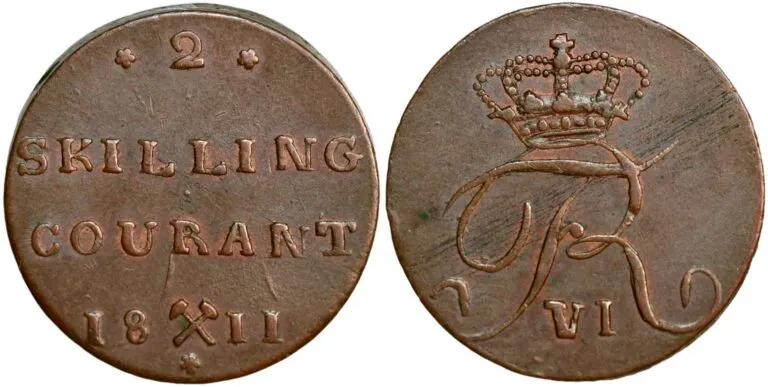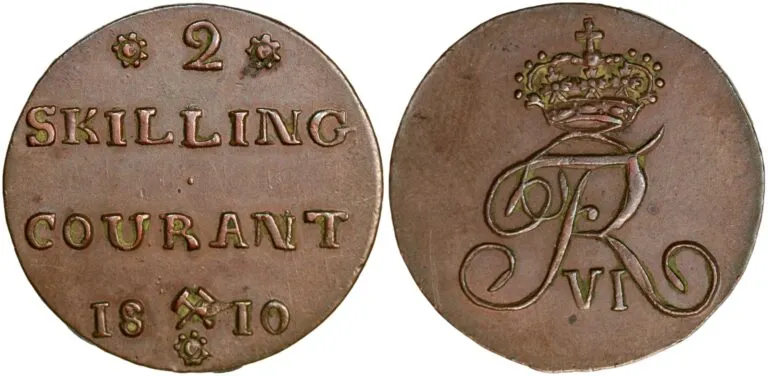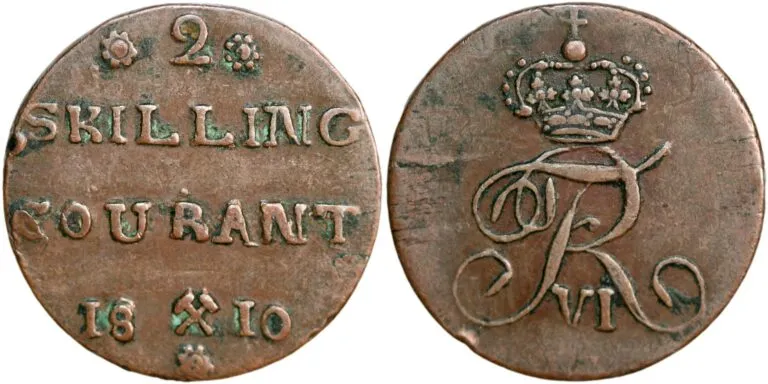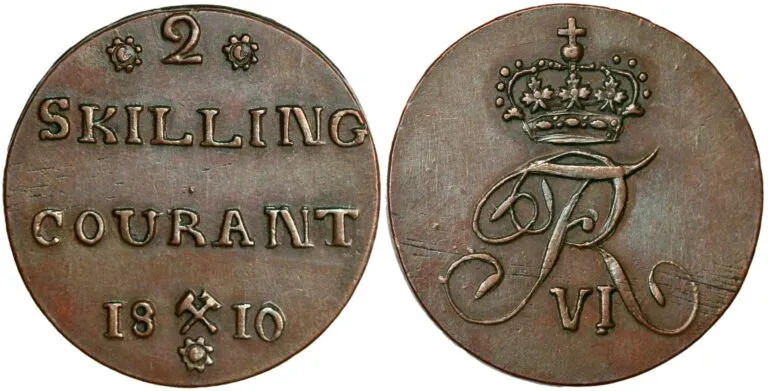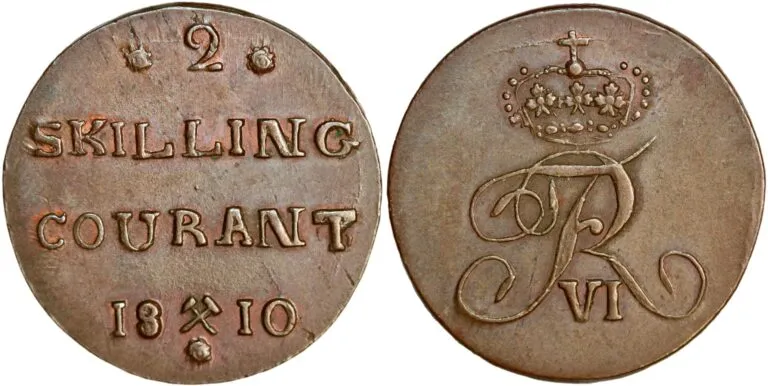
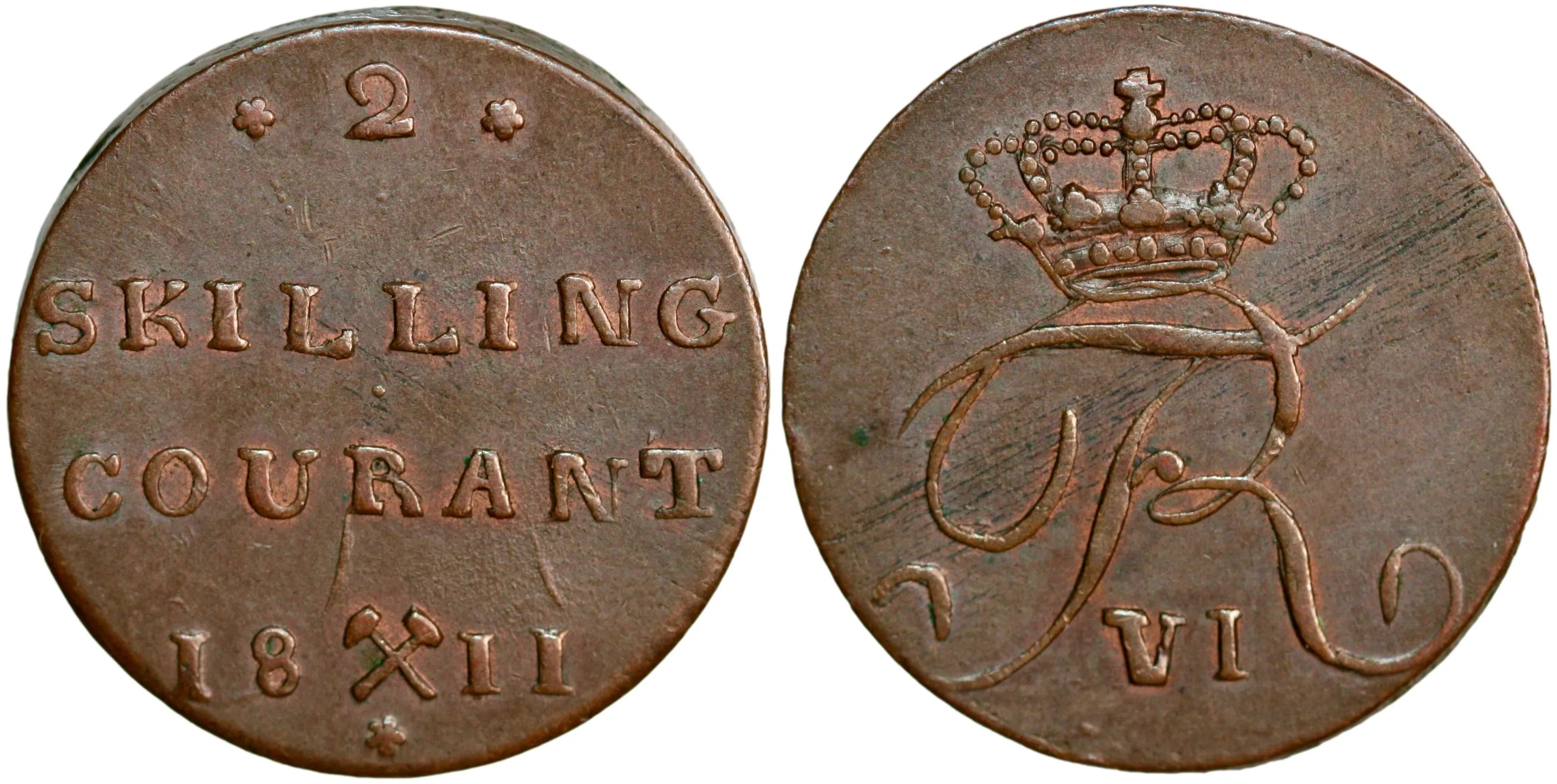
The 2 skilling 1810 is a 28 mm copper coin struck at the Kongsberg mint for King Frederik VI, with a mintage of around 3.45 million. It is one of the old Norwegian coins that turn up most often in inheritances and drawers, so a worn 2 skilling 1810 is rarely worth more than a few hundred kroner, while nice and uncirculated examples cost more.
In short
- The 2 skilling 1810 is copper, weighs about 8.35 g and measures 28 mm.
- The obverse shows Frederik VI’s crowned monogram; the reverse reads 2 SKILLING COURANT with the date split by the Kongsberg mint mark.
- About 3.45 million were struck dated 1810 and about 1.19 million dated 1811.
- It was minted in the war years 1807–1814, when silver and small change vanished from circulation.
- At Denarius a 2 skilling 1810 currently costs from NOK 350 to 1,150, depending on condition.
Contents
What is the 2 skilling 1810?
The 2 skilling 1810 is a large copper coin from the last years of Norway’s union with Denmark. It was struck at the Norwegian mint in Kongsberg, and the type was issued in 1810 and 1811. Catalogues give a weight of 8.35 g and a diameter of 28 mm, with a plain edge.
The obverse shows King Frederik VI’s monogram, FR VI, beneath a crown. The reverse carries 2 SKILLING COURANT in four lines, with the date divided by the Kongsberg mint mark of crossed hammers: 18 ⚒ 10. There is no portrait of the king on the coin.
The word COURANT shows that the value is reckoned in courant money. One rigsdaler courant was 96 skilling, so a 2 skilling 1810 was 1/48 of a rigsdaler. To see how skilling, rigsdaler and speciedaler fit together, read skilling and speciedaler, Norway’s old currency.
Why was the 2 skilling 1810 struck in copper?
The answer is the war. After the British attack on Copenhagen in 1807, Denmark-Norway entered the Napoleonic Wars on the French side. The British blockade cut the supply lines between Denmark and Norway, customs revenue fell, and the state covered its deficit by printing more banknotes.
According to Norges Bank, silver and small change disappeared from circulation as bad money drove out good. In 1812 prices rose by 152 per cent, the closest Norway has come to hyperinflation. At the same time the Kongsberg silver mines stood idle: they were closed in 1805 and not reopened until 1816.
Copper was already an established coin metal. According to the Norwegian historical encyclopedia (Norsk historisk leksikon), skillings were struck in copper from 1771, and the last silver skilling was struck in 1780. The 2 skilling 1810 belongs to a copper series meant to supply small change once the silver was gone.
How do you identify a Norwegian 2 skilling 1810?
The Norwegian 2 skilling 1810 is easy to recognise: large, heavy and without a portrait. Denmark also struck a 2 skilling dated 1810, but it is much smaller, about 20 mm and under 5 g, with the king’s head and a Latin legend. If the coin says COURANT and has a crowned monogram, it is Norwegian.
There are several varieties within the type. Some coins have small rosettes on either side of the figure 2, others have crosses, and the crown above the monogram varies in size. Specialists collect the varieties, which are listed in the Norwegian catalogues, but for most collectors condition matters more.
The coin also exists dated 1811, with a mintage of about 1.19 million, roughly a third of 1810. At Denarius a 2 skilling 1811 currently costs NOK 950 (protocol no. 6249).
What is a 2 skilling 1810 worth?
With such a large mintage, the 2 skilling 1810 is no rarity, and its value depends almost entirely on condition. Many examples circulated for decades and are worn, corroded or cleaned. A coin that has been polished or scrubbed loses much of its value.
Indicative market prices as of October 2026 (Norwegian grades, with approximate international equivalents):
| Grade | Description | Indicative price |
|---|---|---|
| 1- to 1 (VG–F) | Clearly worn but legible | approx. NOK 100–300 |
| 1+ to 01 (VF–EF) | Nice example with light wear | approx. NOK 300–800 |
| 0/01 to 0 (AU–UNC) | Uncirculated, ideally with original copper lustre | from approx. NOK 1,000 |
Top examples fetch more. A coin graded MS 63 BN by NGC sold for USD 216 at an American auction in 2023. For more on the Norwegian grading scale and other coins, see what old Norwegian coins are worth.
The 2 skilling 1810 at Denarius
Denarius has several examples of the 2 skilling 1810 in different grades. Each object has been examined, photographed and described with its grade, and has its own protocol number. At the time of writing they cost:
- 2 skilling 1810 at NOK 350 (protocol no. 1550)
- 2 skilling 1810 at NOK 750 (protocol no. 6248)
- 2 skilling 1810 at NOK 850 (protocol no. 1907)
- 2 skilling 1810 at NOK 1,150 (protocol no. 5597)
The price difference reflects the grade given in each description. To value a coin of your own, compare it with the catalogue Norges Mynter, recent auction results or ask the Norwegian Numismatic Society (Norsk Numismatisk Forening).
The Norwegian coins of Frederik VI, 1808–1814
Frederik VI had ruled as crown prince regent for his ill father, Christian VII, since 1784, and became king of Denmark-Norway in 1808. Under the Treaty of Kiel in January 1814 he had to cede Norway to Sweden. He was the last king to rule both realms, and his coins are the last of the Danish era in Norway.
The coins from his short reign as king of Norway are few, and almost all are small change:
| Coin | Year | Metal | Note |
|---|---|---|---|
| 4 and 8 skilling | 1809 | Billon (silver alloy) | Marked IGP for mint master Johann Georg Prahm |
| 4 skilling courant | 1809 | Copper | Large, heavy copper coin |
| 2 skilling courant | 1810–1811 | Copper | Approx. 3.45 million (1810) and 1.19 million (1811) |
| 1 skilling | 1812 | Copper | One-year type |
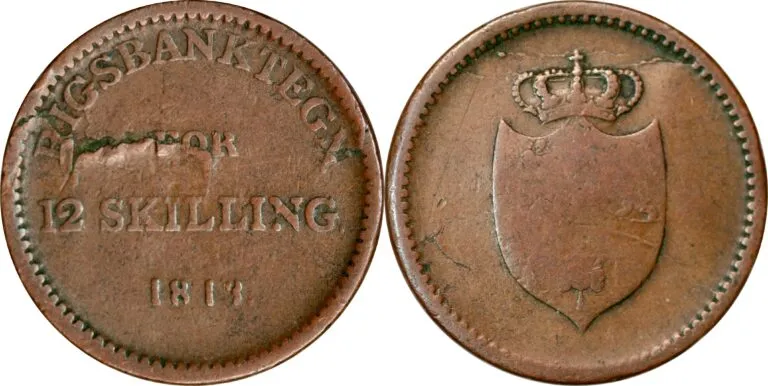
| 6 and 12 skilling rigsbanktegn | 1813 | Copper | Struck at Kongsberg 1813–1815, all dated 1813 |
Johann Georg Prahm was mint master at Kongsberg from 1807 to 1824, through the whole transition from the Danish to the Swedish-Norwegian era.
What is a rigsbanktegn of 1813?
On 5 January 1813 the Rigsbank was founded, and the rigsbankdaler replaced the rigsdaler courant. Old notes could only be exchanged at 6:1, an event often called the state bankruptcy. The rigsbankdaler was divided into 96 rigsbank skilling, and Kongsberg struck copper coins of 6 and 12 rigsbank skilling bearing the word RIGSBANKTEGN. According to Norsk historisk leksikon, the Norwegian pieces were called in towards the end of 1815.
At Denarius a 12 skilling rigsbanktegn 1813 currently costs NOK 400 (protocol no. 2381). The banknotes of the same years are covered in Norwegian banknotes through history.
Small Danish-Norwegian coins, including the 2 skilling 1810, kept circulating in Norway long after 1814. Only laws of 1839 and 1842 removed their legal-tender status in Norway, which explains why so many are well worn.
Frequently asked questions
What is a 2 skilling 1810 worth?
Most examples of the 2 skilling 1810 are worn and worth roughly NOK 100–300. Nice examples in grade 1+ to 01 (about VF to EF) often sell for NOK 300–800, and uncirculated coins with original copper lustre from about NOK 1,000 upwards. At Denarius they currently cost from NOK 350 to 1,150.
Is the 2 skilling 1810 rare?
No. Around 3.45 million examples of the 2 skilling 1810 were struck at Kongsberg, and it is one of the old Norwegian coins people come across most often. Condition, and to some extent the variety, decides the price.
Is the 2 skilling 1810 Norwegian or Danish?
The large copper coin with a crowned monogram and the words 2 SKILLING COURANT was struck at Kongsberg and is Norwegian. Denmark also struck a 2 skilling dated 1810, but it is much smaller, about 20 mm, and shows the king’s portrait.
What does COURANT mean on the coin?
COURANT means the value is reckoned in courant money, in which 96 skilling made one rigsdaler courant. A 2 skilling was therefore 1/48 of a rigsdaler.
Why is the 2 skilling 1810 made of copper?
It was struck during the war with Britain (1807–1814), when silver and small change disappeared from circulation and the state covered its deficit by printing notes. Copper was cheap to coin, and copper skillings had been struck in Norway since 1771.
Browse the 2 skilling 1810 and other coins of Frederik VI
All coins from Frederik VI’s reign are listed in the Frederik VI category, and the full range of early coins in Norway before 1814. Skilling coins struck after 1814 are under Norway 1814–1874. Denarius guarantees that everything it sells is genuine and as described, and ships worldwide.