The most valuable rare Norwegian coins are royal coins of the Middle Ages, the archbishop’s skillings of the 1520s and 1530s, special issues from the Danish period, and a handful of dates with very low mintages. But rarity is only part of the story: history, demand and condition matter just as much. This guide covers the rarest Norwegian types and dates and explains why they are scarce.
This article is about rarity and history, not prices. For indicative prices denomination by denomination, see our price guide what are old Norwegian coins worth.
In short
- Norway’s first coin was struck for Olav Tryggvason around 995–1000. Royal coins of the 11th century are among the oldest and most sought-after rare Norwegian coins.
- Archbishop Olav Engelbrektsson was the last Norwegian mint authority before the Reformation. His skillings of 1523–1537 are highly prized.
- The Schydtz coins of 1689 are linked to paying for horse transport: 12 skilling in summer and 16 skilling in winter.
- Rare dates exist in later periods too, such as the speciedaler of 1833 and the 2 øre of 1968.
- Errors such as “SKILLIING” on the 1 skilling of 1771 are popular, but not necessarily expensive.
Contents
What makes rare Norwegian coins rare?
Rarity has several causes. The obvious one is a low mintage: some dates were struck in only a few thousand pieces. Just as important is how many survived. In the Middle Ages, old coins were called in and melted at each recoinage, and many silver coins have been melted down since.
Then there is demand. Norwegian coins have many collectors, while the number of surviving coins from a small country is limited. A moderately scarce Norwegian coin can therefore cost more than a far rarer coin from a larger country.
Finally, condition counts for a lot. A common date in uncirculated condition can be worth more than a rare date that is heavily worn. The best rare Norwegian coins combine a scarce type with good preservation.
Rare Norwegian coins of the Middle Ages
The first royal coins
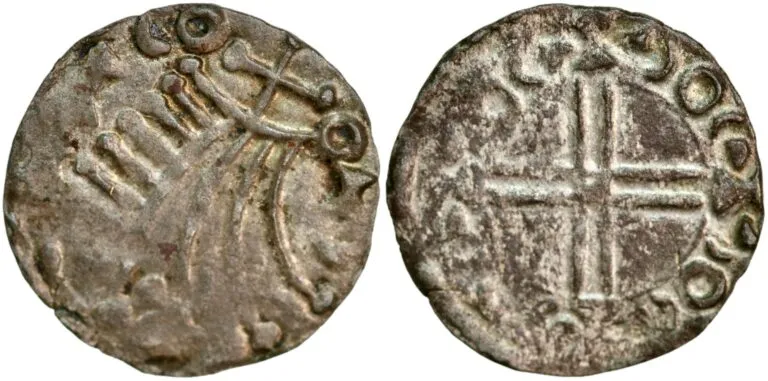
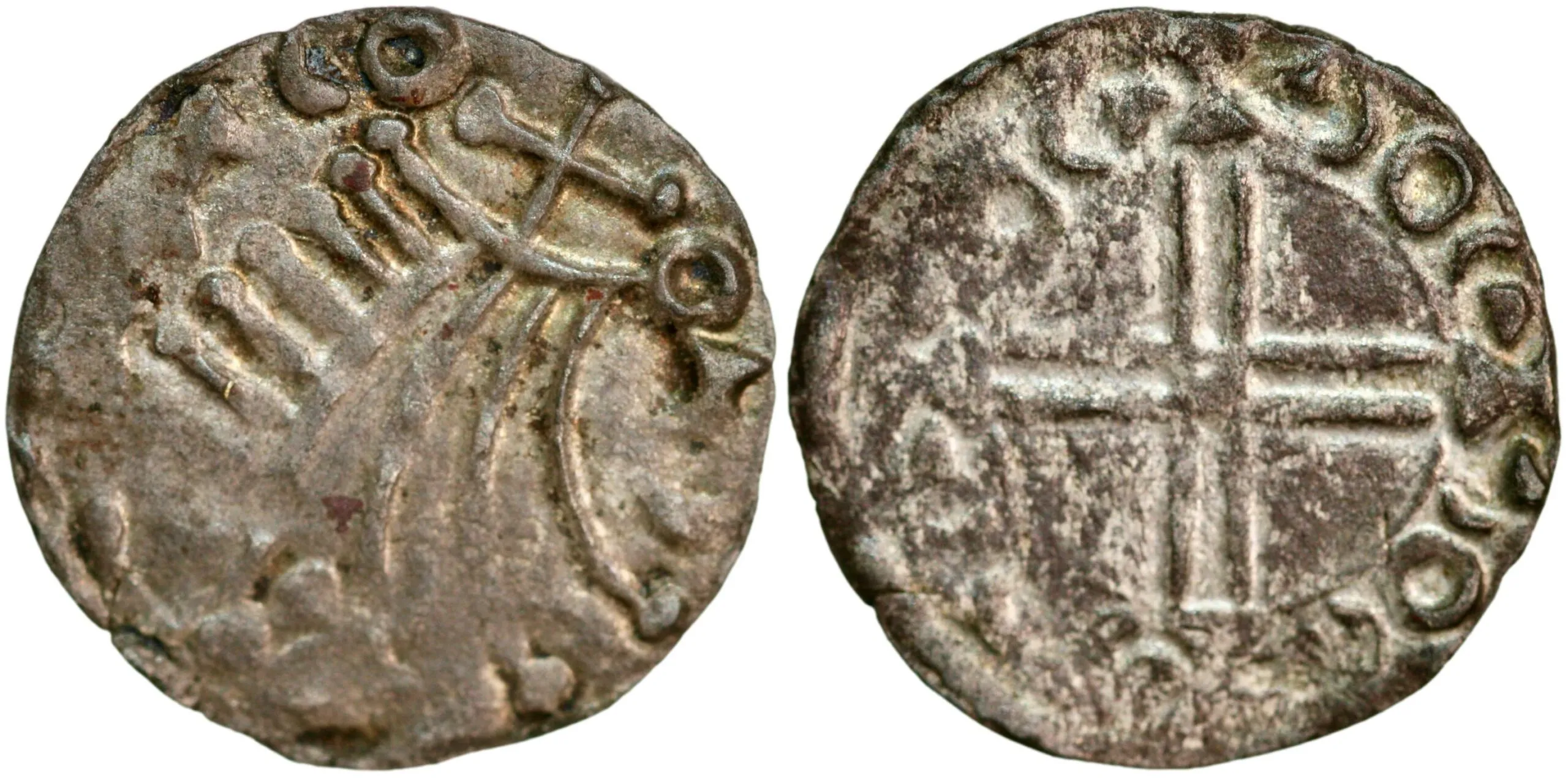
According to Norges Bank, the first Norwegian coin was struck for Olav Tryggvason around 997–998. Harald Hardrada built up a national coinage but reduced the silver content to about a third. Coins of this period are very rare and among the most coveted rare Norwegian coins. We cover them in our Viking coins buyer’s guide.
Olav Kyrre’s pennies (1067–1093)
Most of what we know about Olav Kyrre’s coinage comes from the Gresli hoard. In the autumn of 1878 a 14-year-old farmhand found a treasure in a potato field in Tydal. The hoard held 2,253 coins, of which 2,209 were Norwegian. It was probably buried around 1080.
The coins are unusual because they emphasise the moneyers. Some legends say who made the die, and some are written in runes. The king’s name also appears in Old Norse: “Olafr konungr”. At Denarius, a penny of 1066–1093 costs NOK 39,750 at the time of writing (protocol no. 5478).
The archbishop’s skillings (1523–1537)
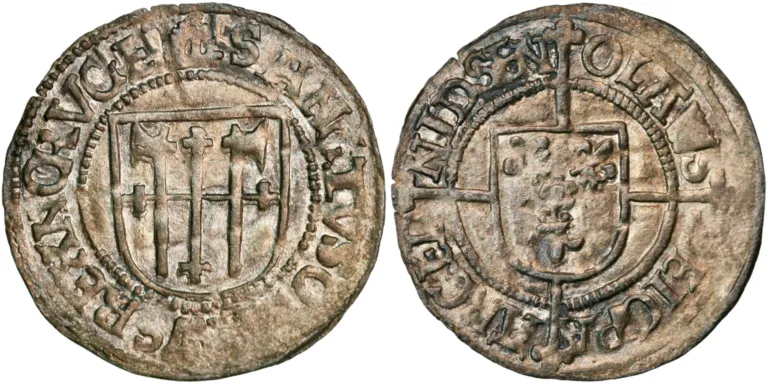
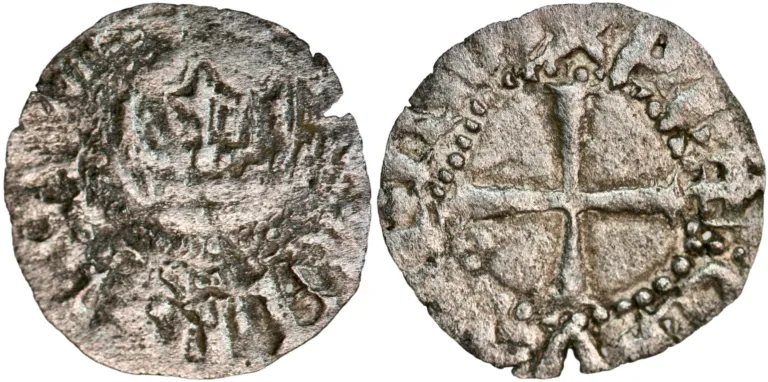
At the end of the Middle Ages, the archbishops of Nidaros (Trondheim) struck their own coins. Erik Valkendorf was the first to put a date on Norwegian coins, on skillings of 1518 and 1519. His successor Olav Engelbrektsson struck skillings with the archbishop’s arms on one side and the arms of Nidaros over a long cross on the other.
Excavations at the Archbishop’s Palace in Trondheim have uncovered the archbishop’s mint workshop. According to Norges Bank, Olav Engelbrektsson was the last Norwegian mint authority before he had to flee the country in 1537. At Denarius, a skilling of 1523–1537 with a documented provenance costs NOK 45,000 at the time of writing (protocol no. 5944).
Rare Norwegian coins of the Danish period: the Schydtz coins of 1689
After the Reformation, Danish kings controlled the coinage. Norway got a permanent mint in Christiania (Oslo) in 1628, and at Kongsberg from 1686. Among the rare Norwegian coins struck in Christiania, two small silver pieces of 1689 from the reign of Christian V stand out.
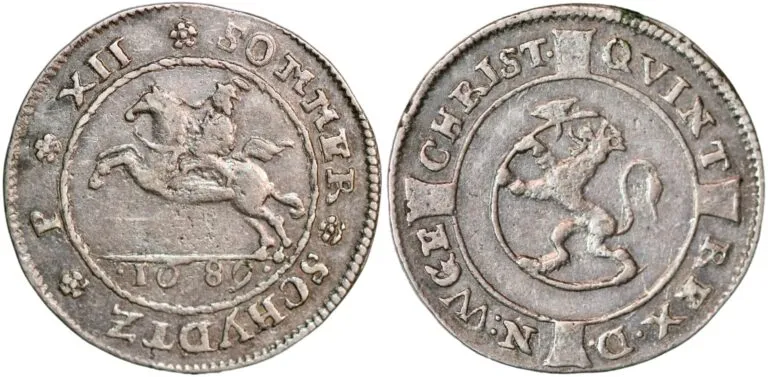
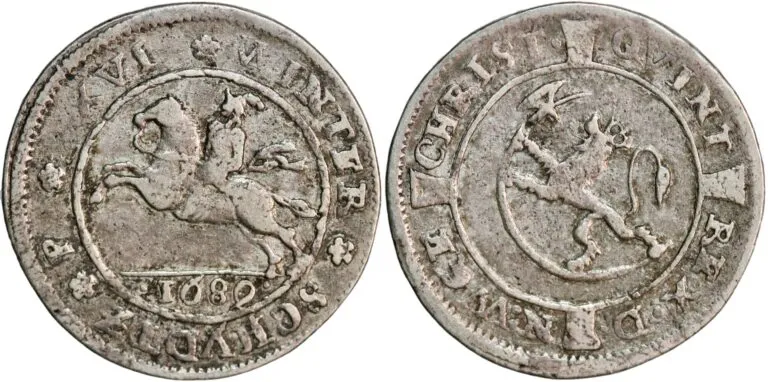
One is a 12 skilling inscribed SOMMER SCHYDTZ. The other is a 16 skilling (1 mark), known as the Winter Schydtz. “Schydtz” is an old spelling of skyss, the Norwegian system of hired horse transport. According to Norwegian numismatic literature, the coins were meant for paying transport fares, with a higher rate in winter than in summer.
Whether they are coins or tokens has been debated. The Danish numismatist Jørgen Sømod argued that they are true coins, since they carry the king’s name, a denomination and a silver content. The mintage is unknown, and catalogues rate them as very rare. At the time of writing Denarius has both: the 12 skilling 1689 “Sommer Schydtz” at NOK 46,750 (protocol no. 5781) and the 16 skilling 1689 “Winter Schydtz” at NOK 45,000 (protocol no. 5780).
Rare Norwegian coins after 1814: the speciedaler
From 1816, Norway’s unit was the speciedaler, divided into 120 skilling. Read more in skilling and speciedaler, Norway’s old currency.
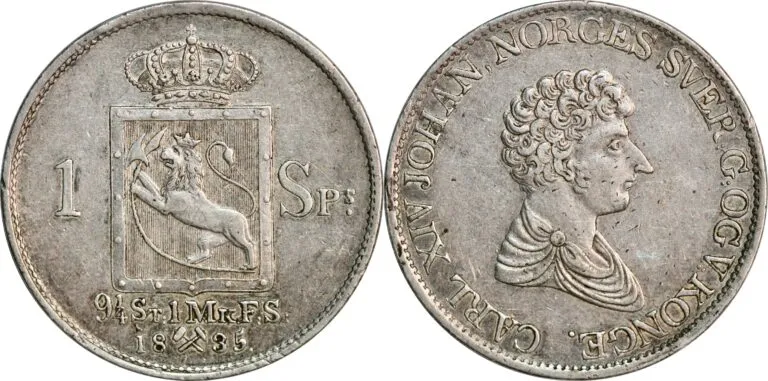
The speciedaler of Carl XIV Johan was struck from 1826 to 1836, and mintages varied widely. According to NGC’s price guide, only about 2,700 were struck in 1833, against about 103,000 in 1834. The 1833 is therefore the great rarity of the series and one of the classic rare Norwegian coins of the 19th century. A speciedaler of 1835 is one of the more common dates, with a mintage of about 40,000, and costs NOK 17,500 at Denarius at the time of writing.
Rare Norwegian coins of the krone era: the key dates
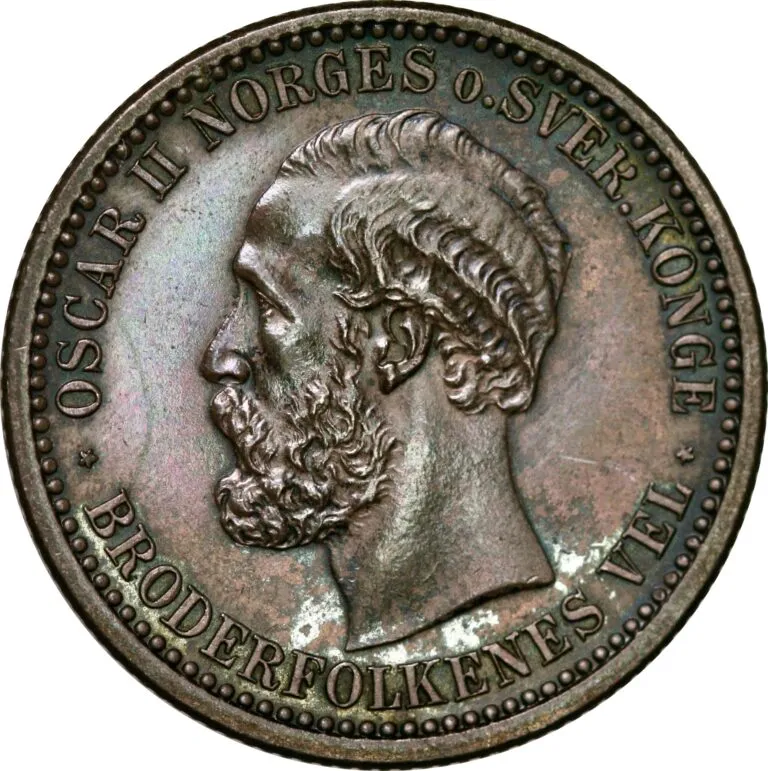
The krone coins from 1875 onwards were struck in large numbers, and most are common. A few dates stand out, among them the 1 krone 1878 with a mintage of about 60,000, and the 2 kroner of 1885, 1887 and 1888 with about 25,000 each.
The best-known modern rarity is the 2 øre 1968, struck only for mint sets, in about 3,500 pieces. Copies circulate, so be careful. Indicative prices for these dates are in our price guide to old Norwegian coins.
Condition can also make an ordinary date valuable. The 50 øre 1895 was struck in about 200,000 pieces and is not among the rarest. In uncirculated condition, however, its price is in a different league from a worn example. At Denarius, a 50 øre 1895 in grade 0 (uncirculated) costs NOK 12,000 at the time of writing (protocol no. 4738).
Are error coins valuable? The 1771 “SKILLIING”
Errors often come up in talk about rare Norwegian coins, but the 1 skilling of 1771 shows that an error does not automatically mean a high value. The coin kept the date 1771 into the 1780s and was struck in almost 55 million pieces in Copenhagen, Altona and Kongsberg. Kongsberg accounted for just over 2 million of them, struck in 1784 and 1785.
With so many dies, spelling mistakes crept in. Known varieties read DANKSE, DANAKE and DNASKE instead of DANSKE, and SKILLIING with a double I. These varieties are popular with collectors, but prices are moderate: at Denarius the “SKILLIING” varieties cost around NOK 1,250–1,500 at the time of writing. You will find them under 1771 errors.
How to tell if you have rare Norwegian coins
- Read the coin. Note the ruler, date, denomination and any mintmaster’s initials.
- Check the catalogues. Norgesmynter (NM), Krause (KM) and older works such as Hede and Brekke list varieties and rarity.
- Grade honestly. Norway uses its own scale, from 0 (uncirculated) downwards. Wear has a big effect on price.
- Look at auction results. Sold prices tell you more than asking prices in adverts.
- Ask the experts. The Norwegian Numismatic Society (Norsk Numismatisk Forening) and local coin clubs have a great deal of knowledge.
Do not clean old coins. Polishing can remove much of the value, even from rare Norwegian coins.
Frequently asked questions
What are the most valuable rare Norwegian coins?
There is no official list, but the most valuable rare Norwegian coins tend to be very scarce medieval coins, the archbishop’s skillings of the 16th century and special issues from the Danish period such as the Schydtz coins of 1689. In later periods, the speciedaler of 1833 and the 2 øre of 1968 are well-known rarities.
Which Norwegian coin dates are rare?
Well-known rare dates include the speciedaler of 1833, the 1 krone 1878, the 2 kroner of 1885, 1887 and 1888, and the 2 øre 1968. Condition still matters a great deal: a worn rare date can be worth less than a common date in uncirculated condition.
Are coins dated 1771 valuable?
Usually not. The 1 skilling dated 1771 was struck in almost 55 million pieces with the same date. Spelling errors such as SKILLIING and DANKSE are popular with collectors but sell at a moderate price level.
What are the Schydtz coins?
The Schydtz coins are two silver coins struck in Christiania in 1689, worth 12 and 16 skilling. According to numismatic literature they were meant for paying for horse transport, with a higher rate in winter. They are considered very rare.
How do I find the value of an old Norwegian coin?
Identify the ruler, date and denomination, and look the coin up in a catalogue such as Norgesmynter (NM) or Krause. For rare Norwegian coins, compare it with actual auction results in the same grade. The Norwegian Numismatic Society can also help with identification.
Are low-mintage coins always expensive?
No. Price depends on mintage, how many survived, demand and condition. A low-mintage coin in poor condition can be affordable, while a common date in top condition can be expensive.
Want to see rare Norwegian coins in the shop? Medieval coins, the archbishop’s skillings and the Schydtz coins are under Norway before 1814. Speciedalers and skilling coins are under Norway 1814–1874, and krone-era coins under Norway after 1874. Every object has been examined, photographed, described and given its own protocol number.