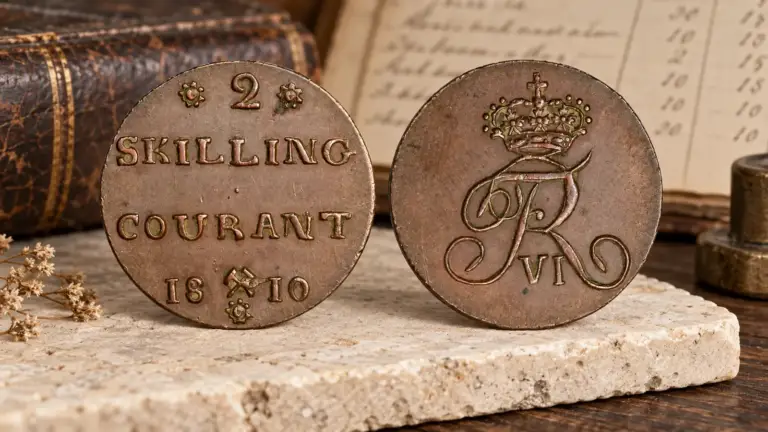
Before the krone, Norwegians counted in rigsdaler, speciedaler, mark and skilling. The Norwegian skilling was the small change, while the rigsdaler and speciedaler were the large silver coins. Under Danish rule 96 skilling made a rigsdaler; from 1816 one speciedaler was 120 skilling; and when Norway adopted the krone in 1874–1875, one speciedaler was converted to four kroner.
In short
- 1 mark = 16 skilling, and from 1625 1 rigsdaler = 6 mark = 96 skilling.
- “Specie” means the daler was an actual struck silver coin, not just a unit of account.
- From 1816 the speciedaler was Norway’s currency unit: 1 speciedaler = 5 ort = 120 skilling.
- At the changeover, 1 speciedaler = 4 kroner, so 1 krone = 30 skilling.
Contents
The system looks confusing because the ratios changed several times, and because there was both a “real” silver daler and a daler of account. Once you see the logic, it falls into place.
What was the Norwegian skilling?
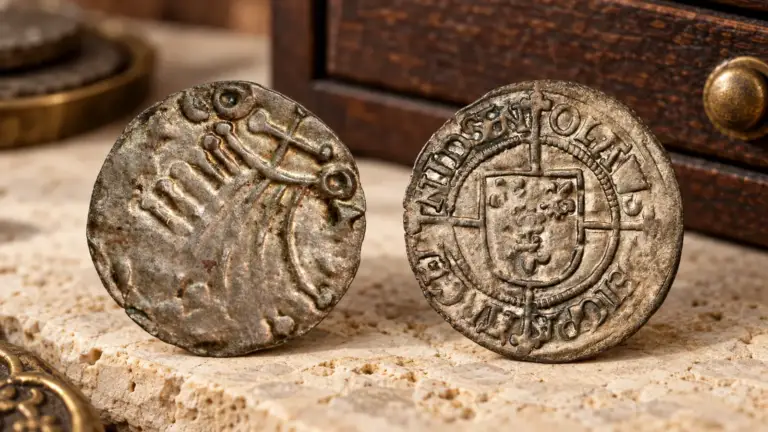
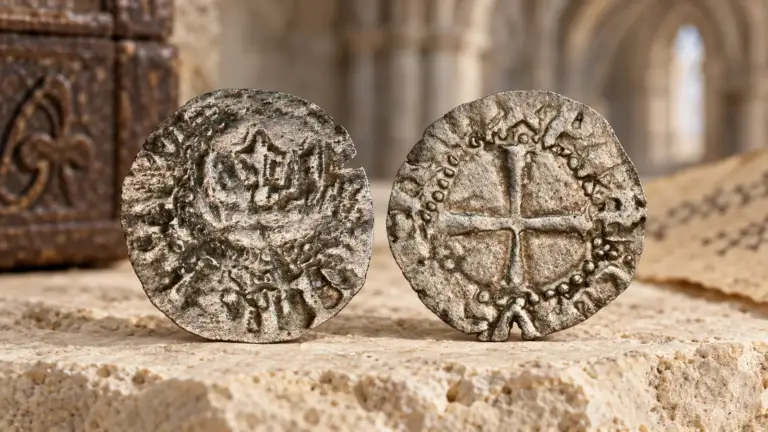
The skilling was a Nordic unit used for reckoning in Denmark and Norway from the late 14th century. It was first struck as a coin in Denmark in the 1440s, and the first Norwegian skillings were struck for King Hans in Bergen in the early 1500s. The archbishops of Nidaros (Trondheim) also struck skillings until the Reformation in 1537.
In the 15th century the skilling replaced the old Norse units øre and ertog, giving 1 mark = 16 skilling, a ratio that lasted for centuries. Skillings were struck in many denominations, from ½ skilling up to 24 skilling, and they were the everyday money most people actually handled.
Rigsdaler or speciedaler: what is the difference?
The daler takes its name from the German thaler, short for Joachimsthaler after the silver town of Joachimsthal in Bohemia; “dollar” comes from the same root. Denmark struck its first daler in 1537, and from 1544 it headed the coinage of Denmark-Norway. The first daler of Norwegian type is dated 1546, made from silver mined at Gullnes in Seljord.
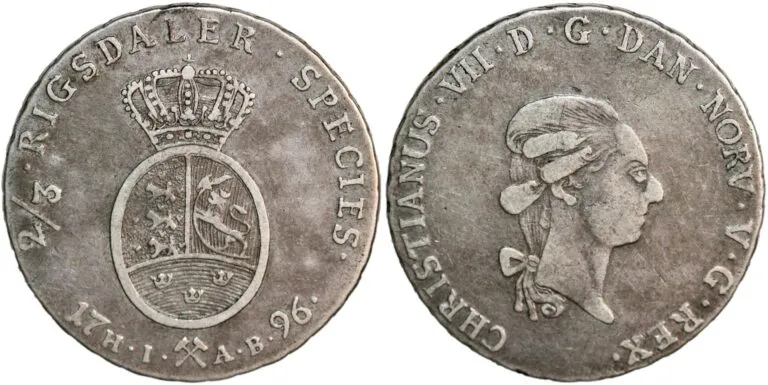
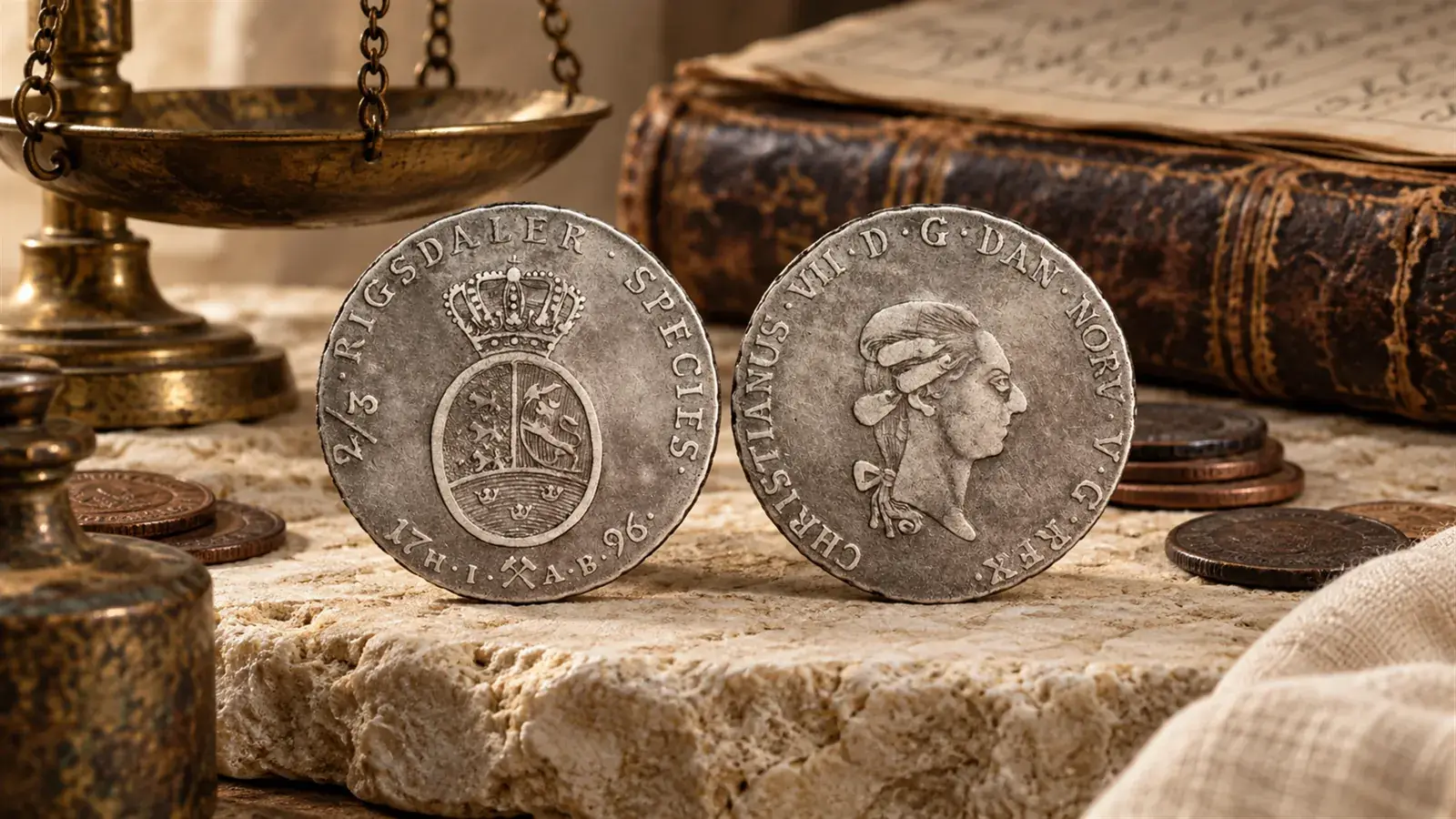
The speciedaler (rigsdaler specie) was the struck silver coin itself, a heavy piece with 25–26 grams of silver. In Norway it was first minted in Christiania in 1628, and from 1686 at Kongsberg. Denarius currently offers a 2/3 speciedaler of 1796 from the reign of Christian VII at NOK 8,500.
The rigsdaler courant was a daler of account worth 96 skilling, paid in small coins with less silver. As the small change was debased, a real speciedaler came to be worth more than 96 skilling. In the 1790s the ratio of speciedaler to courant was fixed at 5:4, so a speciedaler equalled 1¼ rigsdaler courant, or 120 skilling. That is why Norges Bank chose 120 skilling in 1816.
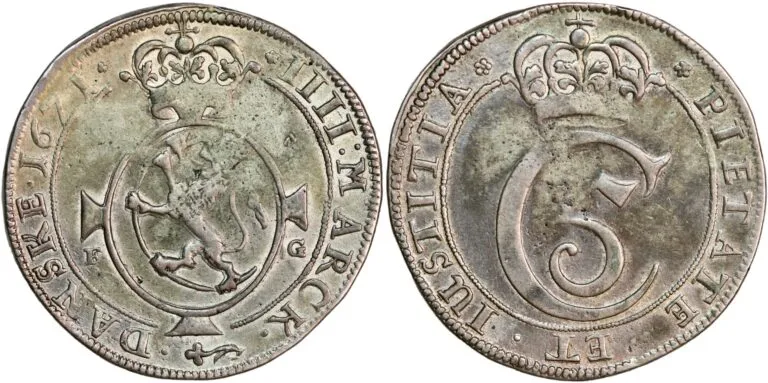
There was also a krone long before 1875. Christian IV introduced it as a unit in 1618, and from 1625 one krone was 4 mark = 64 skilling, or 2/3 of a rigsdaler. These coins are usually called 4 mark. A 4 mark of 1671 from the reign of Christian V is NOK 7,500 at Denarius at the time of writing.
How did the conversion rates change over time?
| Date | Ratio | Note |
|---|---|---|
| 15th century | 1 mark = 16 skilling | Skilling replaces øre and ertog |
| 1544 | 1 rigsdaler = 3 mark = 48 skilling | The daler heads the coinage of Denmark-Norway |
| 1625 | 1 rigsdaler = 4 ort = 6 mark = 96 skilling | 1 krone = 4 mark = 64 skilling |
| 1790s | 1 speciedaler = 1¼ rigsdaler courant = 120 skilling | 5:4 ratio fixed |
| 1813 | 1 rigsbankdaler = 6 mark = 96 rigsbank skilling | Counted as ½ speciedaler |
| 1816 | 1 speciedaler = 5 ort = 120 skilling | Norges Bank founded |
| 1874 | 1 speciedaler = 4 kroner | 1 krone = 30 skilling |
| 1875 | 1 krone = 100 øre | 1 skilling = 3⅓ øre |
So an ort was 24 skilling both before and after 1816: a quarter of a rigsdaler before, a fifth of a speciedaler after. That is why the 24 skilling is one of the most common larger silver coins of the era.
What happened to the rigsdaler in 1813?
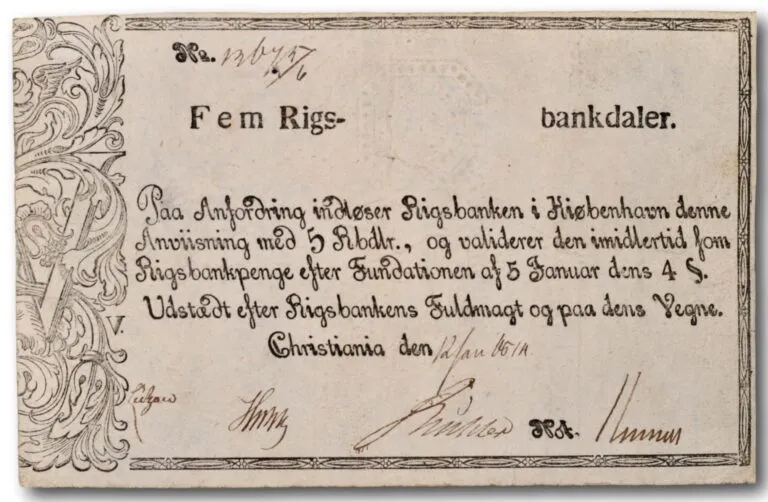
During the Napoleonic Wars the Danish-Norwegian state issued so much paper money that it lost most of its value. On 5 January 1813 a new Rigsbank was set up and the rigsbankdaler replaced the rigsdaler courant. Old notes could only be exchanged for new ones at 6 to 1, an episode often called the state bankruptcy. The rigsbankdaler was divided into 6 mark or 96 rigsbank skilling and was meant to equal half a speciedaler.
No rigsbankdaler coins were ever struck in Norway, and the new notes quickly lost value too. A note from these years, such as the 5 rigsbankdaler of 1814, is NOK 15,000 at Denarius at the time of writing.
Why did Norway adopt the speciedaler in 1816?
After 1814 Norway kept its own monetary system under the new constitution, and the acts establishing Norges Bank were sanctioned on 14 June 1816. The new unit was the speciedaler, divided into 120 skilling or 5 ort of 24 skilling. It kept the silver standard of the old rigsdaler specie: 9¼ speciedaler to a mark of fine silver (about 233.9 grams), or roughly 25 grams of silver per daler.
The bank needed a silver fund of 2 million speciedaler. Voluntary subscription failed, so the fund was raised through compulsory contributions, remembered as the “silver tax”. The bank’s head office was placed in Trondheim.
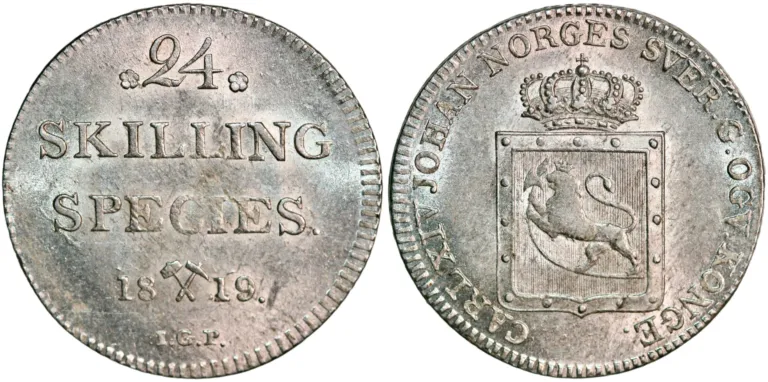
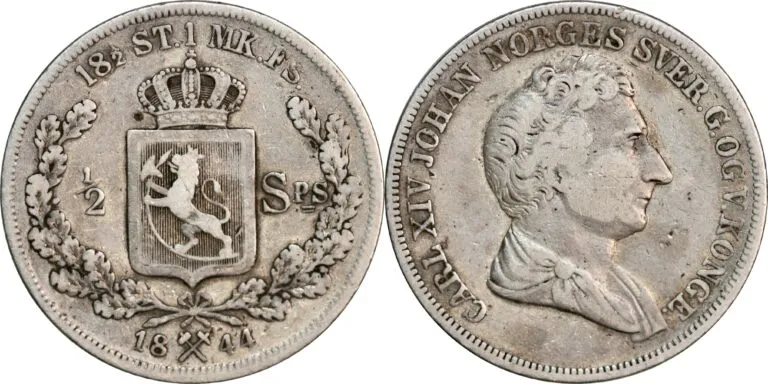
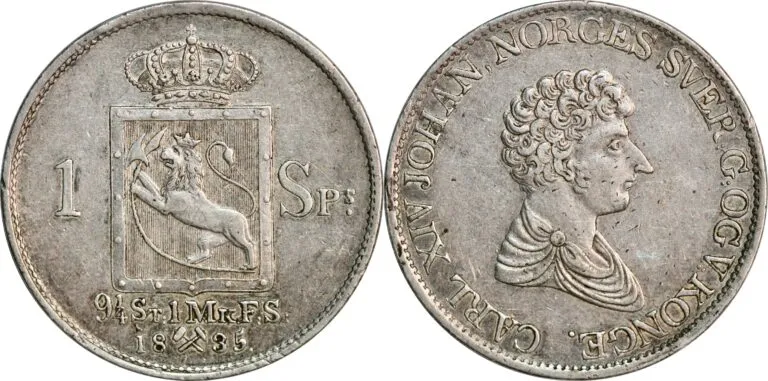
The coins were struck at Kongsberg. In 1816 only the 1 skilling was minted, but from 1819 came copper skillings, silver 8 and 24 skilling, and ½ and 1 speciedaler. At the time of writing Denarius offers a 24 skilling of 1819 at NOK 7,750, a ½ speciedaler of 1844 at NOK 4,500 and a speciedaler of 1835 at NOK 17,500.
How did Norway switch from speciedaler to krone?
The change came in steps. In May 1873 the Storting voted against joining Denmark and Sweden in their monetary union. Yet on 4 June 1873 Norway adopted a gold standard with the krone as its unit, and from 1 January 1874 the speciedaler was divided into 4 kroner instead of 5 ort.
The monetary law of 17 April 1875 cut the link to the speciedaler for good: the krone of 100 øre became the basis of the currency. On 16 October 1875 Norway joined the Scandinavian Monetary Union. One krone was 30 skilling, so one skilling was 3⅓ øre.
To ease the transition, several coins carried both denominations. Well-known examples are the 10 øre/3 skilling and 50 øre/15 skilling of 1874–1875, the 1 krone/30 skilling of 1875, and the gold 10 kroner/2½ speciedaler and 20 kroner/5 speciedaler of 1874. Collectors prize them as transitional pieces.
Which coin types are best known?
- The speciedaler, the large silver coin with about 25 grams of silver, is the centrepiece of any collection from the period.
- The 24 skilling (ort) was a widely used silver coin both before and after 1816.
- The 4 mark, or krone, of the 17th century is an early, large silver coin from the Christiania mint and later Kongsberg.
- Small skillings such as the copper 1 and 2 skilling are affordable and a good place to start.
- The transitional coins of 1874–1875 with both skilling and krone values.
As always, value depends on date, scarcity and condition. Two coins of the same year can differ greatly in price depending on how well preserved they are.
Frequently asked questions
How much was a speciedaler worth in kroner?
One speciedaler was converted to 4 kroner when Norway adopted the krone. The rate applied from 1 January 1874 and was carried into the monetary law of 17 April 1875. One krone therefore equalled 30 skilling.
How many skilling were in a speciedaler?
From 1816, 1 speciedaler = 5 ort = 120 skilling. In the decades before, a speciedaler was also worth 120 skilling in courant money, while the rigsdaler courant of account was 96 skilling.
What is the difference between a rigsdaler and a speciedaler?
The speciedaler, or rigsdaler specie, was the struck silver coin with about 25 grams of silver. The rigsdaler courant was a unit of account worth 96 skilling in lower-grade small change. In the 1790s the ratio was fixed at 5:4, so one speciedaler equalled 1¼ rigsdaler courant.
What does “specie” mean in speciedaler?
“Specie” refers to coined money: the daler existed as an actual silver coin. That set it apart from the courant daler, a unit of account paid in poorer small coins.
When did Norway stop using the skilling?
The krone was introduced from 1 January 1874, and the law of 17 April 1875 made the krone and øre the basis of the currency. During the changeover some coins showed both values, such as the 50 øre/15 skilling.
Was the Norwegian skilling the same as the Danish skilling?
Before 1814 Norway and Denmark shared one system, so the skilling was common to both. Afterwards they went separate ways: Norway counted 120 skilling to the speciedaler from 1816, while Denmark used its own rigsbankdaler and later rigsdaler until both countries adopted the krone.
Want to hold this history in your hand? Browse skillings, marks and dalers in Norway before 1814, speciedaler and skilling coins of the union kings in Norway 1814–1874, and early paper money among our Norwegian banknotes.