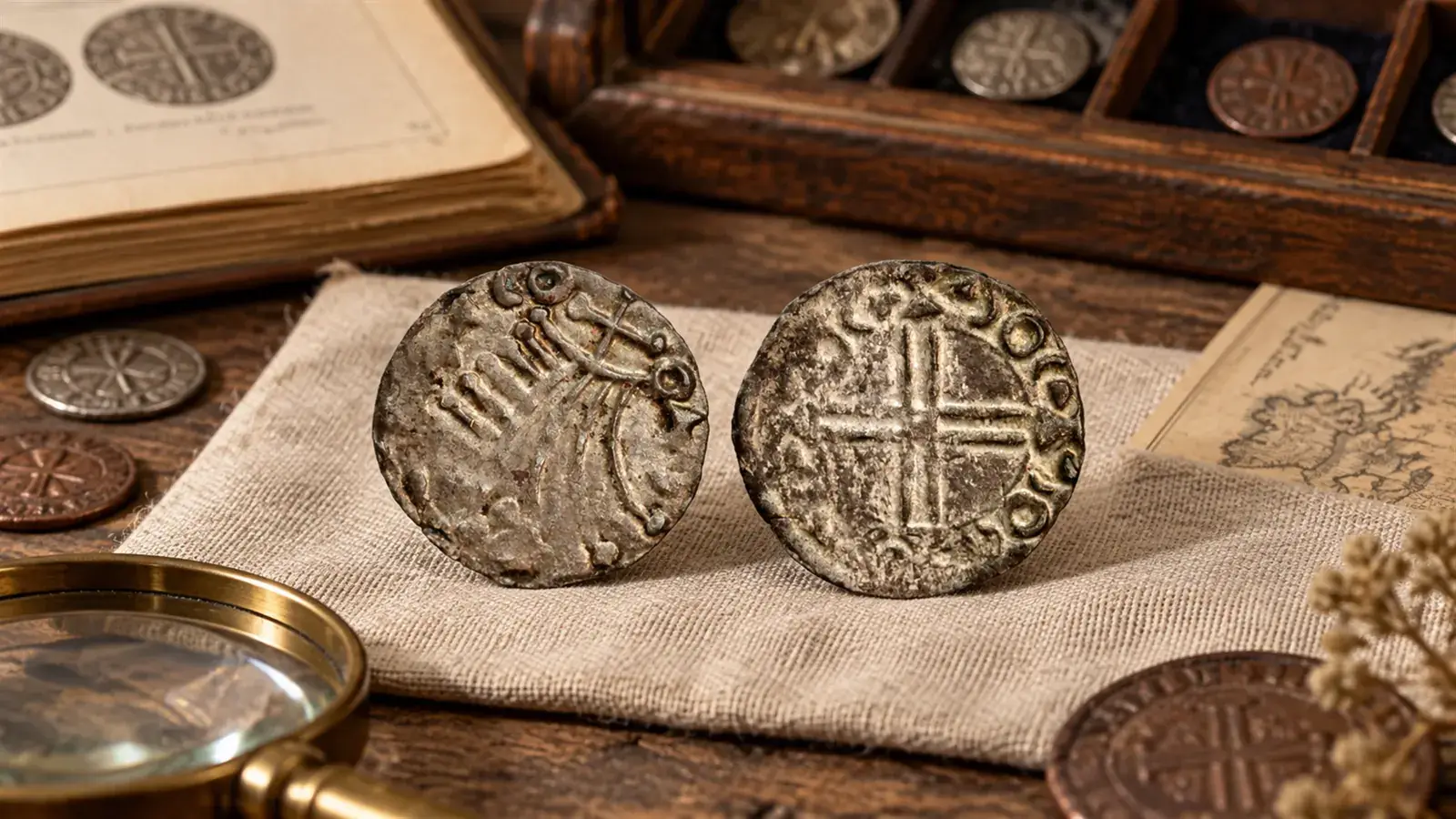
Norwegian coins cover more than a thousand years, from the first silver pennies struck around AD 1000 to the krone in use today. Collectors usually divide them into four periods: the Middle Ages, the Danish-Norwegian era before 1814, the speciedaler and skilling years from 1814 to 1874, and the krone era from 1875. The best way to start collecting Norwegian coins is to pick one period or denomination, get a good catalogue and buy fewer, better-preserved pieces.
In short
- Norway’s first coin, a silver penny, was struck for King Olav Tryggvason between 995 and 1000.
- Coins were struck in Christiania (Oslo) from 1628 and at the Royal Mint in Kongsberg from 1686.
- From 1816 the national unit was the speciedaler, divided into 120 skilling.
- The krone arrived in 1874–1875, with one speciedaler converted to four kroner.
- Norwegian dealers grade coins on their own scale, where 0 means uncirculated.
Contents
What are the main periods of Norway coins?
The periods follow the big turns in Norwegian history: who was king, where the coins were made and which money system applied. Most catalogues and dealers, including our shop, sort Norway coins this way.
The Middle Ages (c. 995–1537)
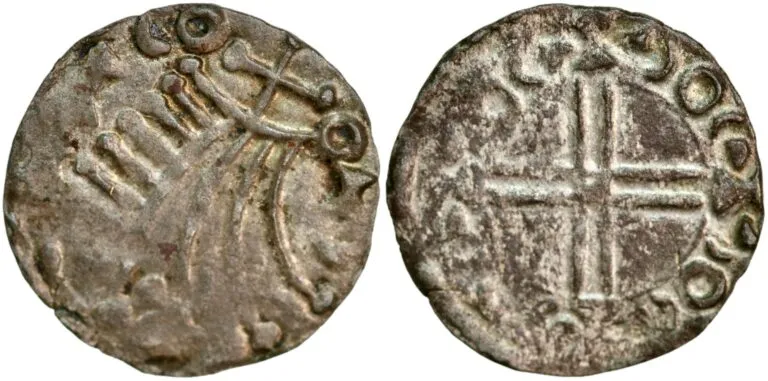
The first Norwegian penny was struck for Olav Tryggvason between 995 and 1000, in almost pure silver. Harald Hardrada (1046–1066) built a national coinage but also cut the silver content to about a third. Latin sources of the time call the penny a denarius.
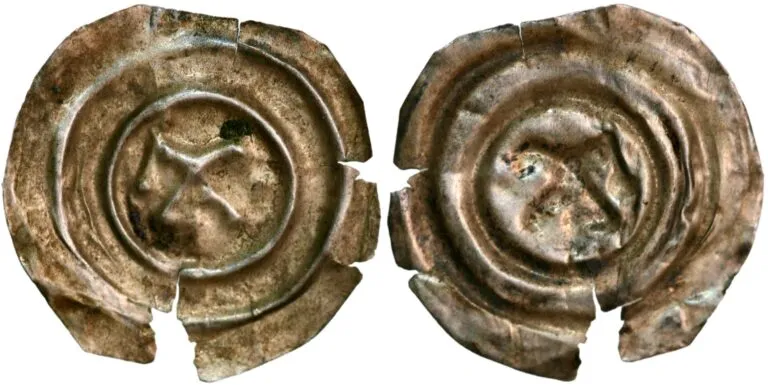
Medieval mints worked in Oslo, Bergen and Nidaros (Trondheim), and for a time in places such as Hamar and Tønsberg. From the 12th century came bracteates: thin, one-sided silver coins. Towards the end of the period the archbishops of Nidaros struck their own coins. Archbishop Erik Valkendorf was the first to put a date on Norwegian coins, on skillings of 1518 and 1519, and the archbishops’ minting ended with the Reformation in 1537.
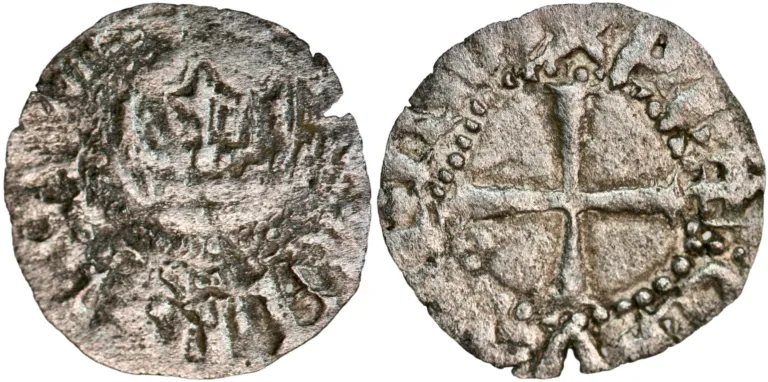
Medieval Norwegian coins are small and often scarce. At the time of writing, Denarius offers a penny from 1066–1093 at NOK 39,750 and a bracteate from 1177–1202 at NOK 8,750.
The Danish-Norwegian era (1537–1814)
From 1537 Norway shared a king and a currency with Denmark, reckoned in rigsdaler, mark and skilling. Much of the coin circulating in Norway was struck in Copenhagen. After silver was found at Kongsberg in 1623, Norway got its own mint in Christiania in 1628. In 1686 the Royal Mint was founded at Kongsberg, close to the silver mines, and the Christiania mint closed in 1695.
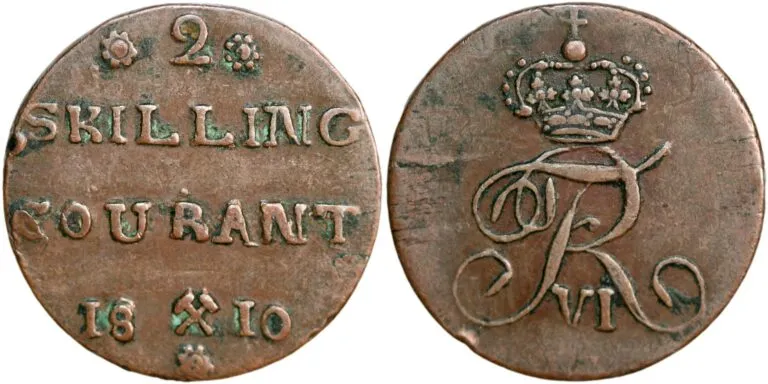
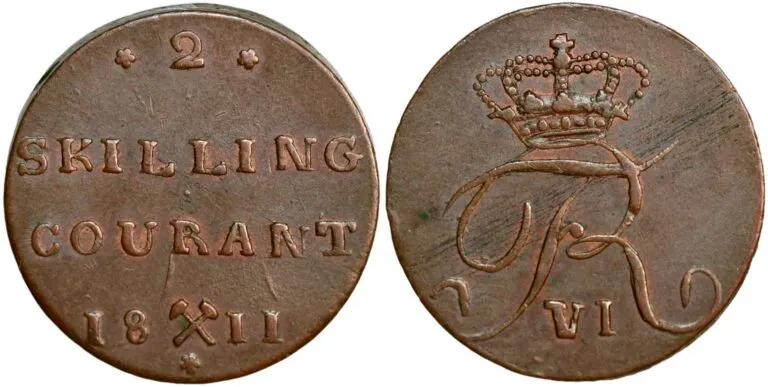
The kings you will meet on these coins are Christian IV, Frederik III, Christian V, Frederik IV, Christian VI, Frederik V, Christian VII and Frederik VI. Collecting by king is a tidy way to build a set. Small change of Frederik VI is an affordable start: a 2 skilling 1810 is NOK 350 at Denarius at the time of writing.
Speciedaler and skilling (1814–1874)
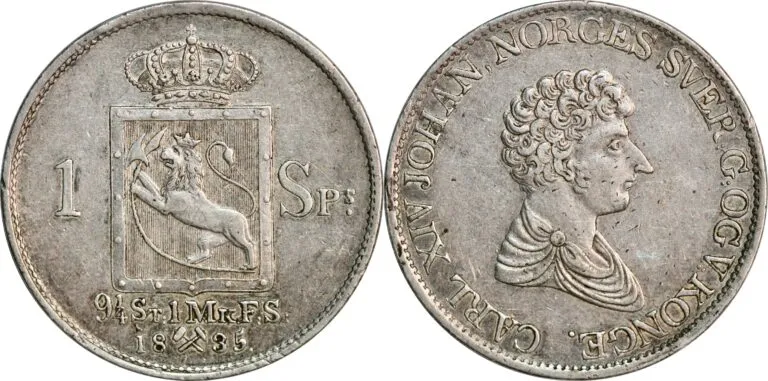
After 1814 Norway got its own monetary system, and Norges Bank, the central bank, was founded in 1816. The unit was the speciedaler, divided into 5 ort or 120 skilling. Coins were struck at Kongsberg and carry the names or portraits of the union kings Carl XIII, Carl XIV Johan, Oscar I and Carl XV.
This period is popular because it is compact and well documented, and it ranges from inexpensive skillings to large silver dalers. A speciedaler of 1835 from the reign of Carl XIV Johan is NOK 17,500 at Denarius at the time of writing.
The krone era (from 1875)
From 1 January 1874 Norway moved to a gold standard with the krone as its unit, and the law of 17 April 1875 made the krone of 100 øre the basis of the currency. In October 1875 Norway joined the Scandinavian Monetary Union. During the changeover some coins carried both denominations, such as the 1 krone/30 skilling of 1875.
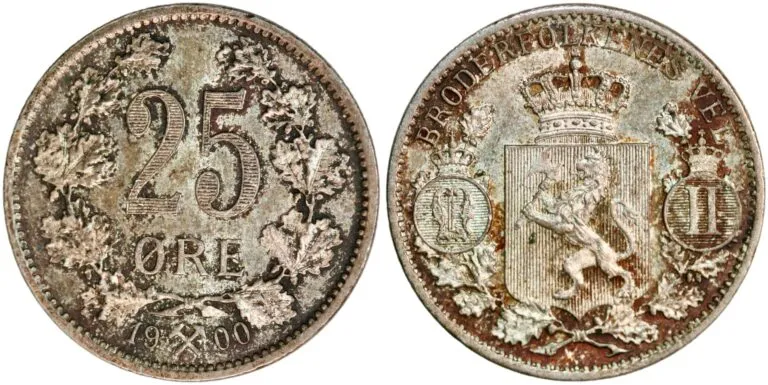
The early krone coins were silver. Cupronickel took over in the 1920s, and during the world wars cheaper metals such as iron and zinc were used. The krone era is a good place to begin, as many dates are still affordable while the best-preserved examples can be valuable. A 25 øre 1900 in beautiful condition is NOK 7,500 at Denarius at the time of writing.
How do you start collecting Norwegian coins?
Most long-term collectors end up with a theme. It makes the collection more meaningful and makes gaps easy to spot.
- Choose a theme. One king, one denomination (2 skilling, say), one period, or a date run of the 1 krone.
- Buy the catalogue first. You will know which dates and varieties exist and which are scarce.
- Put quality before quantity. One well-preserved coin usually holds its value better than several worn ones.
- Buy from sellers who guarantee authenticity. Copies and forgeries exist, especially of rare pieces.
- Keep a simple record of what you own, where you bought it and what you paid.
At Denarius every object is examined, photographed, described and given its own protocol number, and we guarantee that everything we sell is genuine and as described. We ship worldwide.
How are Norwegian coins graded?
Norwegian catalogues and dealers use a numeric scale instead of the English abbreviations. This is roughly how the steps line up:
| Norwegian grade | Meaning | Approx. international |
|---|---|---|
| 0 | Uncirculated, no wear | UNC |
| 0/01 | Almost uncirculated, only light cabinet friction | AU |
| 01 | Light wear on the high points | EF/XF |
| 1+ | Clearly circulated, but no significant wear | VF |
| 1 | Noticeable wear, all letters and numbers legible | F |
| 1- | Heavily worn but identifiable | VG |
| 2 | Poor | G |
In-between grades such as 1+/01 and 1/1+ are common. Grading always involves judgement, and boundaries vary between catalogues and sellers. Grade matters a lot: the same date can cost many times more in 0 than in 1.
How should you store old coins?
- Hold coins by the edge, never by the faces. Skin oils can leave marks.
- Do not clean or polish coins. Cleaning strips the natural surface, leaves hairlines and lowers the value.
- Use PVC-free flips, capsules or coin trays. Soft PVC can leave a green film over time.
- Keep the collection dry at a steady temperature. Attics and basements are poor choices.
- Avoid rubber bands and ordinary paper, which can tarnish silver.
Which catalogues cover Norwegian coins?
The standard reference is Norges Mynter by Ahlström, Brekke and Hemmingsson (1976), and many dealers still quote its “Brekke numbers”. Bjørn R. Rønning’s Norges mynter 1628–1873 (1971) and Kolbjørn Skaare’s Norges mynthistorie (1995) go deeper into the history. They are in Norwegian, but the catalogue sections are easy to follow. Online, Numista is a useful starting point in English, and the Coin Cabinet at the Museum of Cultural History in Oslo publishes material on Norwegian coin issuers.
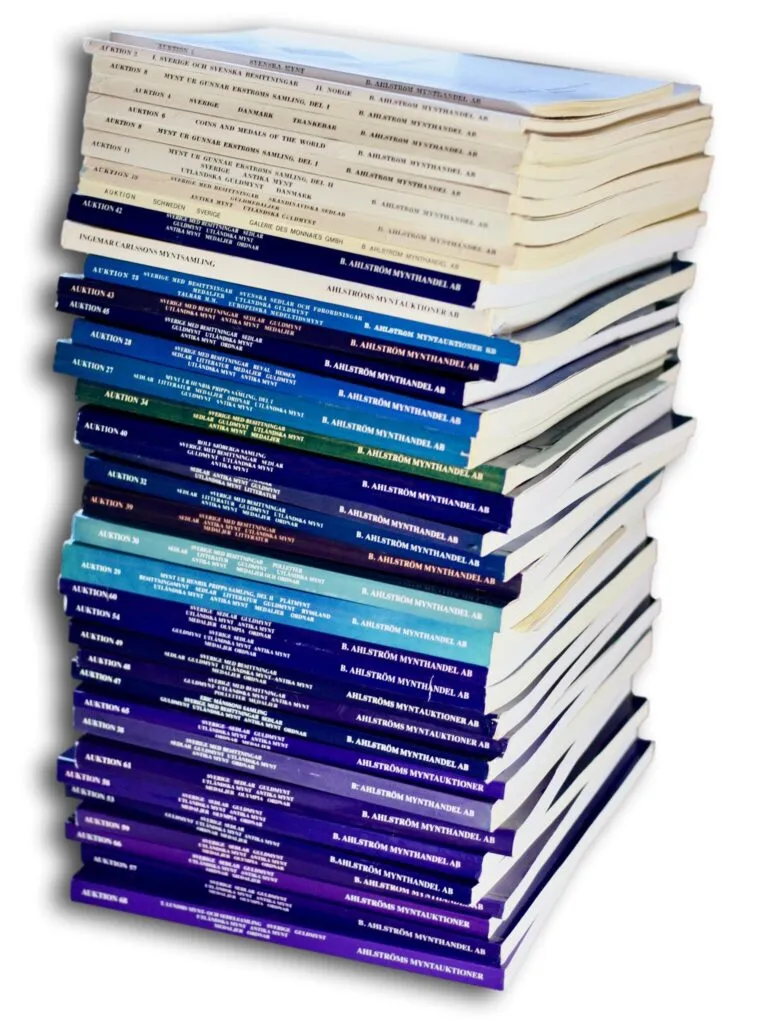
The Norwegian Numismatic Society (Norsk Numismatisk Forening), founded in 1927, publishes a journal four times a year. Old auction catalogues are also valuable for varieties and provenance; Denarius has auction catalogues from Ahlström Mynthandel at NOK 1,750 at the time of writing.
Frequently asked questions
What is the oldest Norwegian coin?
The oldest Norwegian coin is a silver penny struck for King Olav Tryggvason between 995 and 1000. It was made of almost pure silver and is very rare. Pennies became more common under Harald Hardrada, but with far less silver.
Where were Norwegian coins minted?
In the Middle Ages coins were struck in Oslo, Bergen and Nidaros, among other places. In the Danish-Norwegian era much coin came from Copenhagen, while Norway had its own mint in Christiania from 1628 to 1695. Since 1686 Norwegian coins have been struck at Kongsberg.
When did Norway switch from skilling to krone?
The krone was introduced from 1 January 1874, and the law of 17 April 1875 made the krone of 100 øre the basis of the currency. One speciedaler, worth 120 skilling, was converted to four kroner.
What do the grades 0, 01 and 1+ mean on Norwegian coins?
They are steps on the Norwegian grading scale. 0 means uncirculated, 01 roughly extremely fine and 1+ roughly very fine. The scale continues with 1, 1- and 2 for increasingly worn coins.
Should I clean old coins?
No. Cleaning removes the natural surface, leaves fine scratches and almost always reduces collector value. Store coins dry in PVC-free flips or capsules and handle them by the edge.
How do I start collecting Norwegian coins?
Choose a clear theme, such as one king, one denomination or one period, and get a catalogue so you know what exists. Buy fewer coins in good condition rather than many worn ones, from sellers who guarantee authenticity.
Ready to look at real examples? Browse Norway before 1814, Norway 1814–1874 and Norway after 1874. Every coin is described and photographed, so you can judge the condition for yourself.