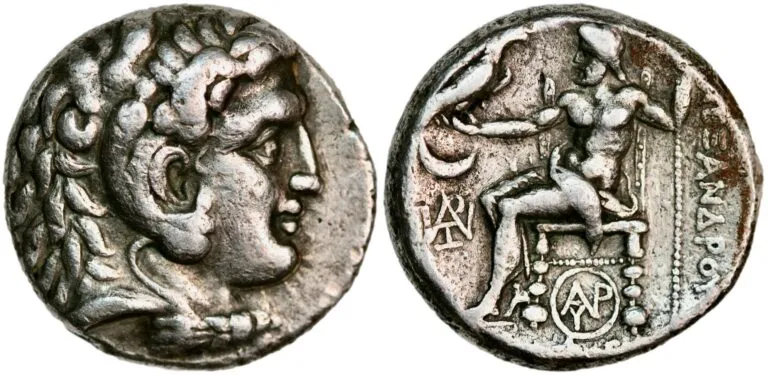
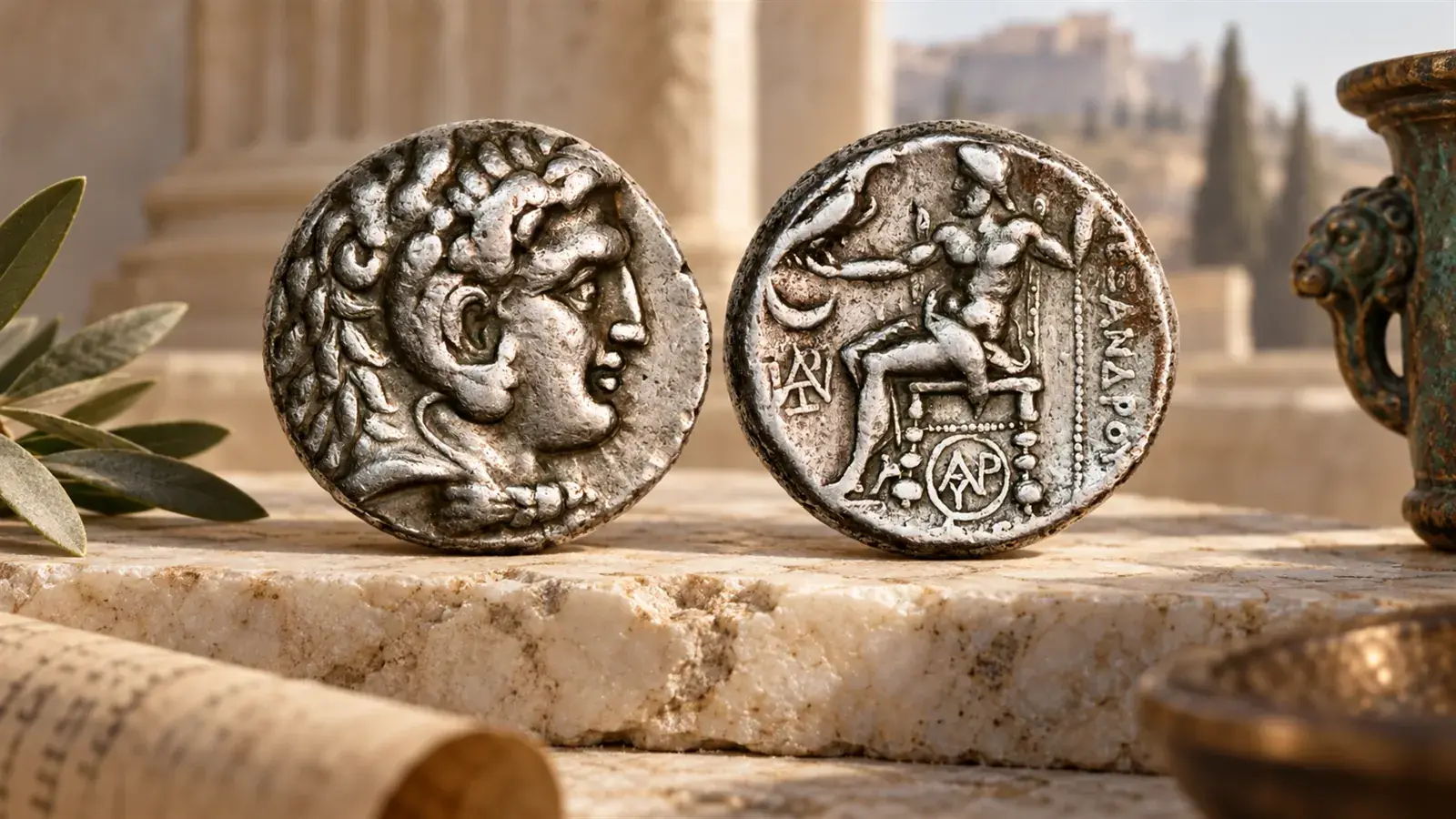
An Alexander the Great coin is, for most collectors, a silver tetradrachm with the head of Herakles wearing a lion skin on one side and Zeus seated on a throne, holding an eagle, on the other. These coins were struck in enormous numbers at mints from Macedonia to Babylon, and the cities and kings that followed kept striking them in his name for more than two centuries after his death in 323 BC. That is why a genuine coin of Alexander is still within reach for most collectors.
In short:
- Alexander III of Macedon (356–323 BC) became king in 336 BC and conquered the Persian Empire.
- His main silver coin was the tetradrachm of about 17.2 g on the Attic standard. The drachm, a quarter of it, weighed about 4.2 g.
- The standard types are Herakles in a lion skin and Zeus enthroned with an eagle, with the legend ΑΛΕΞΑΝΔΡΟΥ, “of Alexander”.
- Most surviving coins are posthumous. Among the tetradrachms illustrated in the standard catalogue by Martin Price, about seven in ten were struck after Alexander’s death.
- A common posthumous tetradrachm in Very Fine condition typically sells for a few hundred US dollars at auction. Well-preserved lifetime issues cost more.
Contents
Who was Alexander the Great?
Alexander was born in Pella in Macedonia in 356 BC, the son of King Philip II and Olympias. He became king in 336 BC, at the age of twenty. Within a few years he had defeated the Persians at the Granikos (334 BC), at Issos (333 BC) and at Gaugamela (331 BC), taken Egypt, Babylon and Persepolis, and led his army as far as the Indus. He died in Babylon in 323 BC, only 32 years old.
The coinage that bears his name followed his conquests and spread across much of the known world.
What does an Alexander the Great tetradrachm look like?
The obverse shows the young, beardless hero Herakles wearing the skin of the lion he killed in his first labour, with the lion’s head worn over his own like a helmet. The choice was not random: the Macedonian royal house, the Argeads, claimed descent from Herakles.
The reverse shows Zeus seated on a throne, holding an eagle on his outstretched right hand and a sceptre in his left. Beside him runs the legend ΑΛΕΞΑΝΔΡΟΥ (“of Alexander”) and, on many coins, ΒΑΣΙΛΕΩΣ ΑΛΕΞΑΝΔΡΟΥ (“of King Alexander”). Small symbols and monograms in the field identify the mint and the issue.
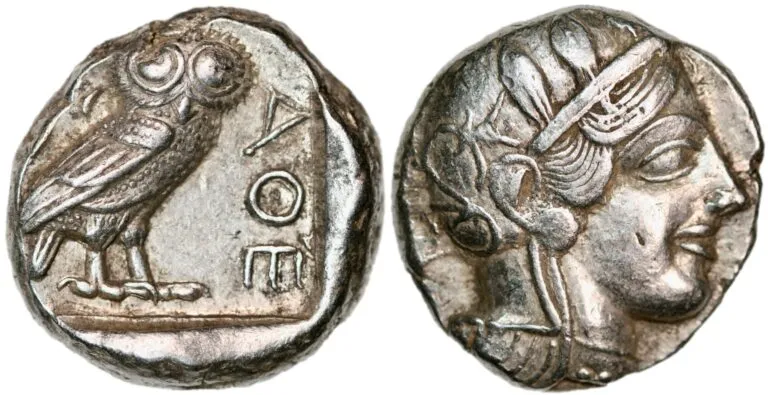
The tetradrachms were struck on the Attic weight standard, and they soon replaced the Athenian “owls” as the most widely circulated coins in the ancient world.
Is Herakles a portrait of Alexander?
It is a popular idea, but most scholars reject it. The same Herakles head appears on earlier Macedonian coins, including those of his father Philip II. Real portraits of Alexander appear only after his death, for example on coins of Ptolemy I in Egypt, with an elephant scalp, and on the tetradrachms of Lysimachos, with the ram’s horn of Zeus Ammon.
Where were Alexander’s coins minted?
During his lifetime, tetradrachms were struck in some 25 cities, seven in Europe, seventeen in Asia and one in Africa. The most productive lifetime mints were Babylon, Amphipolis, Pella, Tarsos and Arados. One of the early mints was Tarsos in Cilicia, which Alexander took in 333 BC.
After his death the number grew dramatically. Counting all the later issuers, coins of Alexander’s type were struck in more than a hundred cities. The standard reference is Martin Price, The Coinage in the Name of Alexander the Great and Philip Arrhidaeus (1991), and dealers usually quote a “Price number” to identify the exact mint and issue.
Lifetime or posthumous: why does it matter for value?
When Alexander died, his generals divided the empire, but nobody wanted to give up a coin that everyone trusted. Ptolemy in Egypt, Seleukos in the east and many cities went on striking tetradrachms with Herakles, Zeus and Alexander’s name. Some cities on the Black Sea, such as Mesembria and Odessos, struck them as late as around 65 BC, and some mints in Asia Minor kept making Alexander drachms until about 170 BC.
Collectors generally pay a premium for lifetime issues, all else being equal. A posthumous coin is still a real Alexander-type coin from antiquity, and often a fine one. It simply was not struck while he was alive. Identifying lifetime coins takes care. These are the usual clues, none of them conclusive on its own:
- Zeus’ legs. Open legs are typical of early coins, crossed legs of later ones. But crossed legs already appear in Egypt around 326/325 BC, and open legs continue after 323 BC.
- The royal title. Coins without ΒΑΣΙΛΕΩΣ and with open legs are more likely to be lifetime issues. Crossed legs together with the title make a lifetime date very unlikely.
- Flan size. Typical lifetime flans measure 25–26 mm. Coins on flans over 30 mm are all posthumous.
- Throne ornaments. Small figures on the throne, such as a Nike, only appear on posthumous coins.
Be aware that many listings put Alexander’s reign, 336–323 BC, in the title. Read the description to see when and where the coin was actually struck. At Denarius, for example, a tetradrachm in Alexander’s name struck at Karrhai under Seleukos I, ca. 310–290 BC (Price 3816, 16.8 g, Very Fine) costs NOK 4,750 at the time of writing (protocol no. 6256).
Drachm vs. tetradrachm: what is the difference?
A tetradrachm is four drachms. Alexander’s tetradrachm weighs about 17.2 g and is the coin most people picture. The drachm weighs about 4.2 g and is noticeably smaller.
The two denominations have different geographies. About 94 per cent of the Alexander drachms illustrated by Price come from Asia Minor, with Kolophon, Lampsakos, Magnesia, Sardes and Abydos as the most productive mints. Drachms are also even more often posthumous than tetradrachms: roughly 86 per cent, against about 72 per cent for tetradrachms. Price illustrated 1,269 tetradrachms and 434 drachms.
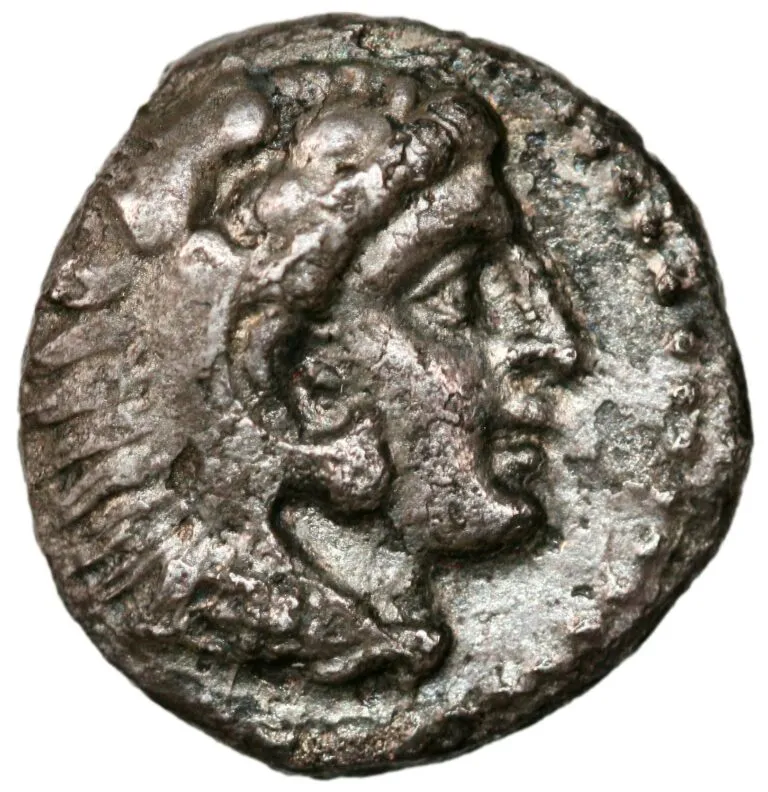
There are smaller fractions too. A hemidrachm struck in Babylonia under Seleukos, 318–316 BC (1.85 g, Fine to Very Fine) costs NOK 1,600 at Denarius at the time of writing (protocol no. 4106).
What determines the price of an Alexander the Great coin?
- Lifetime or posthumous. Lifetime issues from the main Macedonian and Asian mints carry a premium.
- Mint and issue. Some Price numbers are common, others rare. A rare mint can matter more than the date.
- Condition. Look at the hair of the lion skin, Herakles’ face and the details of Zeus and the eagle. Wear here lowers the price quickly.
- Centring and strike. A complete legend and a well-centred, well-struck coin are worth more.
- Surface and marks. Smooth, original surfaces are preferred. Test cuts and countermarks show the coin was checked in circulation; they tell you about its history, not its date.
- Imitations. Alexander’s types were also copied by peoples outside the Greek world. Such ancient imitations are a collecting field of their own and are priced differently from official issues.
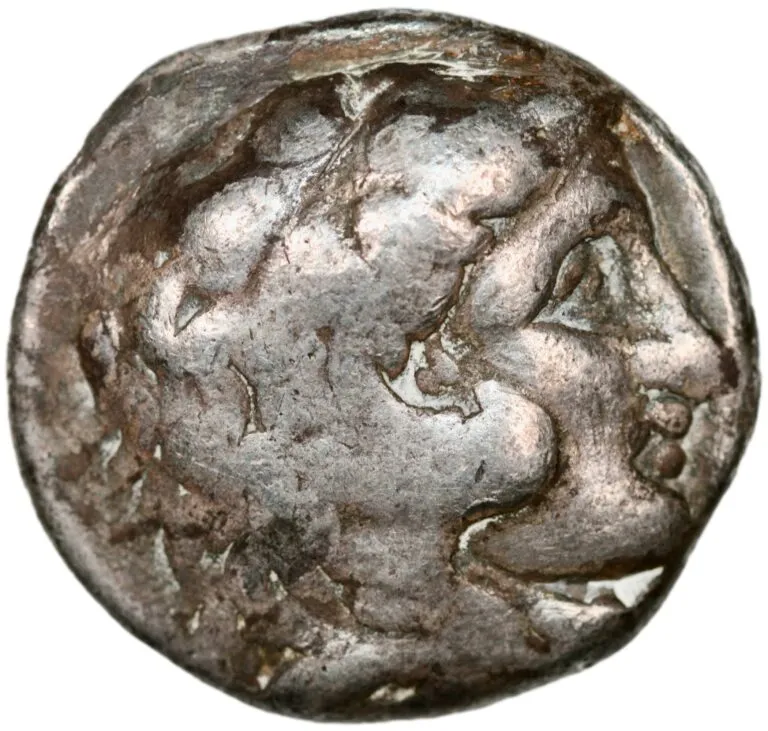
An example of the last point: a tetradrachm in the style of Alexander, possibly a Celtic imitation (16.51 g, Fine, with an old collection ticket), costs NOK 1,950 at Denarius (protocol no. 1328).
How much is an Alexander the Great tetradrachm worth?
Indicative levels as of October 2026, based on published auction results:
| Coin | Condition | Indicative price |
|---|---|---|
| Early posthumous tetradrachm, Amphipolis | Very Fine (1+) | about USD 320–870 at auction, occasionally over USD 1,000 |
| Lifetime tetradrachm, Amphipolis, ca. 325–323 BC | Extremely Fine (01) | example sold for USD 1,450 (CNG) |
| Posthumous tetradrachm, Karrhai (Denarius, no. 6256) | Very Fine (1+) | NOK 4,750 |
| Hemidrachm, Babylonia (Denarius, no. 4106) | Fine to Very Fine (1/1+) | NOK 1,600 |
Auction prices are usually quoted before the buyer’s premium, and the spread is wide: mint, style, centring and surfaces can make a big difference between two coins in the same grade.
Coins from Alexander’s world
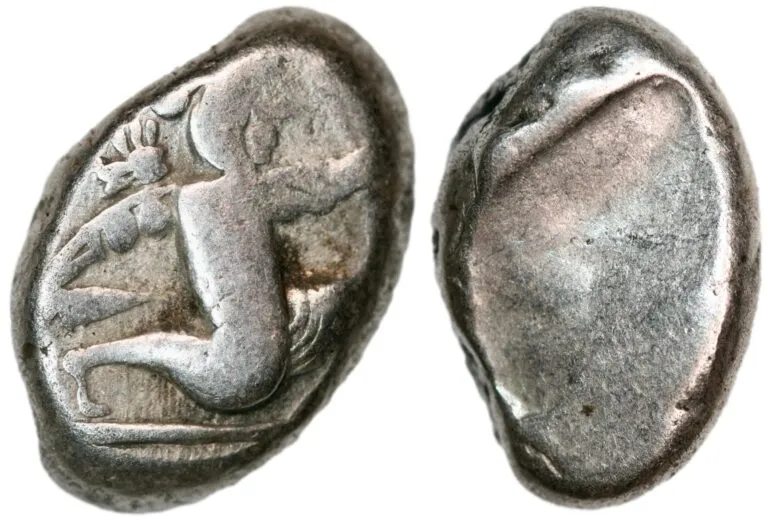
Alexander’s coins make even more sense next to the coins he replaced. The Athenian owl tetradrachm, ca. 454–404 BC (NOK 11,950, protocol no. 5829) was the dominant trade coin before him. The Persian siglos of the Achaemenid kings, ca. 455–420 BC (NOK 1,050, protocol no. 5685) is a coin of the empire he conquered.
Frequently asked questions
How can I tell if an Alexander the Great coin is a lifetime issue?
Look at several features together: open legs on Zeus, no royal title ΒΑΣΙΛΕΩΣ, and a flan around 25–26 mm point towards a lifetime issue. Crossed legs with the title, flans over 30 mm and ornaments on the throne point to a posthumous coin. The safest answer comes from the mint marks and the Price number.
How much is an Alexander the Great tetradrachm worth?
A common early posthumous tetradrachm in Very Fine condition has typically sold for about USD 320–870 at auction, sometimes more. Lifetime issues in high grade cost more; one Extremely Fine lifetime coin from Amphipolis sold for USD 1,450 at CNG.
Does an Alexander the Great coin show his face?
Usually not. The head on his own coins is the hero Herakles, a type used on earlier Macedonian coins as well. Real portraits of Alexander appear after his death, on coins of Ptolemy I and Lysimachos.
What does the inscription on Alexander’s coins mean?
ΑΛΕΞΑΝΔΡΟΥ means “of Alexander”, that is, the coin of Alexander. Many coins add ΒΑΣΙΛΕΩΣ, so that the legend reads “of King Alexander”. Small symbols and monograms in the field identify the mint and the issue.
What is the difference between a drachm and a tetradrachm?
A tetradrachm is worth four drachms and weighs about 17.2 g, while a drachm weighs about 4.2 g. Alexander’s drachms were struck mostly in Asia Minor, and the large majority of them are posthumous.
Would you like an Alexander coin, or a coin from the world he changed? Browse our Greek coins and the wider Greek & Roman section. Every object is examined, photographed and described, has its own protocol number, and is guaranteed genuine.