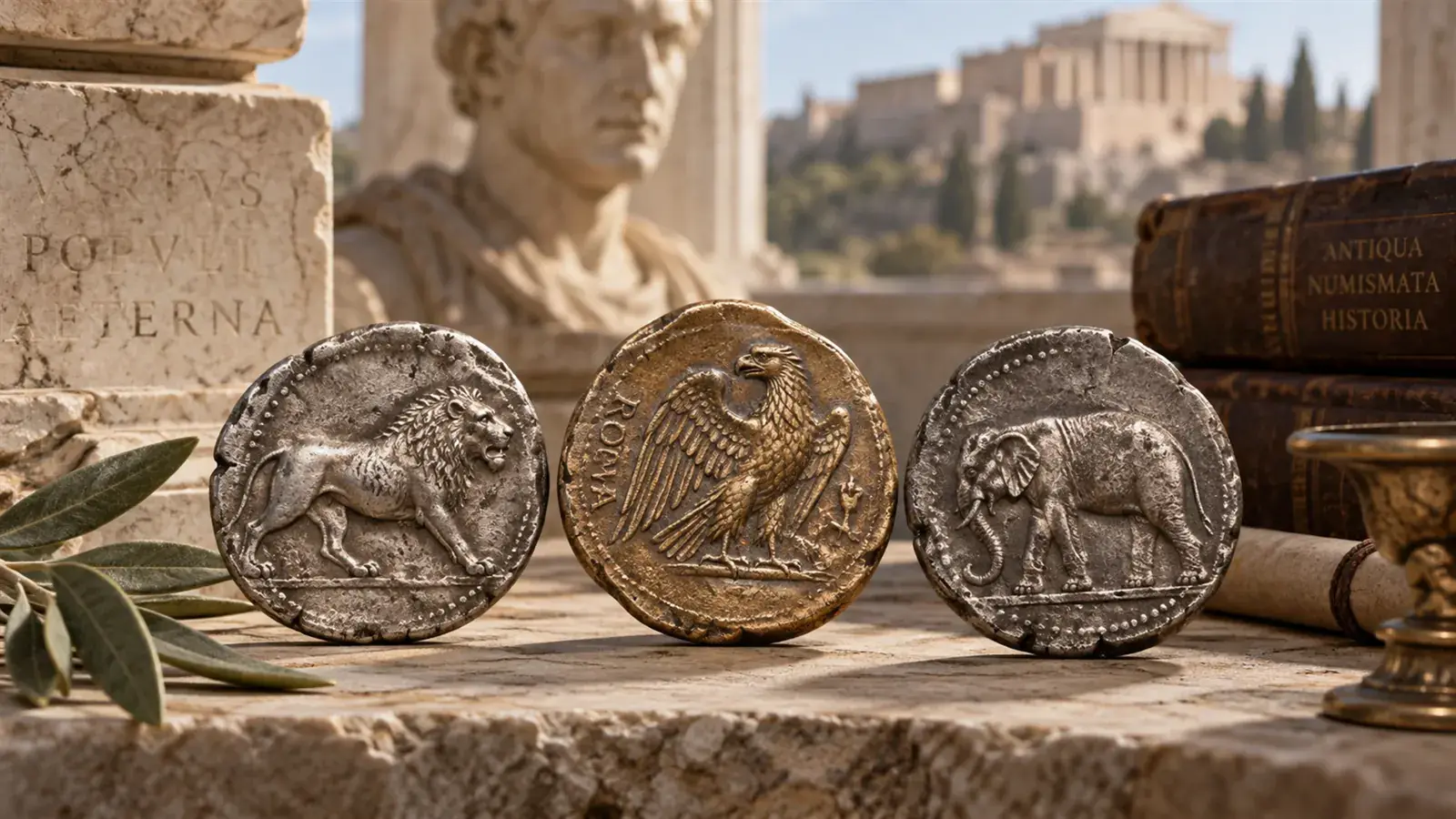
Animals on coins are as old as coinage itself. Since the first coins were struck around 600 BC, an enormous number of animal motifs have appeared on them, and no creature has been too small or too large. Even the little honeybee got its own coin in Norway under King Olav V, while elephants and even giraffes have reigned at the other end of the scale.
Contents
The animals chosen for coins have usually served as symbols of the issuing state’s sovereignty and power. To show this, rulers have struck coins with the lion, the eagle, the horse and the elephant. Here are the stories behind four of the most important animals on coins.
The lion: the oldest of all animals on coins
The lion has always been a sign of royal power, sovereignty and wealth. It is one of the most popular coin motifs in world history, and the world’s very first coins in fact bore a lion. These early coins, struck under King Alyattes of Lydia in present-day Turkey around 600 BC, showed a lion decorated with a rosette. The lion was a symbol of the rich and mighty kingdom of Lydia.
The rosette on the lion’s snout has been linked to the king, as it has been taken to mark the lion as royal property. Some of Alyattes’ electrum coins also carried an inscription, which has made it easier to identify him as the issuer and the city of Sardis as the mint.
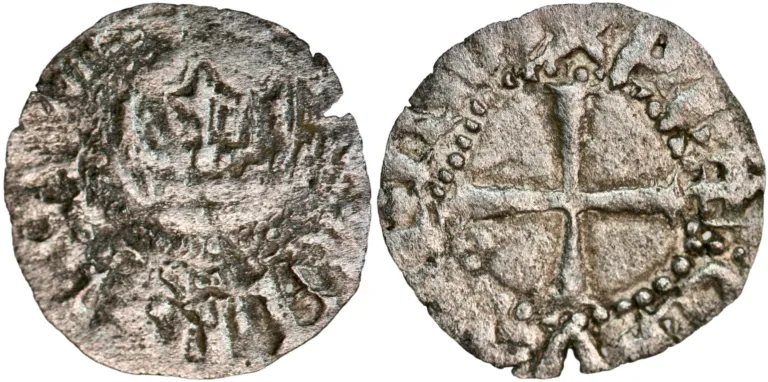
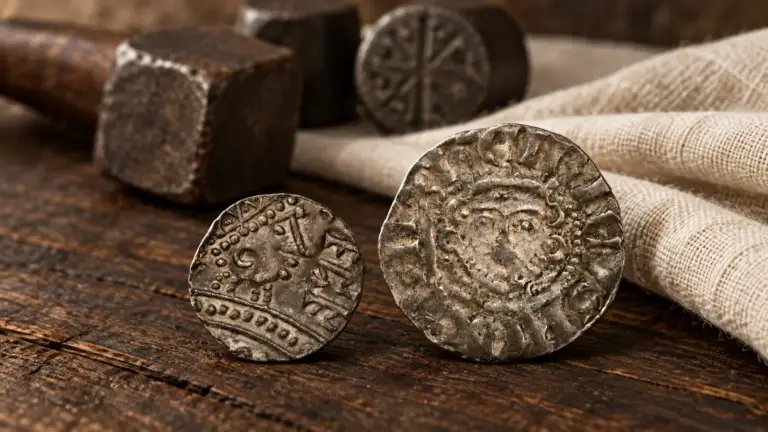
The lion has also dominated Norwegian coins ever since King Eirik Magnusson issued Norway’s first coin with the Norwegian coat of arms in 1285. The lion of the Norwegian arms is regarded as a metaphor for sovereignty and royal power. Pennies from his reign, such as this Norway, penning ca. 1285-1299 – Ex. OMH 1997, belong to the earliest chapter of that story. The difference, of course, is that a lion is a less exotic animal in warm Turkey than in cold Norway.
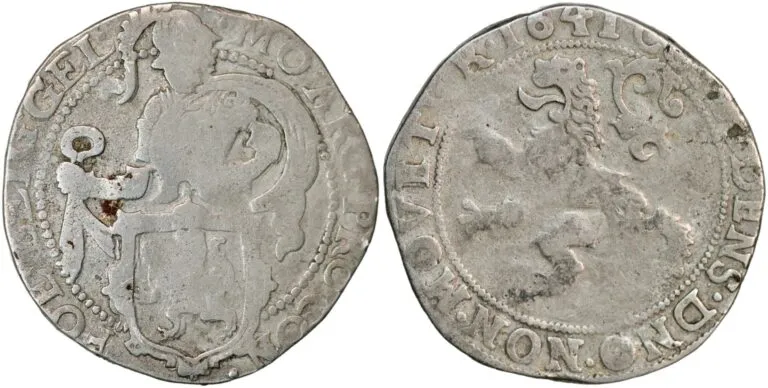
The lion travelled far beyond royal arms. The Dutch Republic, for instance, struck its silver “lion daalders” for trade, like this Netherlands, half lion daalder 1641.
The eagle: from Greek cities to the American dollar
Greek city emblems and the Roman legions
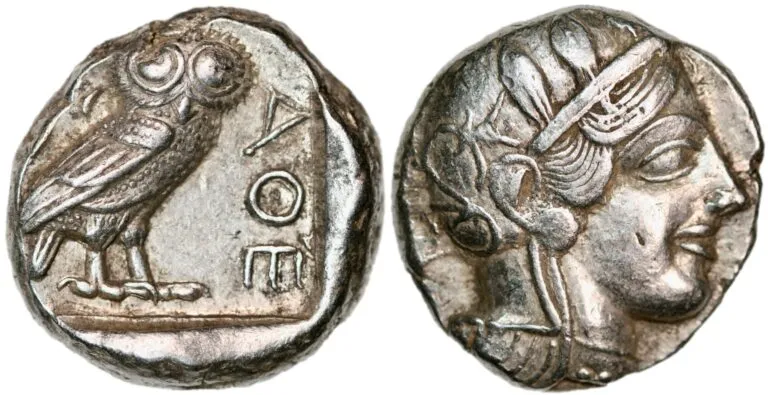
The eagle is another animal that has been used diligently on coins all over the world. Eagles were common on ancient Greek coins (ca. 600–300 BC). The city of Akragas in Sicily, for example, was well known for its coins with an eagle and a crab. The combination became the city’s trademark, just as Aegina had coins with turtles and Athens had its owls – see this Tetradrachm from Athens in Attica (ca. 454-404 BC).
As the Romans annexed ever larger territories around the Mediterranean, Roman coins took over from the older monetary systems. The Romans reorganised coinage with the denarius as the main coin, alongside a range of bronze coins, while the most valuable coin was the gold aureus. The eagle, a fitting symbol of strength, adorned many Roman coins. The legionary standard topped by an eagle was important to show both to proud citizens and to subjects in newly annexed lands. Coins have always served propaganda and politics.
The bald eagle of the United States
In modern times, the United States is especially known for putting eagles on its coins. The Great Seal of the United States, seen on several American coin types, was designed by the Secretary of Congress in 1782. Its importance was underlined in 1790, when the new Supreme Court decided that its own seal should bear the arms of the United States. The Great Seal shows an American bald eagle, and a rather wild version of this bird of prey appeared on the first silver dollars, the “Flowing Hair” type of 1794.
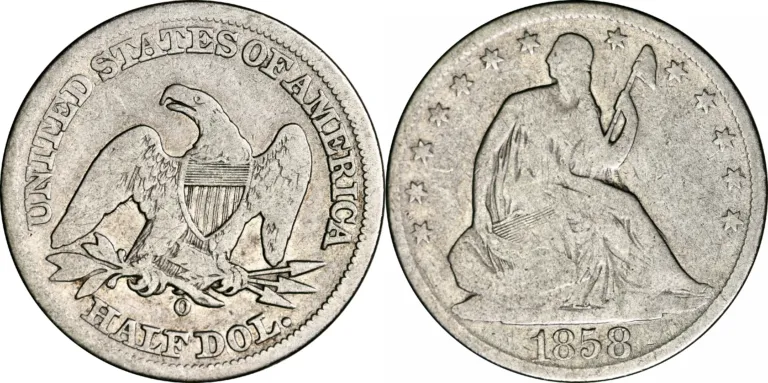
The next dollar type, the “Heraldic Eagle” (1798–1804), was closer in style to the motif on the seal of 1782. It has since become one of the most iconic coins in American numismatic history. It has often been forged, because everyone wants one in their collection. Even so, it is still possible to find a genuine example today if you go to an experienced coin dealer. The heraldic eagle lived on for decades, for example on this USA, ½ dollar 1858.
The Morgan dollar and the Peace dollar
The best-known American dollar of all is the Morgan dollar, whose reverse shows the bald eagle with a bundle of arrows and an olive branch. This silver coin, first struck in 1878, weighed 26.73 g. It was named after its designer, George T. Morgan, an English engraver who came to the US Mint on the recommendation of the Royal Mint in London and was therefore well suited to design American coins. Morgan dollars were struck from 1878 to 1904 and again in the single year 1921 (more on Wikipedia).
In 1918, under the Pittman Act, it was decided to melt just over 270 million silver dollars. The aim was partly to conserve the gold reserves of the United States during the First World War and partly to reinvest in American silver mines. The government was to buy up mine silver, but the purchases did not get going until 1921. That year, production of Morgan dollars resumed.
The same year, the mints also began striking the Peace dollar. On the Peace dollar, Liberty adorned the obverse, while the bald eagle kept watch on the reverse. The type was designed by the medallist Anthony de Francisci, and the American mints struck Peace dollars until 1935. If you want one of the scarcer dates, look for 1921 and 1928 (1934 can also be a good year if you find the right variety).
The horse: Syracuse and the Norwegian rider mark
The decadrachms of Syracuse
The horse has been a recurring theme on the world’s coins. From antiquity, the large decadrachms of Syracuse in Sicily are the best known and most sought after. These coins, worth the large sum of 10 drachms and weighing about 42 g, carried a splendid four-horse chariot (quadriga) at full gallop on the reverse. Beneath the chariot you could see pieces of a soldier’s armour and weapons.
There has been much discussion about why such large coins were struck. They are often thought to have been used for long-distance trade and for buying goods in large quantities. Some decadrachms are inscribed “ATHLA”, which has been interpreted to mean that they may have served as prizes in athletic games. Winning such games was among the most honourable things a person could achieve. More coins from the Greek world can be found among our Greek coins.
King Frederik IV’s rider mark of 1723
Among Norwegian horse coins, King Frederik IV’s “rider mark” (ryttermark) of 1723 has the most exciting story. Its model was a Danish four mark, struck in only a few examples to mark the centenary of the silver discovery at Kongsberg in 1623. The dies were cut by Olaus Wiff in Copenhagen. The Copenhagen four mark showed the king as a general in Roman armour on horseback, holding a marshal’s baton.
Frederik IV was so pleased with the coin that he ordered it struck at the mint in Kongsberg as well. There was one problem: Kongsberg lacked a skilled enough die-cutter in Anders Jonsen Lunder. His apprentice, Erasmus Simon Kongsberg, had shown more talent and had even been sent abroad to learn the trade better. Unfortunately for Erasmus, the timing was poor, for he was outside Norway when the king wanted the rider marks struck.
Instead, the king summoned Wiff from Copenhagen to Kongsberg to take charge of production. Lunder was pensioned off, and Wiff held the die-cutter’s post that had been promised to Erasmus until his death in 1730. Only after Wiff died did Erasmus finally get his promised position as die-cutter at the Kongsberg mint.
It is said that the rider marks were struck in connection with the reopening of a mine at Kongsberg. The coins, 45,000 in number, were to be a gift to Queen Anne Sophie, and the mine was named after her. Since Wiff was only appointed on 15 November, it was impossible to strike all the coins before the new year, so most had to be struck in 1724. Even so, the date 1723 was kept.
For the Kongsberg mint this was a small episode in a scandal-ridden era under Frederik IV: mint master Meyer was sentenced to life imprisonment for embezzlement in 1727, and the die-cutter Lunder had, as mentioned, been removed for lack of skill. See our coins from Frederik IV.
The elephant: animals on coins as propaganda – and murder
The Danish Order of the Elephant
Another animal often found on Danish coins, and on Norwegian coins before 1814, is the elephant. In Denmark, the Order of the Elephant is the highest order of the realm. Its roots go back to a religious brotherhood founded by King Christian I in the 1400s, while the current statutes date from King Christian V in 1693.
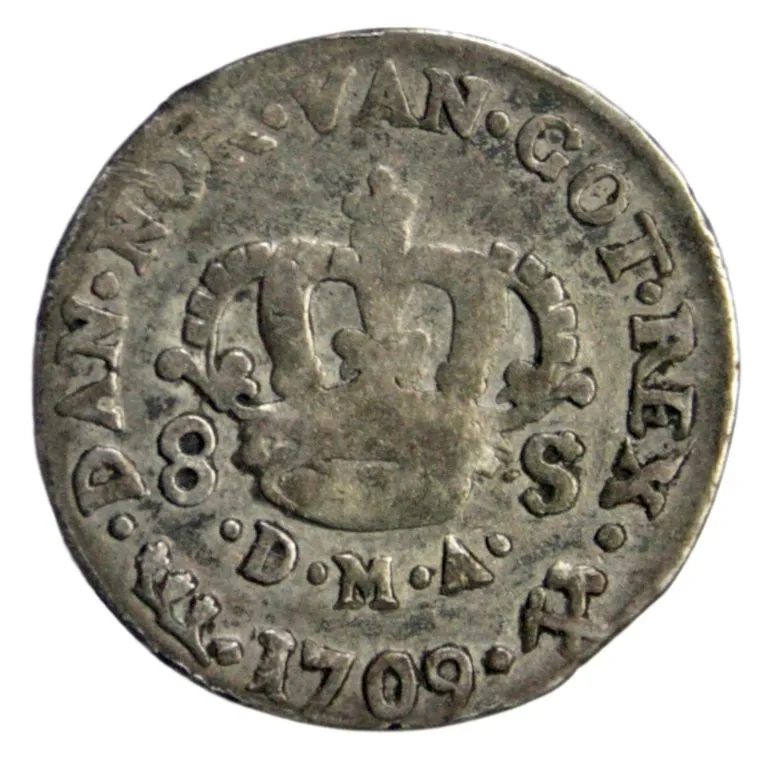
Among Norwegian coins, the order is probably best known from Frederik IV’s “wig eight-skillings”, struck in 1700–1715 and showing the king in a splendid wig, such as this 8 skilling 1709. No proper explanation has been found for why the elephant was chosen for the order, since it is hardly a typical Scandinavian animal.
Julius Caesar’s elephant
Around the Mediterranean, however, elephants were used fairly often, and they appear on both Greek and Roman coins. Julius Caesar, for example, had denarii struck with an elephant trampling a serpent, a symbol that Caesar could defeat his enemies. He was no stranger to the elephant’s symbolic power: when he celebrated his triumphs in Rome in 46 BC, he climbed the Capitol by torchlight, according to Suetonius flanked by 40 elephants carrying lamps.
Caesar understood the importance of using every available channel of propaganda, and he exploited coins to the full. He had both gold and silver coins struck in his own name, and in 44 BC he became the first living Roman to have his own portrait on coins. This was something entirely new in Rome, and it was part of the policy that made him unpopular with the Senate and the Roman elite. As Shakespeare made unforgettable, he was stabbed to death in 44 BC.
Author: Marius Ringsrud, fil. mag.