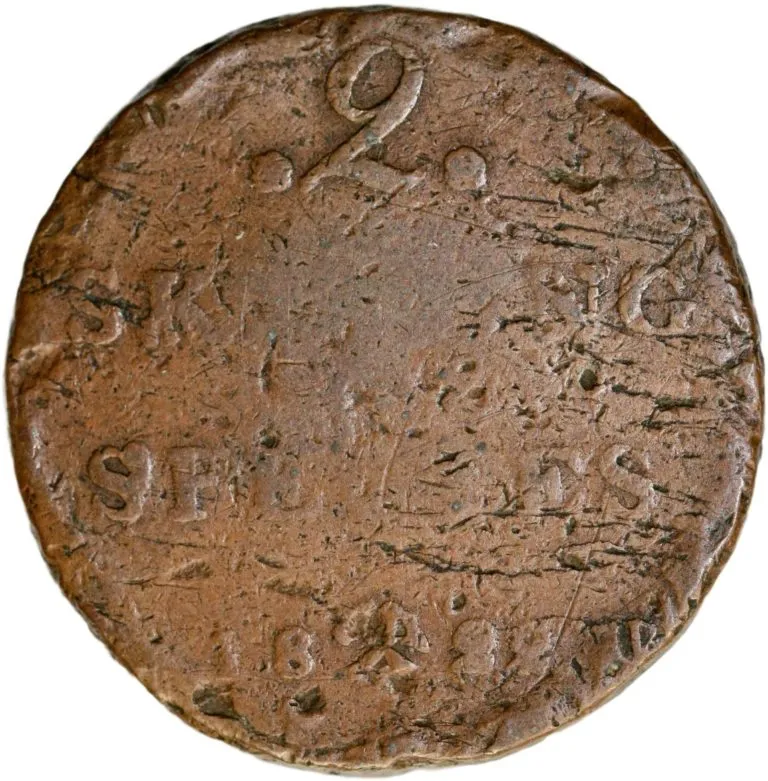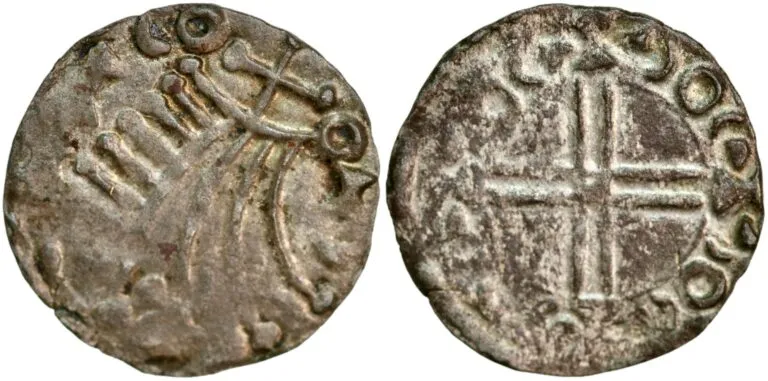
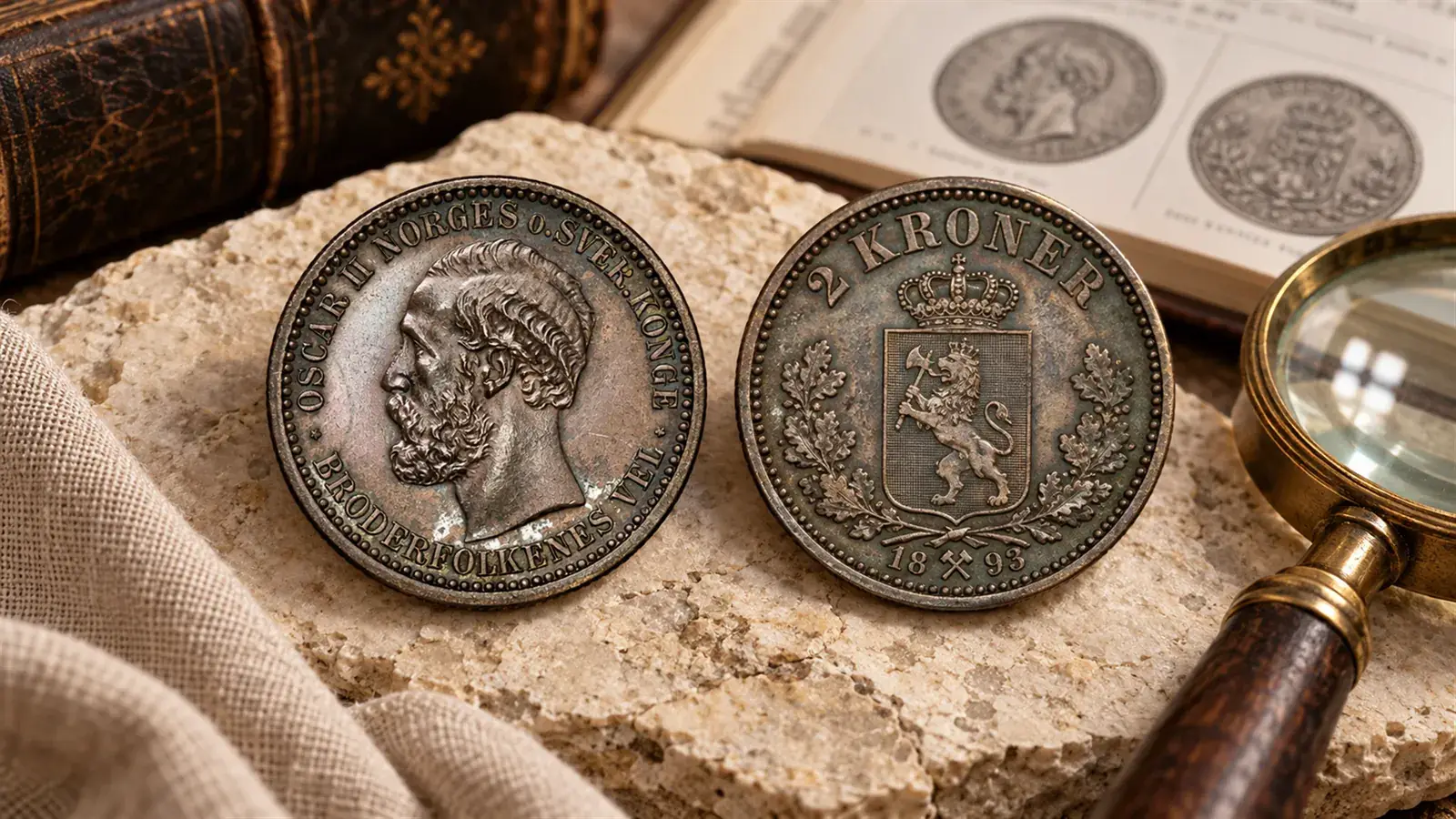
Most old Norwegian coins are worth very little. Common dates from the 1920s onwards in circulated condition typically sell for a few Norwegian kroner (NOK) each. The real value lies in condition and rarity: uncirculated coins, silver coins struck before 1920, gold coins and a small group of rare dates can be worth anything from a few hundred to tens of thousands of kroner.
This Norwegian coins value guide goes denomination by denomination, from the 1 øre to the gold 20 kroner, using the Norwegian grading scale. It ends with a short look at the skilling and speciedaler coins struck before the krone. All prices are indicative ranges in NOK as of October 2026.
In short:
- Common øre and krone coins from 1924 onwards rarely fetch more than NOK 3–30 each in circulated condition.
- Condition matters most. The same date can be worth a few kroner worn and several thousand kroner uncirculated.
- Silver coins from 1874–1919 (10 øre to 2 kroner) nearly always have collector value, usually from a couple of hundred kroner upwards.
- The gold 10 and 20 kroner (1874–1910) are worth at least their gold value, currently around NOK 5,150 and 10,300.
- Well-known rare dates include the 1 krone 1878, the 2 kroner 1885, 1887 and 1888, the zinc 50 øre 1945 and the 2 øre 1968.
Contents
What are old Norwegian coins worth, and why?
Five things decide the value of a Norwegian coin: condition, mintage and date, varieties, metal and collector demand. Condition carries the most weight.
Condition on the Norwegian grading scale
Norwegian dealers and catalogues use their own grading scale. The definitions below follow the Norges Mynter catalogue, with the nearest international grade in brackets:
- 0: uncirculated, with no wear (Unc).
- 0/01: almost uncirculated, with only light “cabinet friction”. This in-between grade is a Norwegian speciality.
- 01: a very nice coin with light wear on the highest points (EF).
- 1+: clearly circulated but without significant wear (VF).
- 1: noticeable wear, but all numbers and letters are legible (F).
- 1-: heavily worn but still identifiable (VG).
- 2: poor (G). Only worth collecting for genuinely rare dates.
The gap between grades is wide. At Denarius, an untouched 50 øre 1895 in Mint State is priced at NOK 12,000 at the time of writing (protocol no. 4738), while a worn example of the same date in grade 1 costs only a fraction of that. The 1 krone 1958 is an even starker case: a grade 1 coin has sold for NOK 35, while grade 0 examples are priced around NOK 7,000.
Mintage and date
A low mintage raises the price, but only when collectors want that date. Around 1,000,000 one-krone coins were struck in 1877 and only around 60,000 in 1878, which makes the 1878 the key date among Oscar II’s kroner. Low mintage on its own guarantees nothing, though. The 2 øre 1911 has the lowest mintage of its series (around 195,000), yet worn examples are advertised for just NOK 100–250.
Varieties, errors and metal
Coins of the same year can differ hugely in value:
- The 50 øre 1945 exists in both copper-nickel and zinc. In uncirculated condition the copper-nickel coin costs about NOK 400 and the zinc coin (mintage about 226,000) NOK 8,500–10,000.
- The 50 øre 1920 was first issued without a hole, then recalled and given a centre hole. In grade 1+ a holed example is priced around NOK 1,200 and an unholed one around NOK 350.
- The 2 kroner 1907 for the border guard exists with and without crossed rifles. The rifle variety (mintage about 27,500) is the expensive one.
- The iron 2 øre 1917 comes in two varieties of the triquetra design, known in Norway as “single line” and “double line”, which are priced very differently.
- Mint errors often carry a value of their own. Denarius currently offers a 10 øre 1957 error strike in Fine to Very Fine for NOK 900 (protocol no. 3488).
Silver, gold and demand
Norway struck circulating coins in silver until 1917 (1 and 2 kroner) and 1919 (10, 25 and 50 øre). A 2 kroner weighs 15 g and contains 12 g of fine silver, so it always has some metal value. Gold coins have an even firmer floor: the 20 kroner contains 8.06 g and the 10 kroner 4.03 g of fine gold. At around NOK 1,280 per gram (9 October 2026), that is a gold value of about NOK 10,300 and 5,150.
Original surfaces matter too. Polishing or cleaning destroys value. A 2 kroner 1917 in grade 0/01 is listed at NOK 1,200–2,000, while a cleaned example in the same grade sold for NOK 800.
Norwegian coins value by denomination: price guide
The table shows indicative prices for common dates as of October 2026. It is based on retail prices at several Norwegian coin dealers, checked in October 2026, and on Denarius’ own prices. These are prices for buying from a dealer. When you sell, expect to receive less. Rare dates are listed in a separate table further down.
| Denomination and period | Circulated (grade 1 to 1+) | Uncirculated (grade 0/01 to 0) |
|---|---|---|
| 1, 2 and 5 øre, Oscar II (1875–1902) | approx. NOK 40–300 | approx. NOK 800–5,000 |
| 1, 2 and 5 øre, Haakon VII (1906–1923, bronze and iron) | approx. NOK 200–500 in 1+, less in 1 | approx. NOK 250–2,500 |
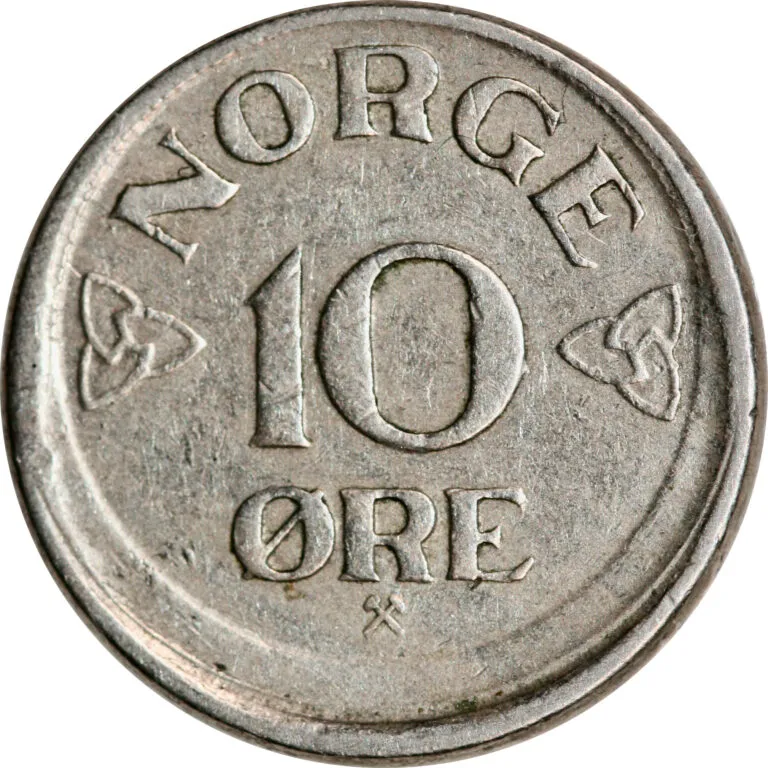
| 1–50 øre from 1924 onwards | approx. NOK 3–30 | approx. NOK 100–1,500 |
| 10 øre, silver (1874–1919) | approx. NOK 50–400 | approx. NOK 150–3,000 (highest for the 1800s) |
| 25 øre, silver (1876–1919) | approx. NOK 140–550 | approx. NOK 1,200–5,000 |
| 50 øre, silver, Oscar II (1877–1904) | approx. NOK 400–1,500 | approx. NOK 3,000–15,000 |
| 50 øre, silver, Haakon VII (1909–1919) | approx. NOK 80–700 | approx. NOK 300–7,500 |
| 1 krone, silver, Oscar II (1877–1904) | approx. NOK 800–2,000 | grade 01: approx. NOK 3,000–6,000 |
| 1 krone, silver, Haakon VII (1908–1917) | approx. NOK 300–600 | approx. NOK 3,000–11,000 (grade 01: 600–2,200) |
| 2 kroner, silver, Oscar II (1878–1904) | approx. NOK 500–3,000 | grade 01: approx. NOK 2,500–9,500 |
| 2 kroner, silver, Haakon VII (1906–1917) | approx. NOK 400–1,000 | approx. NOK 1,000–6,000 |
| 1 krone, copper-nickel (1925–1957) | approx. NOK 5 | approx. NOK 150–1,500 |
| 5, 10 and 20 kroner (from 1963, 1983 and 1994) | face value | approx. NOK 30–125 (uncirculated and proof) |
Øre coins (1–50 øre)
Øre coins from 1924 onwards are the ones most people find in drawers and piggy banks, and they are rarely worth much. Norwegian dealers sell them in grade 1 for NOK 3–5 apiece. Value only appears in uncirculated condition, and even then most dates sit at a couple of hundred kroner.
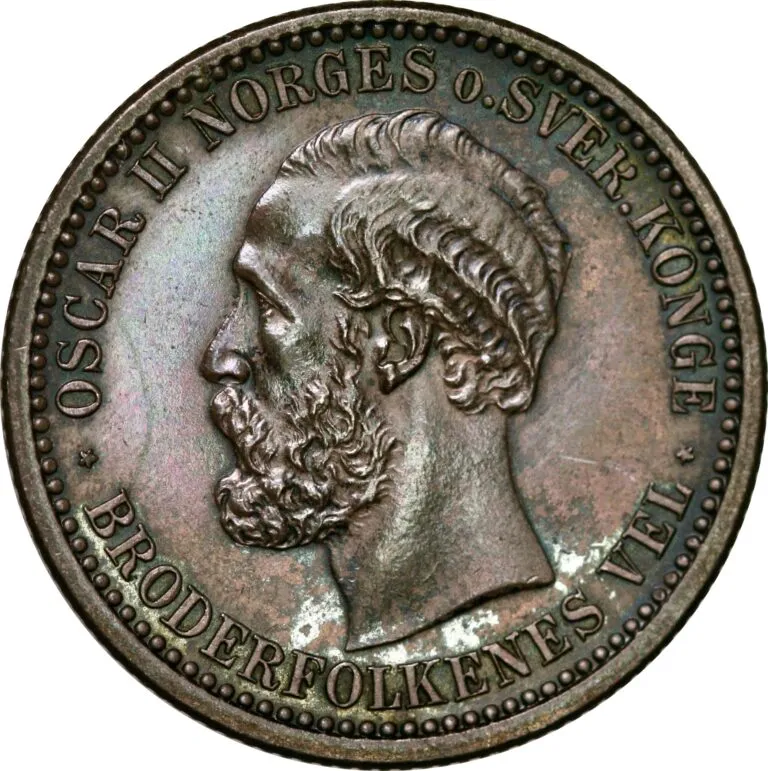
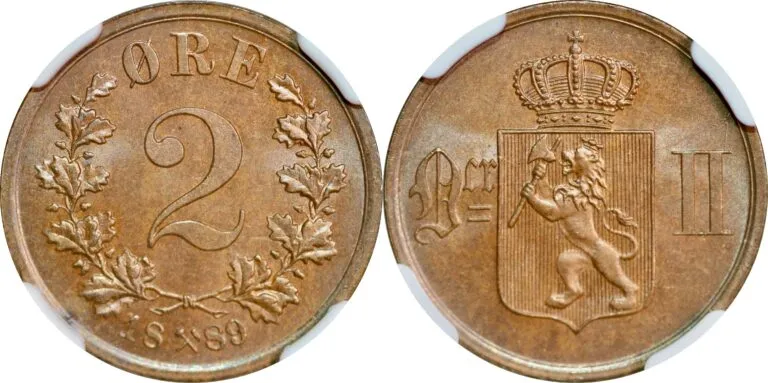
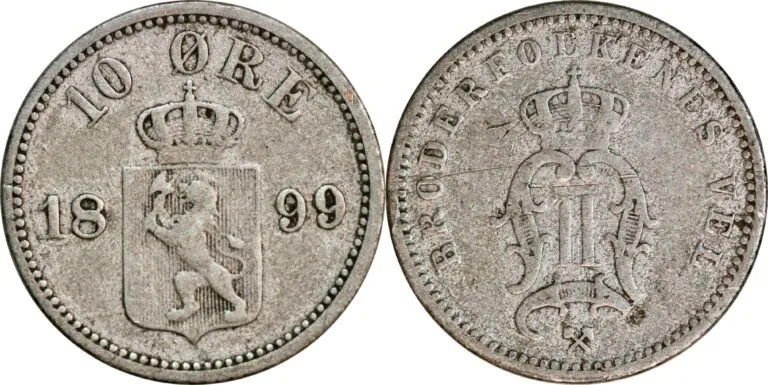
The bronze coins of the union period (1875–1902) and the silver coins struck before 1920 are more interesting. Uncirculated bronze with original lustre is sought after. Denarius currently offers a 2 øre 1889 graded MS 65 BN by NGC for NOK 4,500 (protocol no. 6279). A worn silver coin is far cheaper: a 10 øre 1899 in Fine condition costs NOK 150 (protocol no. 2101).
Silver kroner (1 and 2 kroner)
Oscar II’s 1 and 2 kroner of 1877–1904 were struck in small numbers, usually under 200,000 a year. That is why most cost at least NOK 800–1,000 even when worn. Haakon VII’s silver coins of 1908–1917 had larger mintages and are cheaper. The independence issues, the 2 kroner 1906 and 1907, cost around NOK 1,000 in grade 1+ and NOK 2,000–3,200 in grade 0.
Modern kroner (1, 5, 10 and 20 kroner)
The copper-nickel kroner from 1925 onwards, and the 5, 10 and 20 kroner of Olav V and Harald V, are worth face value when circulated. Uncirculated and proof coins from mint sets usually cost from a few tens of kroner to a couple of hundred. The exceptions are a few early dates in top condition and genuine mint errors.
Gold 10 and 20 kroner
Norway struck gold 10 and 20 kroner from 1874 to 1910. Common dates trade a little above gold value, while low-mintage dates carry a clear collector premium.
| Gold coin | Mintage (approx.) | Indicative price, October 2026 |
|---|---|---|
| 20 kroner 1874, 1875, 1876, 1878, 1886, 1910 | 100,000–250,000 | approx. NOK 11,000–14,000 (grade 01 to 0/01) |
| 20 kroner 1877, 1879, 1883, 1902 | 36,000–50,000 (sources differ, e.g. 38,000 or 46,000 for 1879) | approx. NOK 15,000–20,000 (grade 01 to 0/01) |
| 10 kroner 1910 | sources disagree | approx. NOK 12,500–15,500 (grade 0/01) |
| 10 kroner 1902 | 25,000 | approx. NOK 20,000–25,000 (grade 1+/01 to 01) |
| 10 kroner 1874 and 1877 | 20,000–24,000 | from approx. NOK 20,000 upwards |
The gold value sets a floor and moves with the gold price every day, so check the current spot price before buying or selling.
Rare Norwegian coins: the key dates to look for
These dates stand out because of low mintages or an unusual history. Mintages are rounded and cross-checked against several catalogues. Prices are indicative as of October 2026.
| Coin | Mintage (approx.) | Indicative price |
|---|---|---|
| 1 øre 1885 | 622,000 | approx. NOK 1,500–2,000 in grade 1+ |
| 2 øre 1917 (iron) | 720,000 | approx. NOK 1,000–2,500 in grade 1 to 1+, more for the “single line” variety |
| 2 øre 1968 (mint sets only) | 3,467 | approx. NOK 28,000–35,000 (NGC graded, uncirculated) |
| 5 øre 1907 | 200,000 | approx. NOK 5,000 in grade 0 |
| 5 øre 1918 (iron) | 432,000 | approx. NOK 1,500–2,200 in grade 1 |
| 5 øre 1945 (iron) | 408,000 | approx. NOK 1,600 (grade 1+) to 3,500 (grade 0/01) |
| 10 øre / 3 skilling 1874 and 1875 | 2,000,000 and 996,000 | approx. NOK 225–1,200 in grade 1 to 1+, approx. NOK 800–3,500 in grade 01 to 0/01 |
| 10 øre 1927 | 526,000 | approx. NOK 100–300 in grade 1 to 1+, up to about NOK 2,000 in grade 01 |
| 25 øre 1912 | 200,000 | approx. NOK 1,000–1,400 in grade 1 |
| 50 øre / 15 skilling 1874 and 1875 | 160,000 and 640,000 | approx. NOK 3,500–4,500 in grade 1 to 1+ |
| 50 øre 1880, 1885 and 1888 | 100,000–120,000 | approx. NOK 2,000–4,500 in grade 1- to 1+ |
| 50 øre 1945 (zinc) | 226,000 | approx. NOK 8,500–10,000 in grade 0 |
| 50 øre 1954 | 230,000 | approx. NOK 800 (grade 01) to 2,500 (grade 0/01) |
| 1 krone / 30 skilling 1875 | 600,000 | approx. NOK 3,000–4,500 in grade 1 to 1+, about NOK 18,000 in grade 0/01 |
| 1 krone 1878 | 60,000 | approx. NOK 12,500–18,000 in grade 1- to 1/1- |
| 1 krone 1881 | 80,000 | approx. NOK 6,000 in grade 1+ |
| 1 krone 1888 | 75,000 | approx. NOK 2,200 in grade 1/1-, about NOK 17,500 in grade 01 |
| 1 krone 1958 | 540,000 | a few tens of kroner worn, about NOK 7,000 in grade 0 |
| 2 kroner 1885, 1887 and 1888 | 25,000 each | approx. NOK 7,000–18,000 in grade 1- to 1/1+ |
| 2 kroner 1907 with rifles | 27,500 | approx. NOK 5,000–7,500 in grade 01 to 0/01 |
Watch out for copies and restrikes. A later restrike of the 2 kroner 1887 sells for NOK 700–1,000, while an original in grade 1 costs NOK 12,500–13,500. Copies of the 2 øre 1968 also circulate. The 2 kroner 1917 is often mistaken for a rarity, but around 377,500 were struck and it sells for NOK 400–500 in grade 1+.
What are older coins worth? Skilling and speciedaler before 1875
From 1816 until the krone was introduced on 1 January 1874, Norway’s monetary unit was the speciedaler, divided into 120 skilling. At the changeover, one speciedaler was exchanged for four kroner. Coins from this era are older and often more worn, yet prices are generally higher than for most krone-era coins. Indicative levels as of October 2026:
- Small 19th-century skilling coins (½–4 skilling): approx. NOK 150–1,000 in grade 1 to 1+. Denarius offers a 2 skilling 1822 in Good to Very Good for NOK 150 (protocol no. 3057).
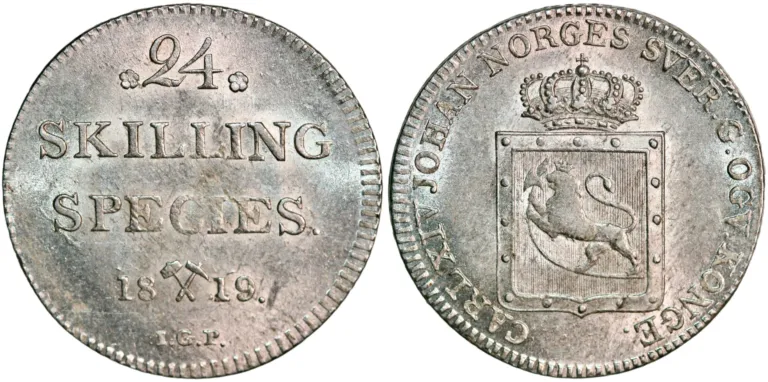
- 12 and 24 skilling of the 1800s: approx. NOK 400–2,200 in grade 1 to 1+/01. Rare dates and top grades cost much more. A 24 skilling 1819, uncirculated and approaching Mint State, is priced at NOK 7,750 at Denarius at the time of writing (protocol no. 5945).
- 18th-century 24 skilling: approx. NOK 1,000–4,000 in grade 1 to 1+.
- 19th-century half speciedaler: approx. NOK 4,000–6,000 in grade 1 to 1+.
- 19th-century speciedaler: approx. NOK 8,000–16,000 in grade 1/1+ to 1+/01. Rare dates and exceptional coins range from NOK 25,000 to well over NOK 60,000.
- 17th-century mark coins (1, 2 and 4 mark): approx. NOK 3,000–8,000 in grade 1 to 1+.
How to find out what your Norwegian coins are worth
- Sort by metal and date. Set aside silver coins from before 1920, all gold coins and anything struck before 1875. That is where the value usually is.
- Grade honestly using the scale above. Most coins taken from circulation are grade 1 or lower.
- Check the Norges Mynter catalogue. It is published every year and lists mintages and prices in six grades. Catalogue prices are dealers’ retail prices.
- Look at actual sales. Auction results and coins marked “sold” by dealers say more than asking prices online.
- Ask a collectors’ society. Norsk Numismatisk Forening (founded 1927) and about 30 local coin clubs bring together experienced collectors.
- Do not clean your coins. Polishing and washing reduce value, and experienced collectors spot it immediately. Very valuable coins can be graded by NGC or PCGS.
Frequently asked questions
Are old Norwegian coins worth anything?
Some are, but most are worth face value or a few kroner. Common coins from 1924 onwards sell for NOK 3–30 each in circulated condition. Silver coins from before 1920, gold coins, uncirculated coins and rare dates can be worth from a few hundred to tens of thousands of kroner.
Which Norwegian coins are the most valuable?
Among coins struck after 1874, the most expensive include the 1 krone 1878, the 2 kroner 1885, 1887 and 1888, the 2 øre 1968 from mint sets, and the gold 10 kroner of 1874, 1877 and 1902. Uncirculated silver coins of Oscar II can also cost NOK 10,000 or more.
What do the grades 0, 01 and 1+ mean on Norwegian coins?
They are the Norwegian grading scale. Grade 0 is uncirculated, 01 roughly equals Extremely Fine, and 1+ roughly equals Very Fine. Grades 1, 1- and 2 follow for increasingly worn coins.
How much is a Norwegian 20 kroner gold coin worth?
A gold 20 kroner from 1874–1910 contains 8.06 g of fine gold, worth around NOK 10,300 as of October 2026. Common dates typically retail for NOK 11,000–14,000. Low-mintage dates such as 1877, 1879, 1883 and 1902 cost approx. NOK 15,000–20,000.
Should I clean old coins before selling them?
No. Cleaning and polishing damage the surface and reduce collector value, often considerably. Store coins somewhere dry and handle them by the edges.
Where can I find a price list for Norwegian coins?
The standard reference is the annual Norges Mynter catalogue, which prices every Norwegian coin from 1814 by grade. Compare it with dealer price lists and auction results, since catalogue prices are retail prices.
Want to see what is in stock? At Denarius, every item is examined, photographed and described with its grade and its own protocol number, and we ship worldwide. Browse Norwegian coins after 1874, Norwegian coins 1814–1874 and Norwegian coins before 1814.