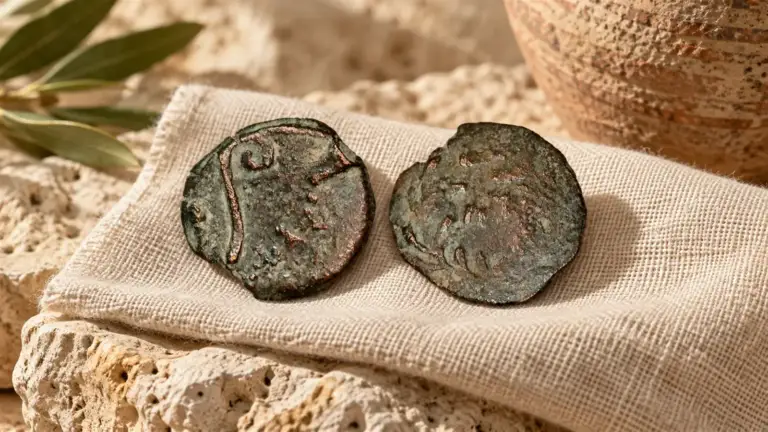
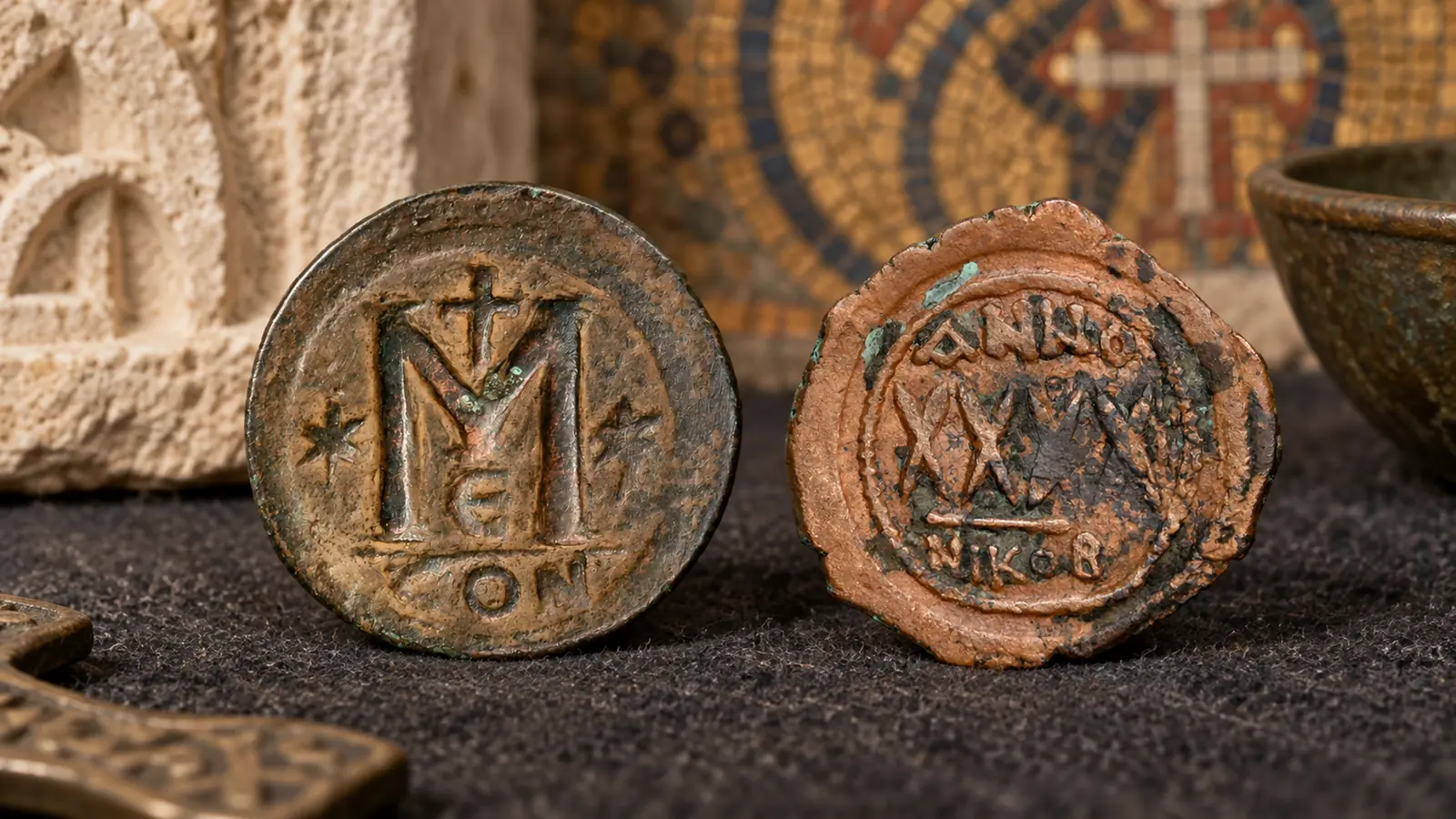
Byzantine coins are the coins of the Eastern Roman Empire, ruled from Constantinople, usually counted from Emperor Anastasius’ reform of 498 to the fall of the city in 1453. The best known are the copper follis, marked with a large M, and the gold solidus. Many show the emperor, and from the late 7th century Christ appears too. The bronzes are surprisingly affordable: a common follis often costs less than NOK 1,000.
In short
- Anastasius I (491–518) introduced a large copper coin, the follis, in 498. It was worth 40 nummi and marked M.
- The value marks are Greek numerals: M = 40, K = 20, I = 10 and E = 5 nummi.
- The gold solidus (Greek nomisma) was struck at 72 to the Roman pound and stayed stable for some 700 years.
- From 538 folles carry the emperor’s regnal year, so many can be dated to a single year.
- From about 969 to 1092, anonymous folles showed Christ instead of the emperor.
Contents
What are Byzantine coins?
“Byzantine” is a later label. The people of the empire called themselves Romans, and the emperor in Constantinople saw himself as the heir of Augustus. The coinage therefore grows directly out of late Roman coinage, and the earliest Byzantine coins carry Latin legends. Greek gradually took over from the 7th century.
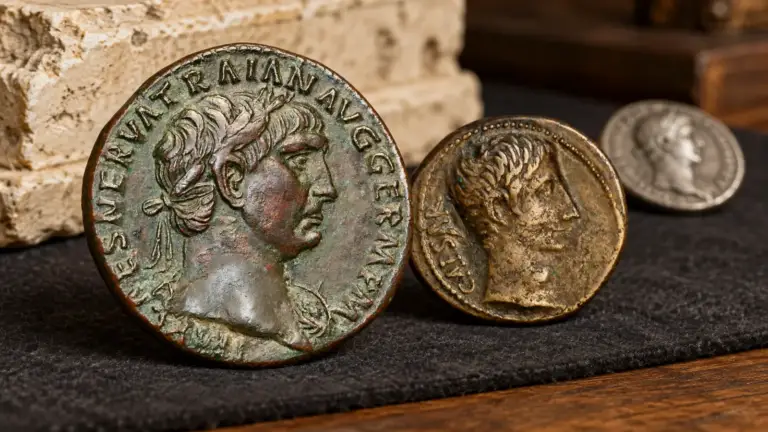
Constantine the Great dedicated Constantinople in 330 and had introduced the solidus early in the 4th century. Even so, most numismatists start Byzantine coins with Anastasius I, because his reform gave the copper coinage an entirely new system. You can see the change by comparing them with Roman coins of 314–476.
The follis: the big copper coin with an M
In late antiquity small change meant tiny copper nummi, which were impractical for anything but small sums. In 498 Anastasius solved this with a series of larger coins that showed their value on the reverse as Greek numerals:
| Coin | Mark | Value |
|---|---|---|
| Follis | M | 40 nummi |
| Half follis | K | 20 nummi |
| Decanummium | I | 10 nummi |
| Pentanummium | E | 5 nummi |
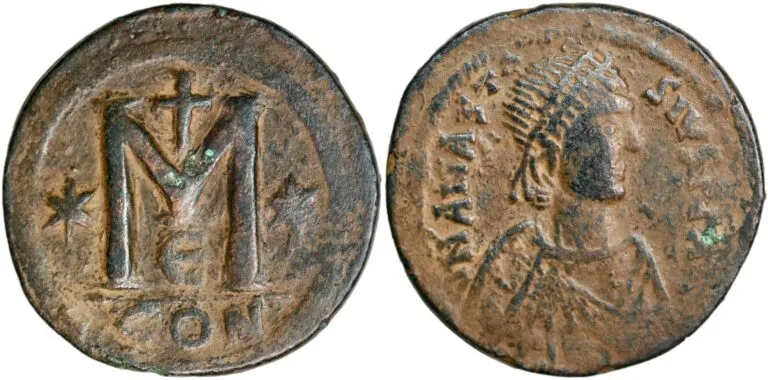
Below the value mark there is often a letter for the workshop (A, B, Γ, Δ, E) and, at the bottom, the mint, such as CON for Constantinople or NIKO for Nicomedia. The system remained in use for about three centuries.
At Denarius, a follis of Anastasius I, 512–517, currently costs NOK 975 (protocol no. 6046). It is the large module of the later part of his reign.
How do you date Byzantine coins?
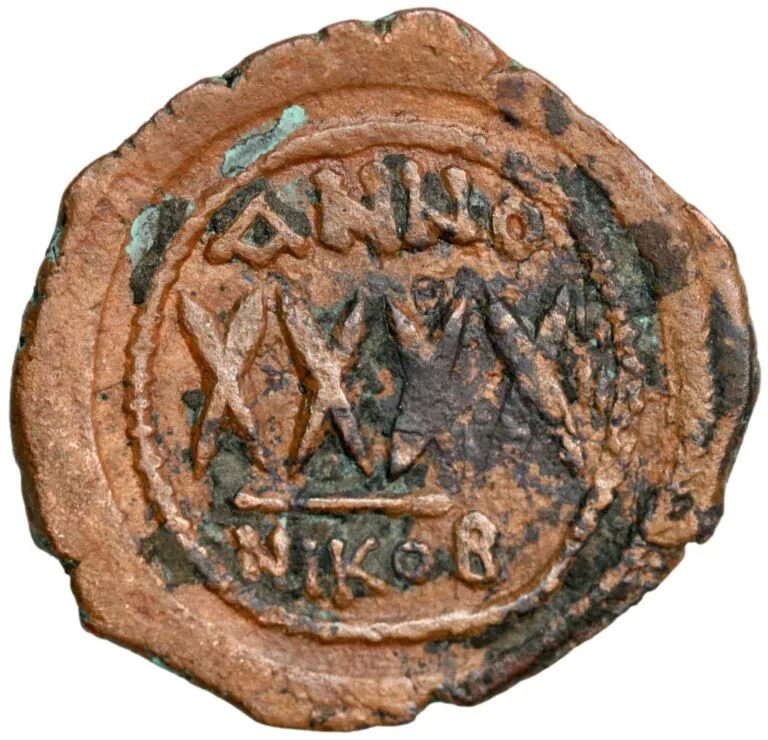
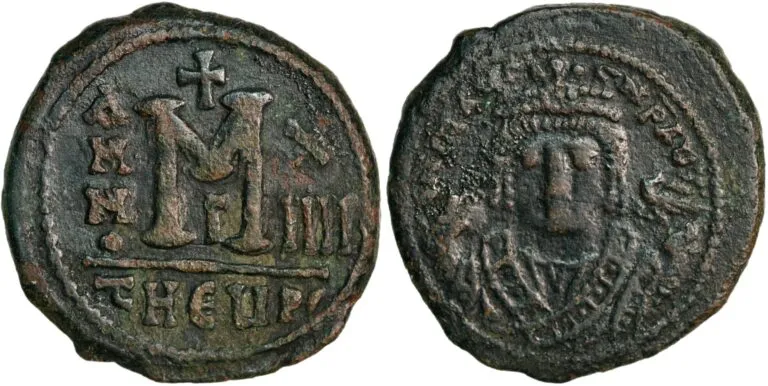
In 538 Justinian I began placing his regnal year on the copper: the word ANNO to the left of the M and the year in Roman numerals to the right. As a result, many Byzantine coins of the 6th and 7th centuries can be dated to a single year.
One example is a follis of Maurice Tiberius (582–602), struck in 595/6, at NOK 750 (protocol no. 6050). Maurice was overthrown in 602 by Phocas, and a follis of Phocas from 602/3 costs NOK 1,150 (protocol no. 4751).
The solidus: a gold coin that lasted 700 years
The solidus was the empire’s gold coin. It was struck at 72 to the Roman pound, weighing about 4.4–4.5 grams, and according to World History Encyclopedia it was the main currency for roughly 700 years. Historians have called it “the dollar of the Middle Ages”, and in western Europe it was known as the bezant.
The solidus was also the model for the Islamic gold dinar. In the 11th century its gold content was steadily reduced, and in 1092 Alexios I replaced it with a new gold coin, the hyperpyron, which lasted until the end of the empire.
Silver and cup-shaped coins
Silver played a smaller part. The silver miliaresion was introduced around 720 under Leo III, twelve to the solidus. From the 11th century many gold and electrum coins were struck cup-shaped. Collectors call them scyphate, from a Greek word for a drinking cup.
A solidus costs far more than a follis. Before buying gold, read our guide to buying gold coins as a collector.
Christ on Byzantine coins
Around 692 Justinian II placed an image of Christ on his gold coins, with the title “King of Kings”. During Iconoclasm in the 8th and 9th centuries the image disappeared again, returning only after 843.
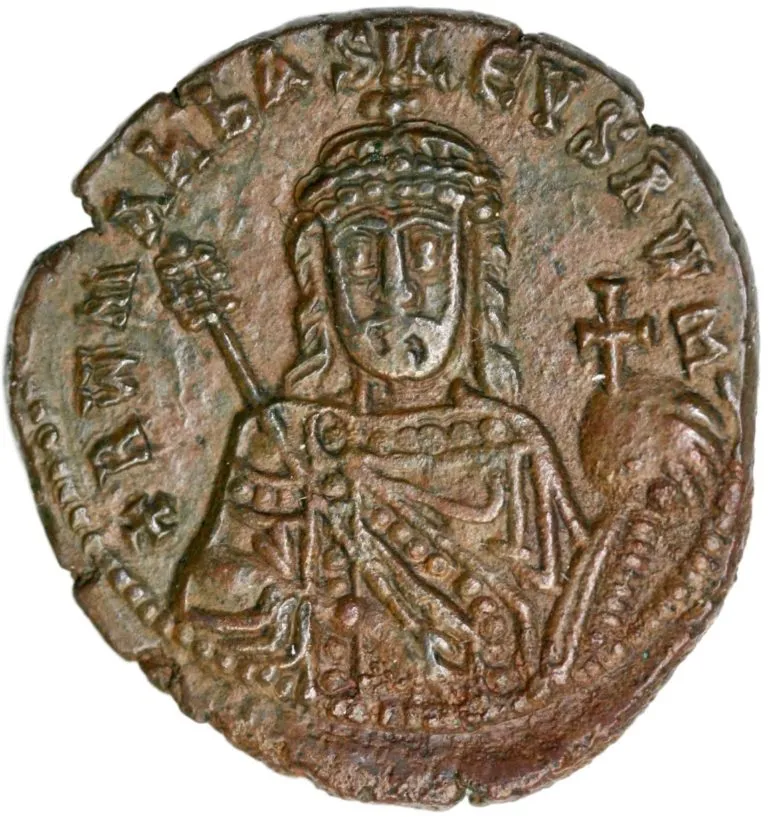
Emperors kept their own portraits on the copper. A bronze of Romanos I Lekapenos (920–944) shows the emperor’s bust on the obverse and a four-line Greek legend on the reverse: “Romanos, by the grace of God, Emperor of the Romans”. At Denarius, a bronze of Romanos I costs NOK 4,500 (protocol no. 2741).
What is an anonymous follis?
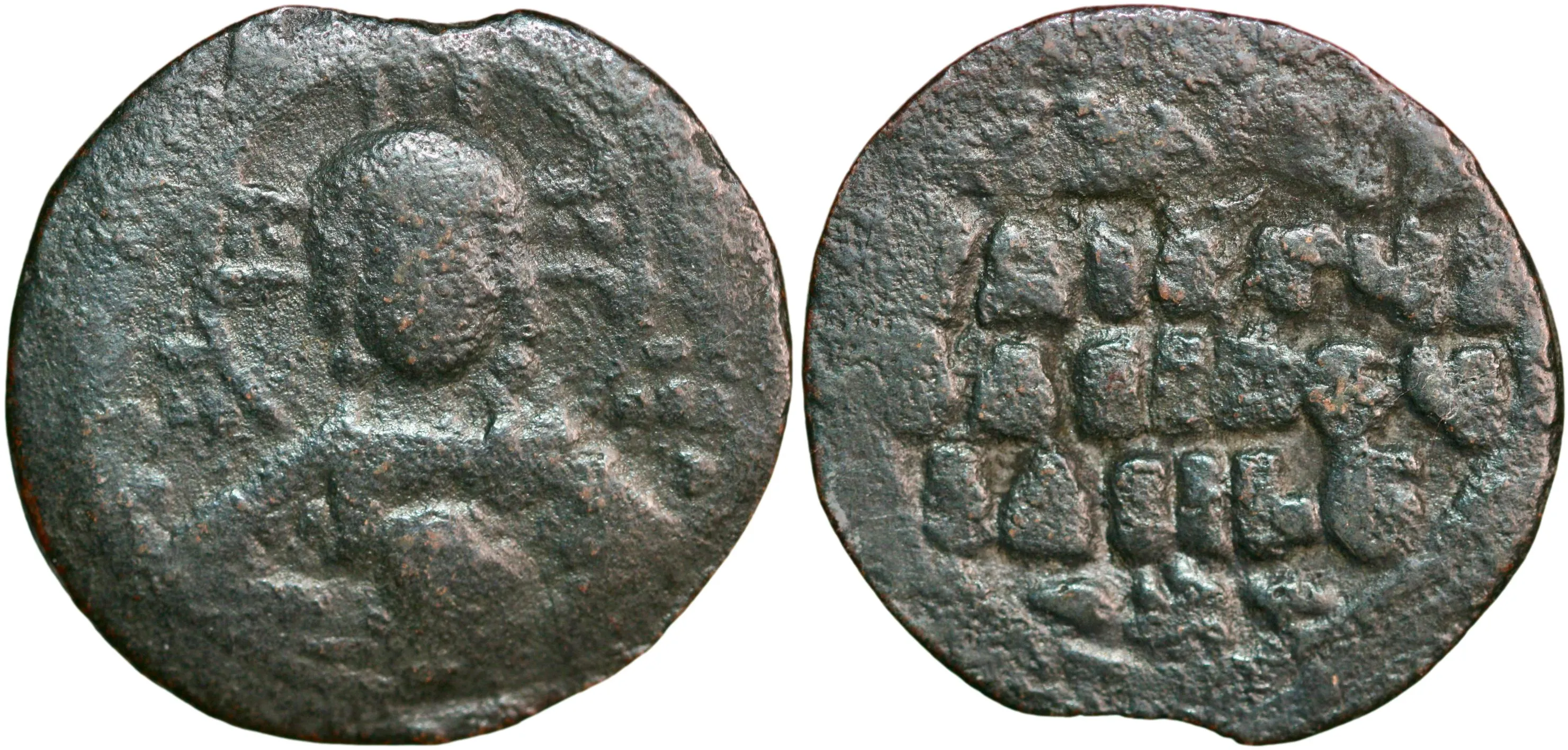
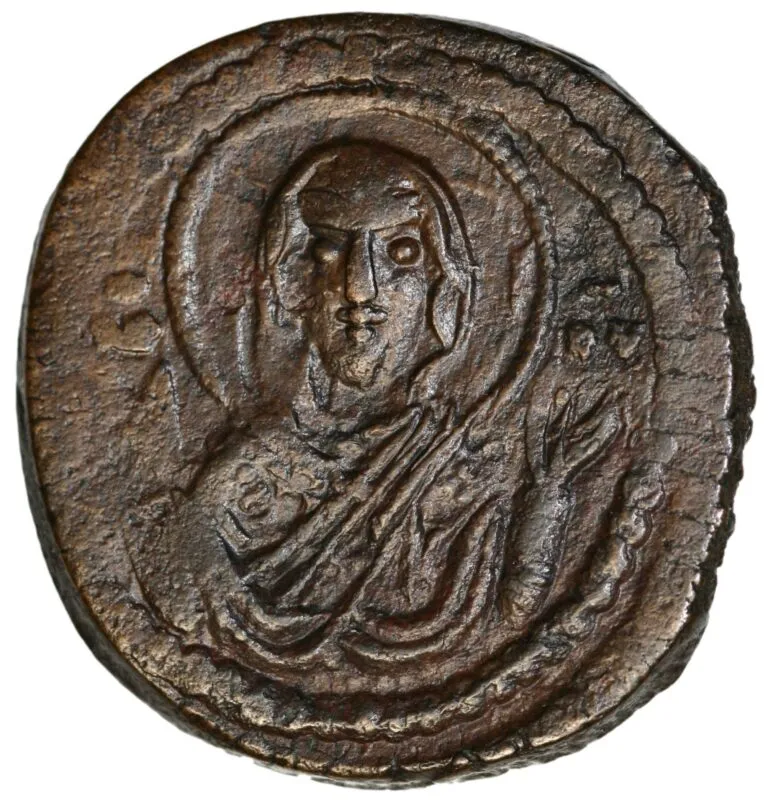
Around 969 something unusual happened. Under John I Tzimiskes the emperor’s name and portrait disappeared from the copper. Instead the obverse showed the bust of Christ and the reverse read “Jesus Christ, King of Kings”. These anonymous folles were struck until the reform of Alexios I in 1092.
Numismatists divide them into classes A to K. Many were overstruck on earlier coins, so traces of an older design are common. At Denarius, an anonymous follis of 976–1028 costs NOK 200 (protocol no. 60863), and a Class G follis of about 1068–1071 costs NOK 3,250 (protocol no. 4199). Class G is regarded as the first copper coin to show the Virgin Mary.
If coins with a biblical connection interest you, see also our guide to the widow’s mite coin.
Byzantine coins in the Viking world
Constantinople, Miklagard to the Norse, drew many Scandinavians, and Harald Hardrada served in the Varangian Guard there before he became king of Norway. Even so, Byzantine coins are rare in Scandinavian finds compared with Islamic dirhams. According to CoinWeek, the most common type is the silver miliaresion of 945–989, and almost 28 per cent of them were pierced to be worn as ornaments.
How much are Byzantine coins worth?
Copper is the most affordable. CoinWeek puts common Class A1 anonymous folles at usually USD 100 or less, with scarcer classes and fine examples costing more. For gold, the metal sets a floor: at the British auction house Denham’s, solidi of Justinian I, Heraclius and Constans II in F–VF condition sold for GBP 320–440 hammer in December 2024, and the gold price has risen since.
Guide levels as of October 2026, together with Byzantine coins at Denarius at the time of writing:
| Coin | Grade / source | Price |
|---|---|---|
| Anonymous follis, Class A1 | Common examples, CoinWeek | Around USD 100 or less |
| Solidus, Justinian I or Heraclius | F–VF, Denham’s Dec. 2024 (hammer) | GBP 320–440 |
| Anonymous follis 976–1028 | Denarius, protocol no. 60863 | NOK 200 |
| Follis, Maurice Tiberius 595/6 | Denarius, protocol no. 6050 | NOK 750 |
| Follis, Anastasius I 512–517 | Denarius, protocol no. 6046 | NOK 975 |
| Follis, Phocas 602/3 | Denarius, protocol no. 4751 | NOK 1,150 |
| Follis, Class G, c. 1068–1071 | Denarius, protocol no. 4199 | NOK 3,250 |
| Romanos I, 920–944 | Denarius, protocol no. 2741 | NOK 4,500 |
Tips for collecting Byzantine coins
- Pick a theme: one follis per emperor, one coin from each mint, or a type set of anonymous folles from Class A to K.
- Look for readable details: a clear M, mint and regnal year make a coin more interesting and easier to attribute.
- Accept overstrikes and irregular flans: they are normal on Byzantine coins, though they affect the price.
- Do not clean them yourself: the patina protects the bronze. Read how to clean Roman coins before you try anything.
- Buy with a guarantee: gold coins in particular are forged. Denarius guarantees that everything it sells is genuine and as described.
Frequently asked questions
What are Byzantine coins?
Byzantine coins are the coins of the Eastern Roman Empire, ruled from Constantinople, usually counted from the reform of Anastasius I in 498 to the fall of the city in 1453. The key denominations are the copper follis and the gold solidus.
What does the M on Byzantine coins mean?
M is the Greek numeral for 40 and shows that the coin is a follis worth 40 nummi. K means 20, I means 10 and E means 5 nummi. The system was introduced by Anastasius I in 498.
What is an anonymous follis?
An anonymous follis is a Byzantine copper coin without the emperor’s name or portrait, struck from about 969 to 1092. It shows the bust of Christ and often the legend “Jesus Christ, King of Kings”. Numismatists divide them into classes A to K.
What is the difference between a solidus and a follis?
The solidus is the gold coin, struck at 72 to the Roman pound and weighing about 4.4–4.5 grams. The follis is the large copper coin for everyday use. In the middle Byzantine period, 288 folles made one solidus.
How do you date a Byzantine coin?
From 538 many copper coins carry the emperor’s regnal year, shown by ANNO and a Roman numeral beside the M. Otherwise a coin is attributed from the emperor’s name, portrait and mint, using catalogues such as Sear and Dumbarton Oaks.
How much are Byzantine coins worth?
Common copper coins start at a few hundred Norwegian kroner, while well-preserved and rare types cost several thousand. Gold solidi cost more because of the metal; at one British auction house common solidi sold for GBP 320–440 hammer in December 2024.
Browse Byzantine coins at Denarius
You will find Byzantine coins in the Byzantine coins category, and more of them, along with other ancient coins, under Greek & Roman. Every object is examined, photographed and described, and has its own protocol number. Denarius ships worldwide.