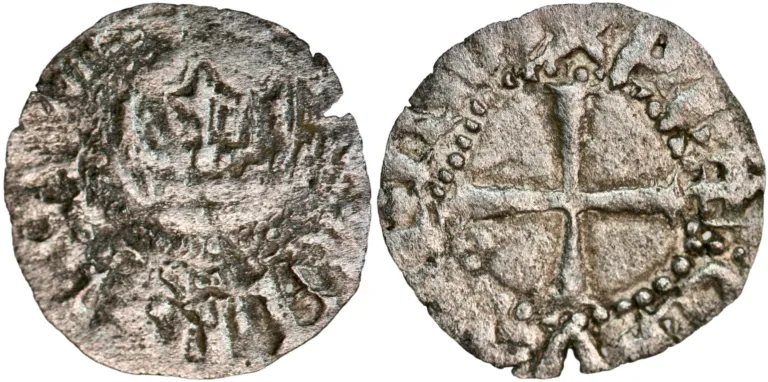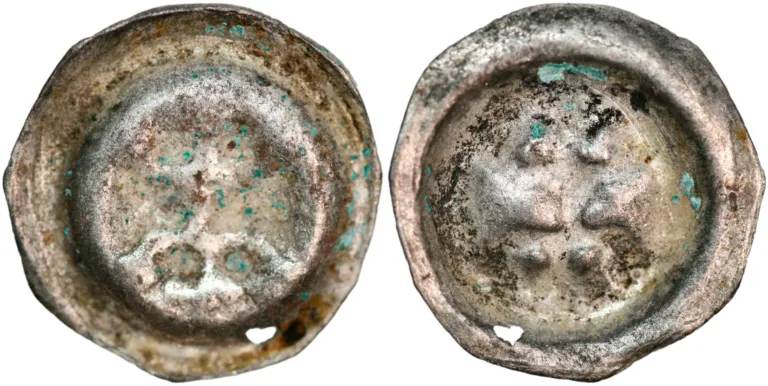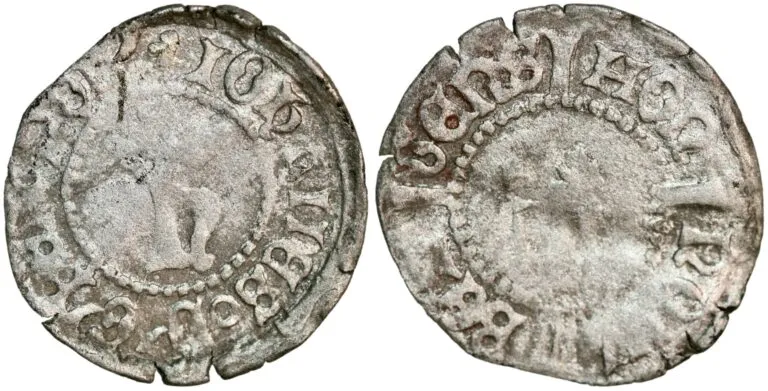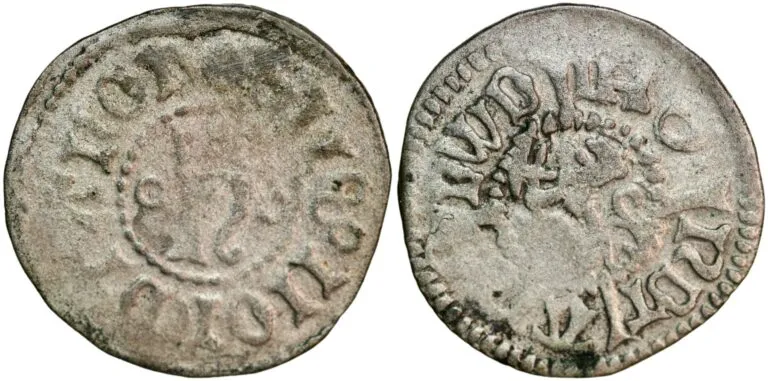
Norwegian medieval coins after King Sverre are the two-sided pennies, small hollow pennies, hvids and early skillings struck in Norway between about 1280 and the Reformation in 1537. The story falls into two parts: a rich series of pennies up to 1387, then a gap of almost a century, before King Hans and the archbishops of Nidaros revived Norwegian coinage with the hvid and skilling on the Lübeck model.
In short
- Late in the reign of Magnus Lagabøte, bracteates gave way to thicker two-sided pennies, and Eirik Magnusson (1280–1299) completed the reform.
- From around 1285, Norwegian coins show the lion with an axe, the national coat of arms as we know it today.
- No Norwegian coinage is securely known from the death of Olav Håkonsson in 1387 until King Hans (1483–1513).
- The hvid and skilling came with the Lübeck system: 1 mark = 16 skilling = 48 hvid = 192 pennies.
- The last Norwegian medieval coins were struck for Archbishop Olav Engelbrektsson, who fled the country in 1537.
Contents
For the earlier centuries, see our guide to Viking-age coins and the article on bracteates, Norway’s thin medieval coins of Sverre’s time.
What happened to Norwegian medieval coins after Sverre?
In the 1200s most Norwegian medieval coins were small one-sided bracteates. According to Norges Bank, the silver content of Håkon Håkonsson’s bracteates fell from about 50 to 25 per cent during his reign. Magnus Lagabøte also began with bracteates, but towards the end of his reign he replaced them with thicker pennies struck on both sides.
The coinage was usually renewed when a new king took the throne. Eirik Magnusson, who became king as a child in 1280, instead completed the reform his father had begun. The penny was the basic unit of Norwegian medieval coins, at 240 pennies to the mark.
Norwegian medieval coins of 1280–1319: pennies with the lion
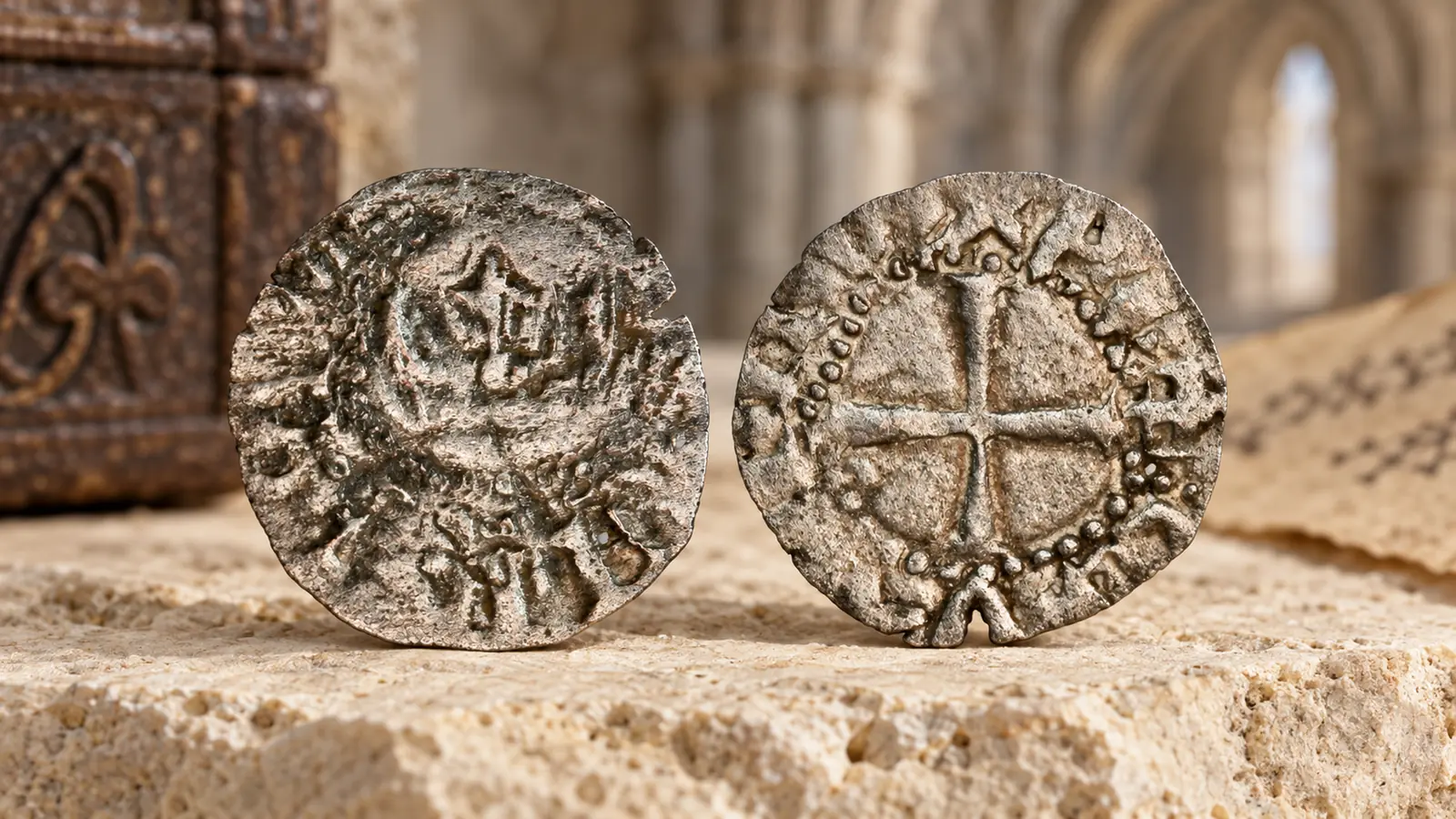
According to the University of Oslo Coin Cabinet, Eirik Magnusson’s first pennies closely copy the English sterling penny after the English recoinage of 1279. The legends name the mints: CIVITAS BERGENSIS, “the city of Bergen”, and CASTRUM TUNSBERGIS, “the castle of Tunsberg”.
From about 1285 a new type appeared with the coat of arms in its familiar form, a rampant lion holding an axe, the first time the lion with the axe appears on Norwegian medieval coins. Eirik struck whole, half and quarter pennies, and the coinage was renewed several times. Norges Bank notes that pennies with under 10 per cent silver were called “black crowns” (svartkroner), while “white roses” (hvitroser) held about 50 per cent.
At Denarius, a penny of this kind from about 1285–1299, with provenance back to 1997, currently costs NOK 9,500 (protocol no. 5961).
Duke Håkon and King Håkon V Magnusson
While Eirik was king, his brother Duke Håkon Magnusson was allowed to strike coins in his own name; Norges Bank dates his minting right to 1284. The duke’s coins were struck in Oslo with the legend MONETA DE ASLOIA, “coin from Oslo”, and matched the king’s coins in weight and silver.
As King Håkon V (1299–1319) he issued an unusually large number of types in Oslo and Bergen, from double pennies to quarter pennies. The early pennies were of good silver. A later series with a crown as the main motif held far less, yet the king ordered it to pass at full value, with harsh penalties for anyone who refused it.
Norwegian medieval coins in the 1300s: hollow pennies
After Håkon V died in 1319, Norway shared a king with Sweden, Magnus Eriksson. He struck anonymous pennies and bracteates in both countries, at uncertain Norwegian mints. By the late 1300s Norwegian medieval coins were once again small and one-sided. The Coin Cabinet calls them hollow pennies (German Hohlpfennig): bracteates with a raised rim around a sunken centre.
Håkon VI Magnusson (1355–1380) struck hollow pennies with a crowned “h” at Akershus in Oslo. His son Olav Håkonsson, who ruled together with his mother Queen Margaret, issued similar pieces with a crowned “O”. At Denarius, a penny from Håkon VI’s reign, 1355–1380, currently costs NOK 10,000 (protocol no. 5913).
Why did Norway stop minting coins after 1387?
Olav Håkonsson, who was also king of Denmark, died young in 1387, early in the long union between Norway and Denmark. According to the University of Oslo Coin Cabinet, no Norwegian coinage is securely known from his death until King Hans. For almost a hundred years there are no Norwegian medieval coins to collect, and the country made do with older and foreign coins.
What is a hvid? King Hans and the Lübeck system
Hvid is the Danish-Norwegian name for the North German silver coin called the witten. According to Store norske leksikon it was worth a third of a skilling, and Denmark began striking hvids after 1380. With the hvid came the Lübeck monetary system, which reached Norway through Denmark: 1 mark = 16 skilling = 48 hvid = 192 pennies, so one skilling was 12 pennies.
With King Hans (1483–1513), Norwegian medieval coins came back. In the coronation charter he signed in order to be elected, he promised that pennies would be struck in Trondheim according to the privileges of Nidaros Cathedral, and coins in Oslo and Bergen. The skilling, half skilling, six-penny piece, hvid and hollow penny are known from his reign, and he struck the oldest Norwegian gold coin, a gulden from Bergen.
Under King Hans the silver content of the hvid fell until it was worth a quarter skilling or less. At Denarius, a hvid from his reign currently costs NOK 15,000 (protocol no. 5288).
Gaute Ivarsson’s mint workshop in Nidaros
Archbishop Gaute Ivarsson (1475–1510) struck hvids in the king’s name in Nidaros. Digs at the Archbishop’s Palace in Trondheim in 1991–1995 found three medieval mint workshops. The best preserved was Gaute’s and can be seen today in the museum built over the site.
A 2010 study (Lohne et al.) records 282 Norwegian hvids known from Gaute’s time, 192 of which can be linked to the workshop. The authors estimate an output of around 600,000 hvids at a small profit, and conclude that the coinage mattered as much for its political and symbolic value as for income. At Denarius, a hvid from Gaute’s time, 1474–1510, with provenance back to 1929, currently costs NOK 11,000 (protocol no. 5169).
The skilling and the last Norwegian medieval coins
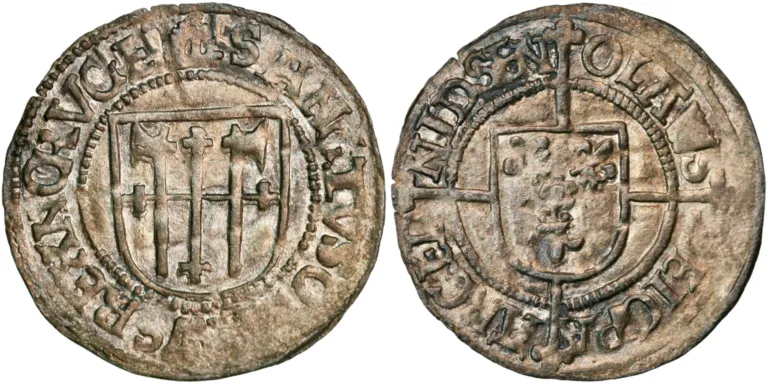
The next archbishop, Erik Valkendorf (1510–1522), struck skillings in Nidaros showing St Olav, with the legend SANCTUS OLAVS REX NORVEGIAE. His skillings dated 1518 and 1519 are regarded as the first Norwegian coins to carry a date.
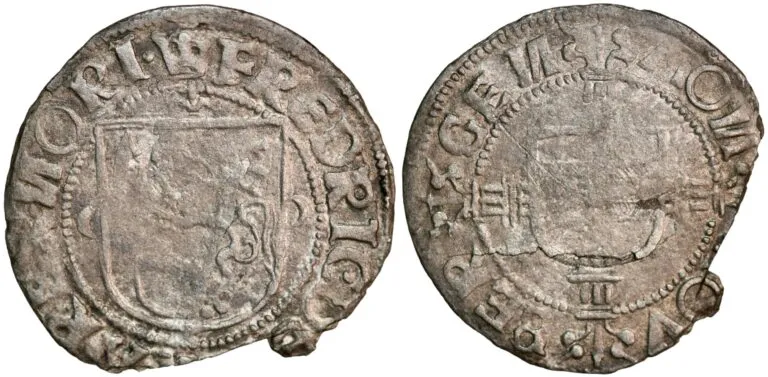
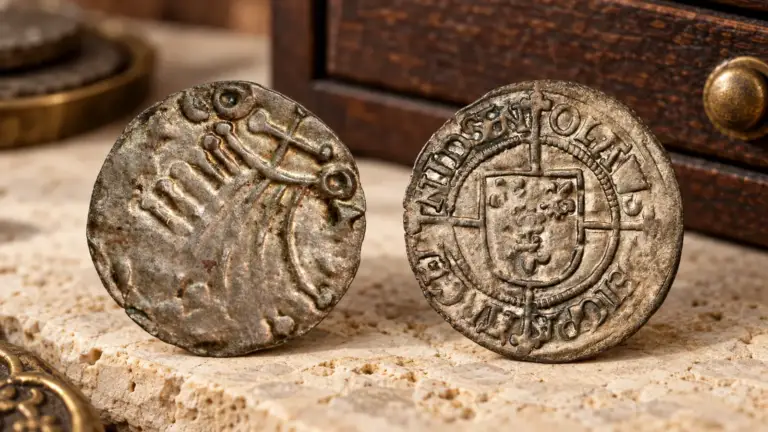
A double hvid was struck in Oslo during the interregnum of 1523–1524, and hvids are also known from Frederik I (1524–1533). Archbishop Olav Engelbrektsson (1523–1537) struck skillings in Nidaros with the arms of the archbishopric, two axes over a cross, and legends naming St Olav as king of Norway. The very last Norwegian pennies were two-penny pieces called blafferter, struck in bracteate style for him.
At Denarius, a skilling dated 1524–1533 currently costs NOK 8,500 (protocol no. 5649), and a skilling of Olav Engelbrektsson’s time, 1523–1537, with provenance back to 1995, costs NOK 45,000 (protocol no. 5944).
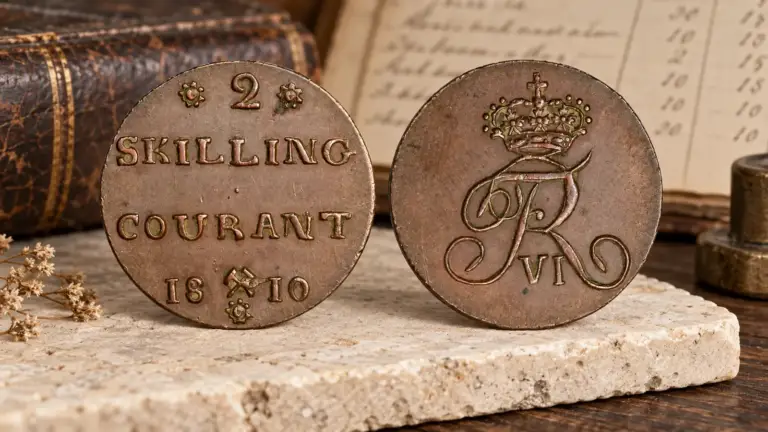
On 1 April 1537 Olav Engelbrektsson sailed from Steinvikholm into exile in the Netherlands, and the Reformation ended coinage by the Church. The skilling itself lived on; follow it to the krone in skilling and speciedaler, Norway’s old currency.
What should you look for when collecting Norwegian medieval coins?
- Legality and provenance: Coins from before 1650 found in Norway belong to the state and must be reported. Buy Norwegian medieval coins with a known history, such as old collections or earlier auctions.
- Attribution: Types are identified with standard works such as Schive and Kolbjørn Skaare’s Norges mynthistorie. Most Norwegian medieval coins are undated, so dating rests on type, style and find evidence.
- Condition: A legible legend, a clear motif and an intact edge matter a great deal. Hollow pennies are fragile.
- Authenticity: Modern copies exist of some types. Buy from a seller who guarantees authenticity.
Denarius guarantees that everything it sells is genuine and as described, and every object has its own protocol number.
How much do Norwegian medieval coins cost?
Prices for Norwegian medieval coins depend on type, rarity, condition and provenance. The table shows the current selection at Denarius (October 2026). Most objects exist in a single example only.
| Coin | Period | Price at Denarius |
|---|---|---|
| Penny, reign of Eirik Magnusson | c. 1285–1299 | NOK 9,500 (protocol no. 5961) |
| Penny, reign of Håkon VI | 1355–1380 | NOK 10,000 (protocol no. 5913) |
| Hvid, time of Gaute Ivarsson | 1474–1510 | NOK 11,000 (protocol no. 5169) |
| Hvid, King Hans | 1483–1513 | NOK 15,000 (protocol no. 5288) |
| Skilling | 1524–1533 | NOK 8,500–26,500 (protocol nos. 5649, 5324, 5326) |
| Skilling, Olav Engelbrektsson | 1523–1537 | NOK 45,000 (protocol no. 5944) |
For the value of other coins, consult the standard catalogues, auction results or the Norwegian Numismatic Society (Norsk Numismatisk Forening).
Frequently asked questions
What are Norwegian medieval coins?
Norwegian medieval coins are the coins struck in Norway from Olav Tryggvason’s penny around 995 to the Reformation in 1537. After King Sverre’s time they consist of pennies and bracteates up to 1387, and of the hvid and skilling from the reign of King Hans (1483–1513) until Archbishop Olav Engelbrektsson fled in 1537.
What is a hvid coin?
Hvid is the Danish-Norwegian name for the North German silver coin called the witten. It was originally worth a third of a skilling. In Norway it was struck from the reign of King Hans, among others by Archbishop Gaute Ivarsson in Nidaros, and its silver content fell until it was worth a quarter skilling or less.
Why are there no Norwegian coins from most of the 1400s?
No Norwegian coinage is securely known from the death of Olav Håkonsson in 1387 until King Hans (1483–1513). For almost a century the country used older and foreign coins.
Can I legally buy Norwegian medieval coins?
Yes, as long as the coin was acquired lawfully. Coins from before 1650 found in Norway today belong to the state and must be reported, so buy coins with a known provenance.
How much are Norwegian medieval coins worth?
At Denarius, pennies and hvids from 1280–1510 currently cost from about NOK 9,500 to 15,000, and skillings of the 1520s and 1530s from NOK 8,500 to 45,000.
Browse Norwegian medieval coins at Denarius
Pennies, hvids and skillings of the late Middle Ages are listed under Gaute Ivarsson et al., and the bracteates of the 1100s under Sverre Sigurdsson. The full range of early Norwegian coins is in Norway before 1814. Denarius ships worldwide, and questions can be sent to kundeservice@denarius.no.