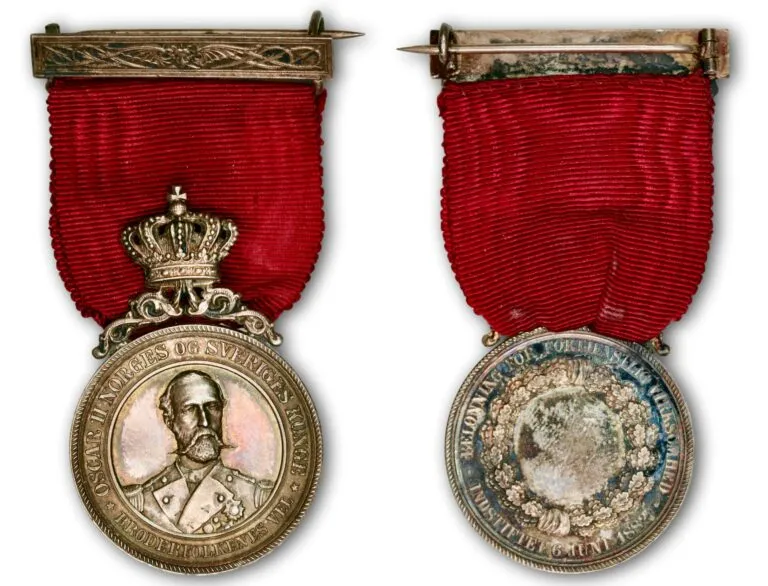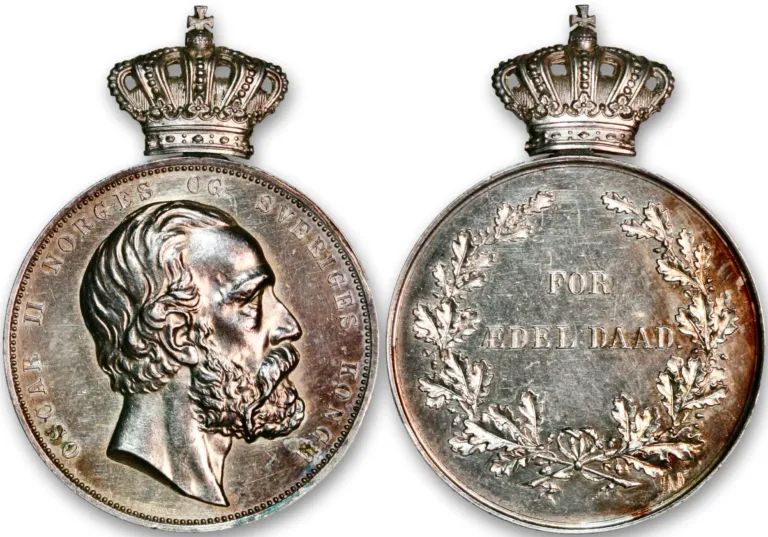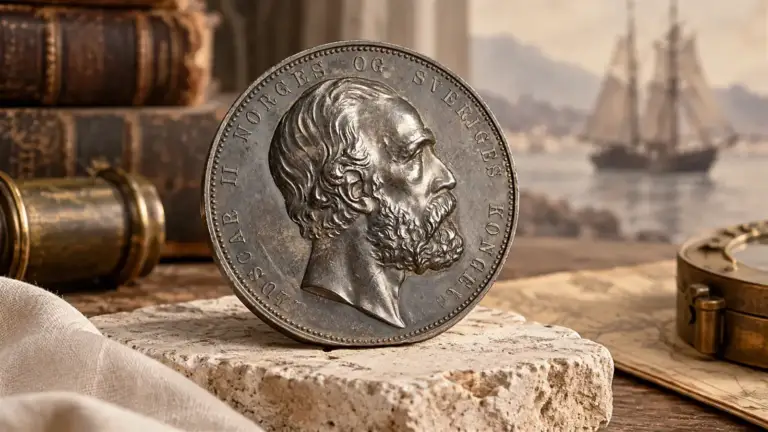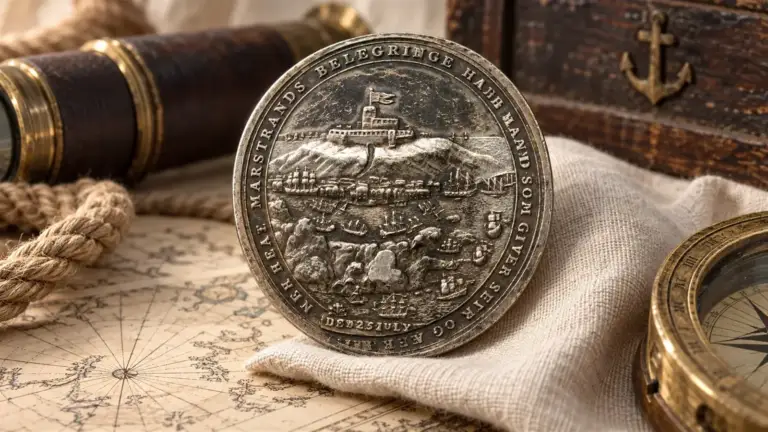
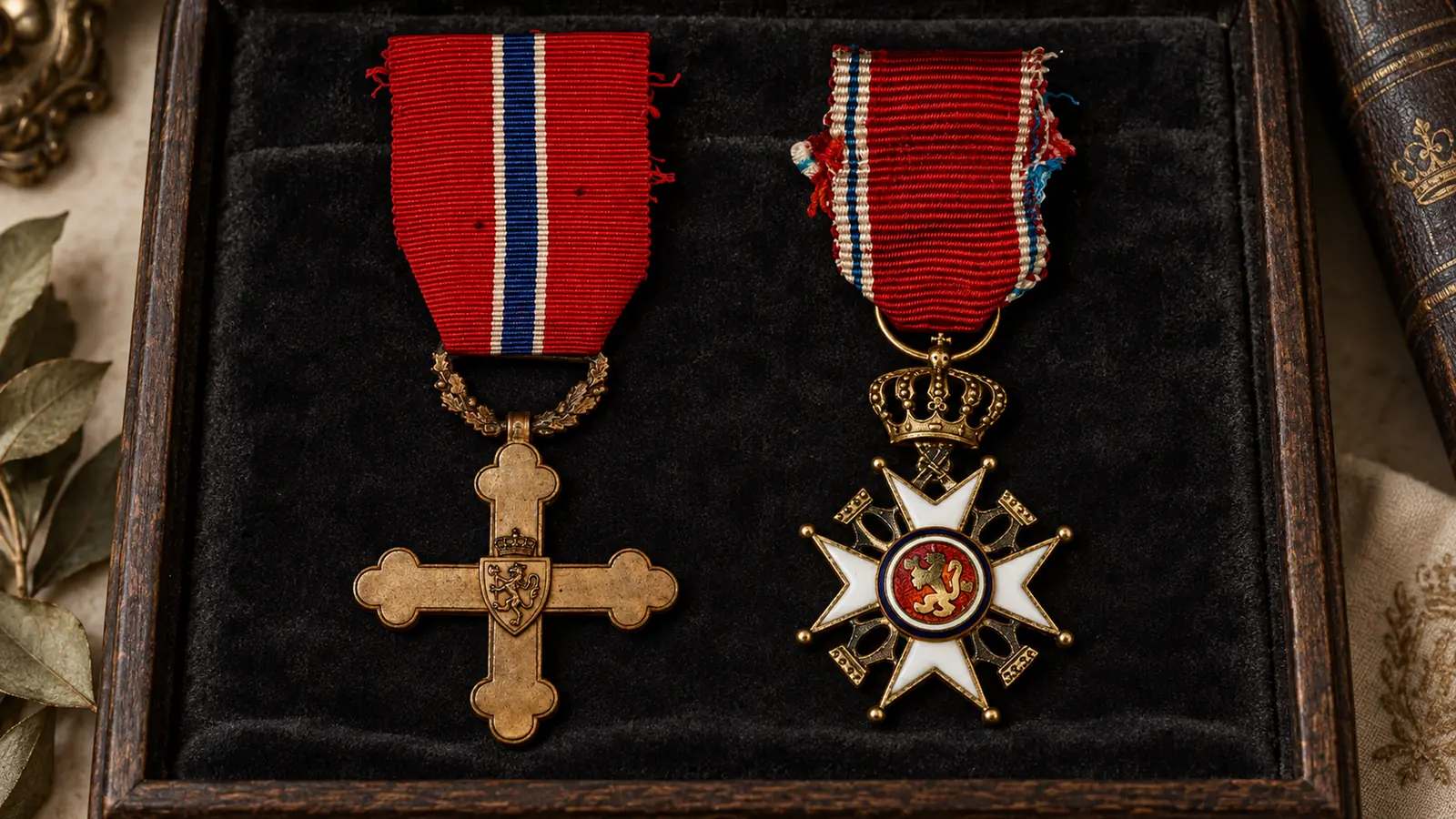
Norwegian medals and orders are awarded by the King, either on the advice of an order council or in the Council of State on the government’s recommendation. The War Cross with Sword of 1941 ranks highest. Next comes the Order of St Olav, founded in 1847, while the King’s Medal of Merit, created in 1908, is the royal award most Norwegians receive.
This guide explains the main Norwegian medals and orders, who awards them and since when, with examples of Norwegian medals Denarius has in stock.
In short:
- King Haakon VII instituted the War Cross with Sword in London on 23 May 1941. It ranks first among Norwegian decorations.
- King Oscar I founded the Order of St Olav on 21 August 1847. It now has five classes, from Knight to Grand Cross.
- The King’s Medal of Merit dates from 1 February 1908. Since 2012 it is normally awarded in silver, and gold is kept for wholly exceptional cases.
- Nominations for the Order of St Olav and the King’s Medal of Merit go through the County Governor to the Chancellery of Orders at the Royal Court.
- Older Norwegian medals from the union with Sweden (1814–1905) form a collecting field of their own.
Contents
Orders and medals: what is the difference?
An order is a fellowship with a Grand Master, statutes and several classes, and members receive insignia such as a cross, a star or a sash. A medal is a simpler decoration, usually a round disc worn on a ribbon, often in gold and silver grades. In everyday speech, and in this article, “Norwegian medals” covers both.
Which Norwegian medals and orders rank highest?
The order of precedence for awards conferred or approved by the King was laid down by royal decree on 11 June 1943, with later additions. At the top are the War Cross with Sword, the Medal for Civic Merit (no longer awarded), the Order of St Olav and the Royal Norwegian Order of Merit. The table lists the main Norwegian medals and orders.
| Award | Instituted | Instituted by | Awarded by |
|---|---|---|---|
| War Cross with Sword (Krigskorset) | 23 May 1941 | Haakon VII (in London) | The King in Council of State |
| Medal for Civic Merit (Medaljen for borgerdåd) | 10 April 1819 | Charles III John | The King in Council (not awarded since a 2004 decision) |
| Order of St Olav | 21 August 1847 | Oscar I | The King, on the order council’s recommendation |
| Royal Norwegian Order of Merit | 14 June 1985 | Olav V | The King |
| St Olav’s Medal | 17 March 1939 | Haakon VII | The King |
| Medal for Heroic Deeds (Medaljen for edel dåd) | 19 August 1885 | Oscar II | The King |
| King’s Medal of Merit (Kongens fortjenstmedalje) | 1 February 1908 | Haakon VII | The King, after nomination via the County Governor |
The War Cross: the highest of all Norwegian medals
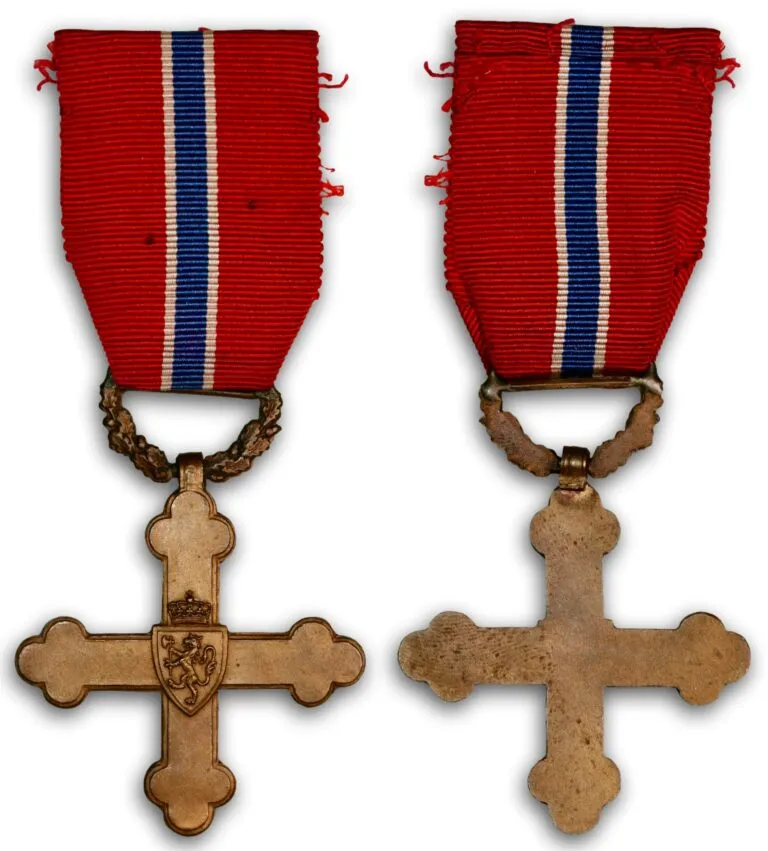
The War Cross was instituted by royal decree on 23 May 1941, while King Haakon VII and the government were in exile in London. It is awarded for outstanding gallantry or leadership in combat, also posthumously. At first it could be given without a sword for civilian service, but this option was removed on 18 May 1945.
Further awards are marked with extra swords on the ribbon. Only one person, the resistance fighter Gunnar Sønsteby, received the War Cross with three swords. Awards stopped in 1949. After the statutes were revised in 2009, Captain Eiliv Austlid received it posthumously for the fighting at Dovre in 1940, and in 2011 Trond André Bolle became the first recipient for actions after the Second World War, in Afghanistan.
The War Cross is conferred by the King in Council of State, and the Ministry of Defence’s decorations council advises on such cases. At the time of writing, a Norwegian War Cross (1941–) costs NOK 12,500 at Denarius (protocol no. 5792).
The Order of St Olav: Norway’s order of chivalry since 1847
King Oscar I founded the Royal Norwegian Order of St Olav on 21 August 1847, naming it after Olaf the Holy. It rewards outstanding service to the country and to humanity. The King awards it on the recommendation of an order council made up of a chancellor, a vice-chancellor and at least two members, with the Lord Chamberlain as treasurer.
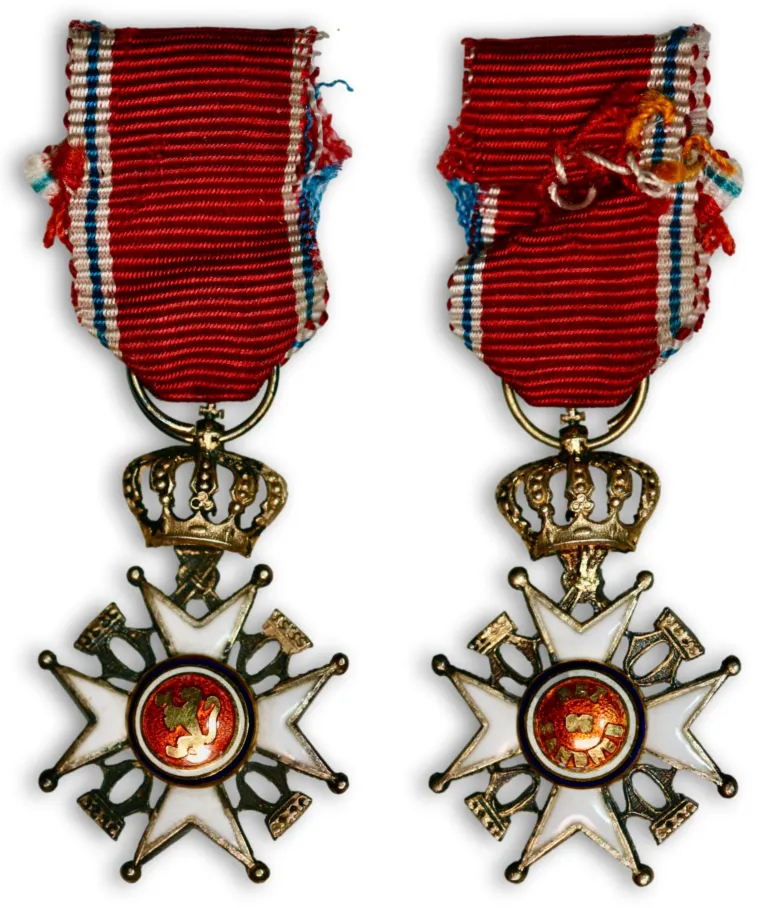
The order began with three grades: Grand Cross, Commander and Knight. The commander grade was divided in 1872 and the knight grade in 1890. Today the five classes are Grand Cross, Commander with Star, Commander, Knight First Class and Knight. In 1882 Oscar II added a collar to the Grand Cross. Apart from royalty and heads of state, only Norwegians receive the order today.
A point for collectors: under the order’s rules, the insignia go back to the order when the holder dies or is promoted. Miniatures, the small versions worn with evening dress, are a separate category. At the time of writing, an Order of St Olav miniature costs NOK 2,000 at Denarius (protocol no. 5941).
The Order of Merit and St Olav’s Medal
King Olav V instituted the Royal Norwegian Order of Merit on 14 June 1985. It is given for services to Norway abroad and to foreign citizens living in Norway.
St Olav’s Medal is a silver medal instituted by Haakon VII on 17 March 1939. It rewards spreading knowledge of Norway abroad and strengthening ties with Norwegians overseas. St Olav’s Medal with Oak Branch, from 1943, is a separate war decoration.
The King’s Medal of Merit: Norwegian medals for service to society
King Haakon VII instituted the King’s Medal of Merit on 1 February 1908 to reward merit in the arts, science and business and distinguished public service. It took over the role of Oscar II’s Medal for Meritorious Service, which ended with the dissolution of the union in 1905.
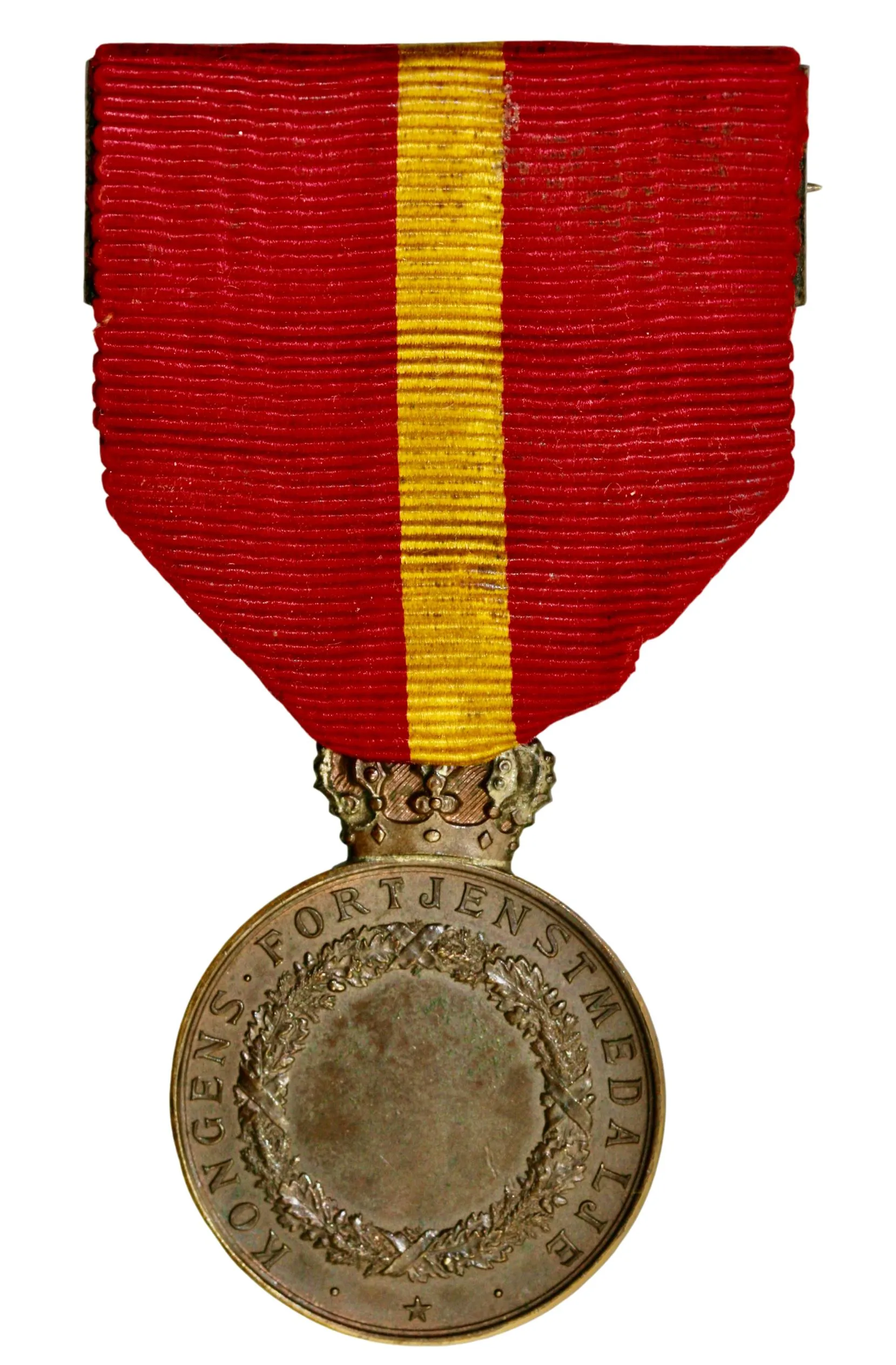
The medal was made in gold and silver. Since the statutes were revised on 30 March 2012, it is simply the King’s Medal of Merit, normally in silver. Gold is awarded only in wholly exceptional cases and cannot be applied for. The emphasis is on long-term service to society, including voluntary work.
Nominations go through the County Governor to the Chancellery of Orders. The obverse shows the reigning king, and the reverse carries the recipient’s name within a wreath. The ribbon is red with a yellow central stripe, the colours of the royal standard. At the time of writing, a case model for King Haakon VII’s Medal for Meritorious Service costs NOK 1,850 at Denarius (protocol no. 3139).
Older Norwegian medals from the union with Sweden
Many of the most interesting Norwegian medals for collectors date from the 1800s, when Norway and Sweden shared a king. Several older Norwegian medals are engraved with the recipient’s name, so the medal can be linked to a particular person.
The Medal for Civic Merit (1819)
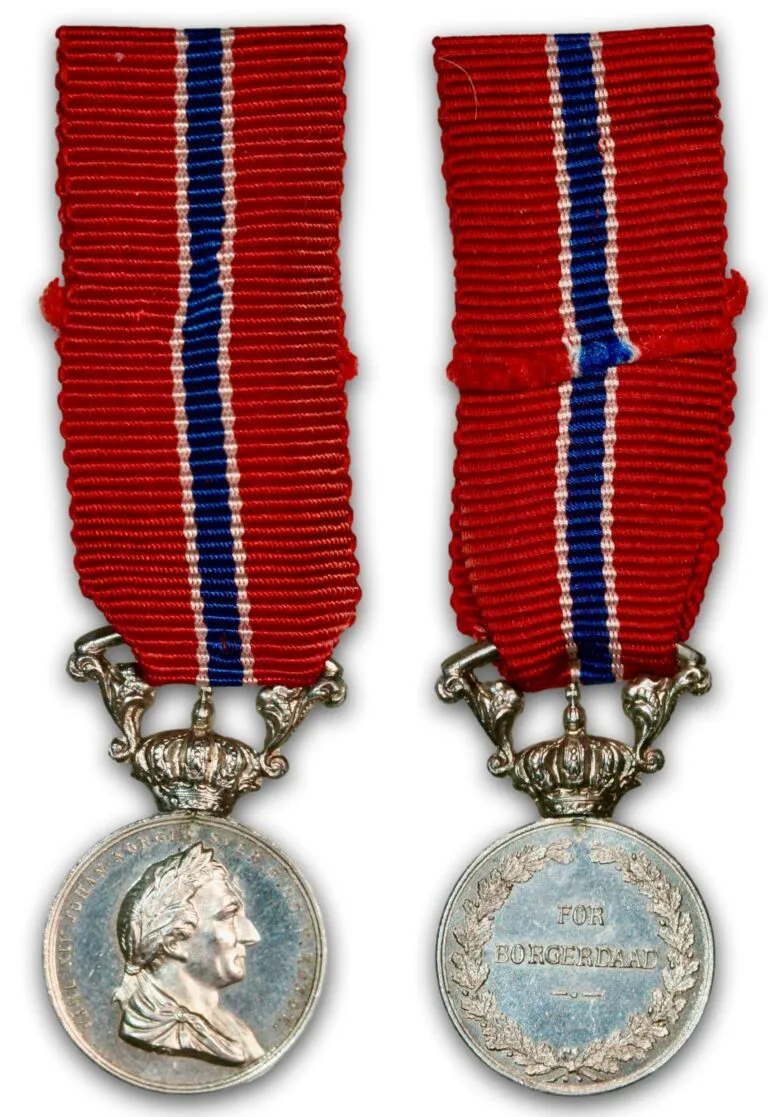
Charles III John (Carl Johan) instituted the Medal for Civic Merit on 10 April 1819, in gold and silver. It was extended on 13 April 1844, was conferred by the King in Council and ranked just after the War Cross. In 2004 the government decided that it would no longer be awarded. At the time of writing, a Medal for Outstanding Civic Achievement (1867–1907) in silver costs NOK 5,500 at Denarius (protocol no. 5492).
Oscar II’s Medal for Meritorious Service (1882)
Oscar II instituted this medal in gold and silver to mark his silver wedding in 1882. It rewarded service in public and private life, in Norway and abroad. From 1888 the obverse carried the king’s portrait, and the medal was struck at the Royal Mint in Kongsberg. Awards ended in 1905. At the time of writing, King Oscar II’s Medal for Civil Service (1882) costs NOK 16,500 at Denarius (protocol no. 5153).
The Medal for Heroic Deeds (1885)
Oscar II instituted the Medal for Heroic Deeds on 19 August 1885. It is awarded for saving life at the risk of one’s own, to Norwegians and foreigners alike. Until 1905 there were three classes, then two. Read more in our article on the Medal for Heroic Deeds. At the time of writing, a Royal Medal for Heroic Deeds 1885–1905 costs NOK 4,500 at Denarius (protocol no. 5936).
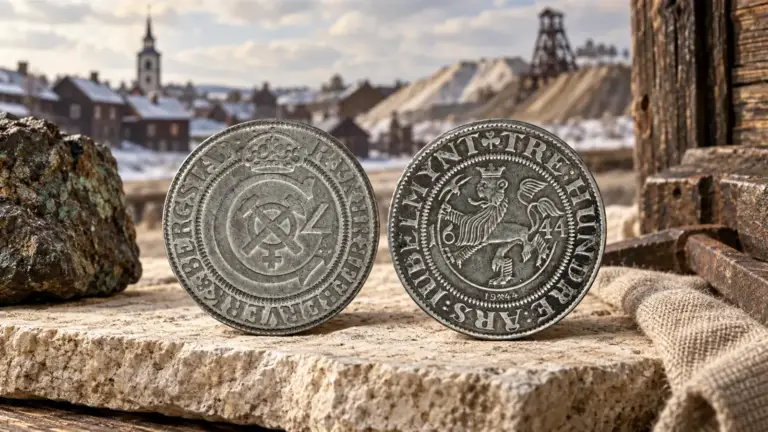
There are also many commemorative Norwegian medals, such as the Røros medal of 1944.
What makes Norwegian medals valuable?
Prices for Norwegian medals vary widely. These factors matter most:
- Type and rarity: Medals awarded to few people are scarcer than commemorative medals struck in large numbers.
- Metal and grade: Gold was awarded to fewer people than silver, and the metal is worth more.
- The recipient: A named medal with a documented story is more interesting than an anonymous one.
- Accessories and condition: An original case, ribbon and award letter add value. Wear, repairs and replaced ribbons reduce it.
If you have inherited Norwegian medals and want to know what they are worth, compare catalogues and auction results, or ask the Norwegian Numismatic Society. As with coins, copies of sought-after Norwegian medals exist, so it pays to buy where authenticity is guaranteed. At Denarius every object is examined, photographed and described with its own protocol number, and Denarius guarantees that everything it sells is genuine and as described.
Frequently asked questions
What is the highest Norwegian military award?
The War Cross with Sword, instituted by King Haakon VII in London on 23 May 1941, ranks first among all Norwegian orders and medals. It is conferred by the King in Council of State for outstanding gallantry or leadership in combat.
Who awards the Order of St Olav?
The King, as Grand Master, awards it on the recommendation of the order council. Apart from royalty and heads of state, it is now given only to Norwegians.
What is the King’s Medal of Merit?
The King’s Medal of Merit (Kongens fortjenstmedalje) was instituted by King Haakon VII on 1 February 1908. It rewards long-term service to society, including voluntary work. Since 2012 it is normally awarded in silver, and the gold medal is reserved for wholly exceptional cases.
Can anyone nominate someone for a Norwegian medal?
Yes. Nominations for the King’s Medal of Merit and the Order of St Olav are addressed to the King and sent to the County Governor (statsforvalteren) where the candidate lives. The County Governor forwards them to the Chancellery of Orders at the Royal Court with a recommendation.
What are old Norwegian medals worth?
The value of old Norwegian medals depends on the type, metal, period, condition and whether the recipient is known. An original case, ribbon and award documents add to it. For guidance, compare catalogues and auction results, or ask the Norwegian Numismatic Society (Norsk Numismatisk Forening).
Looking for Norwegian medals and orders for your collection? Browse all medals at Denarius, or the Miscellaneous category with foreign orders and literature. Denarius is based in Oslo and ships worldwide.