The Medal for Heroic Deeds – Medaillen for Ædel Daad in the spelling of the time – was instituted by King Oscar II by royal resolution on 19 August 1885, after careful study and long deliberation. The rescue medal, as it was also called, kept the diplomatic missions of Norway and Sweden busy for a long time. Ambassadors and consuls sent reports home to Christiania on how other seafaring nations rewarded rescues at sea.
Contents
“Our honour and our might, white sails have brought us,” wrote the poet Bjørnstjerne Bjørnson (1832–1910). Yet just as much honour came to Norway through its seamen’s conduct when ships and crews from other countries were in danger during a storm or a shipwreck. Norwegians had already been decorated with the most prestigious rescue medals of Great Britain, France and the United States.
The Medal for Heroic Deeds in three classes
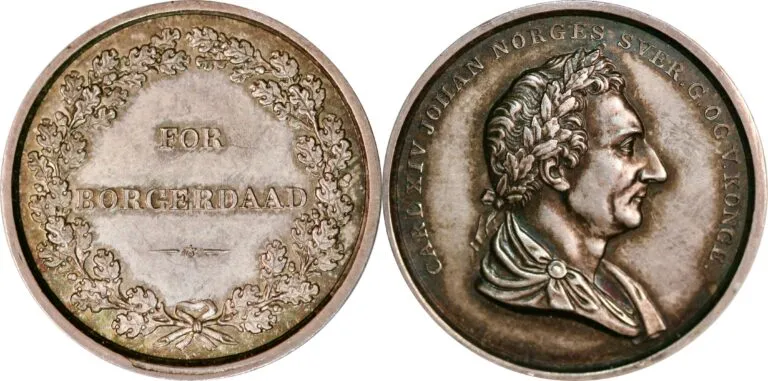
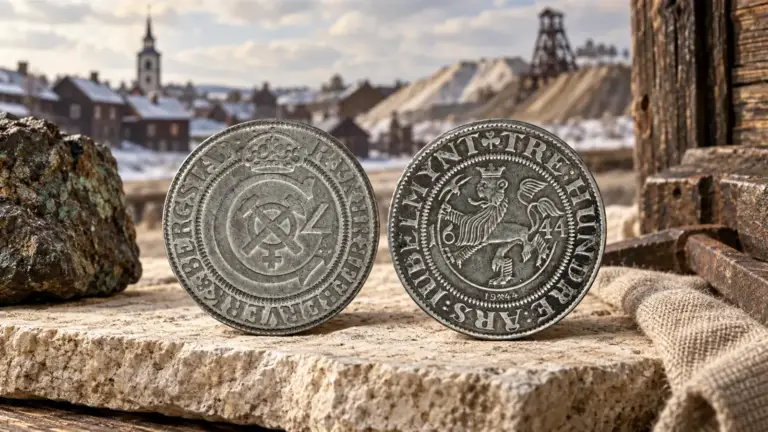
Neither the seafaring King Oscar II, himself the holder of a French rescue medal, nor his predecessors had overlooked acts of rescue. The Medal for Civic Deeds (Medaillen for Borgerdaad) had long served as a reward for rescues. It was instituted in 1819, and from 1844 it was awarded in two classes, gold and silver. Many of these medals went to foreign ship’s captains and to Norwegians who distinguished themselves through honourable rescues. One example from this period is the Norway, Medal for Civic Deeds (1844-1867).
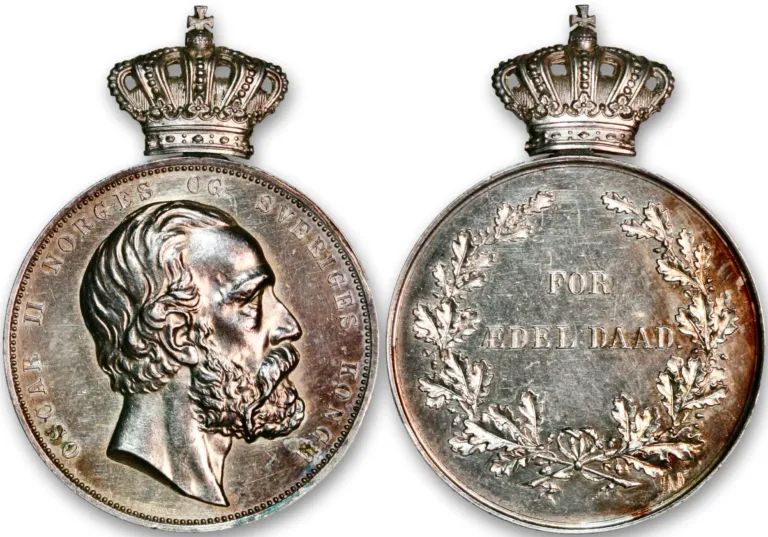
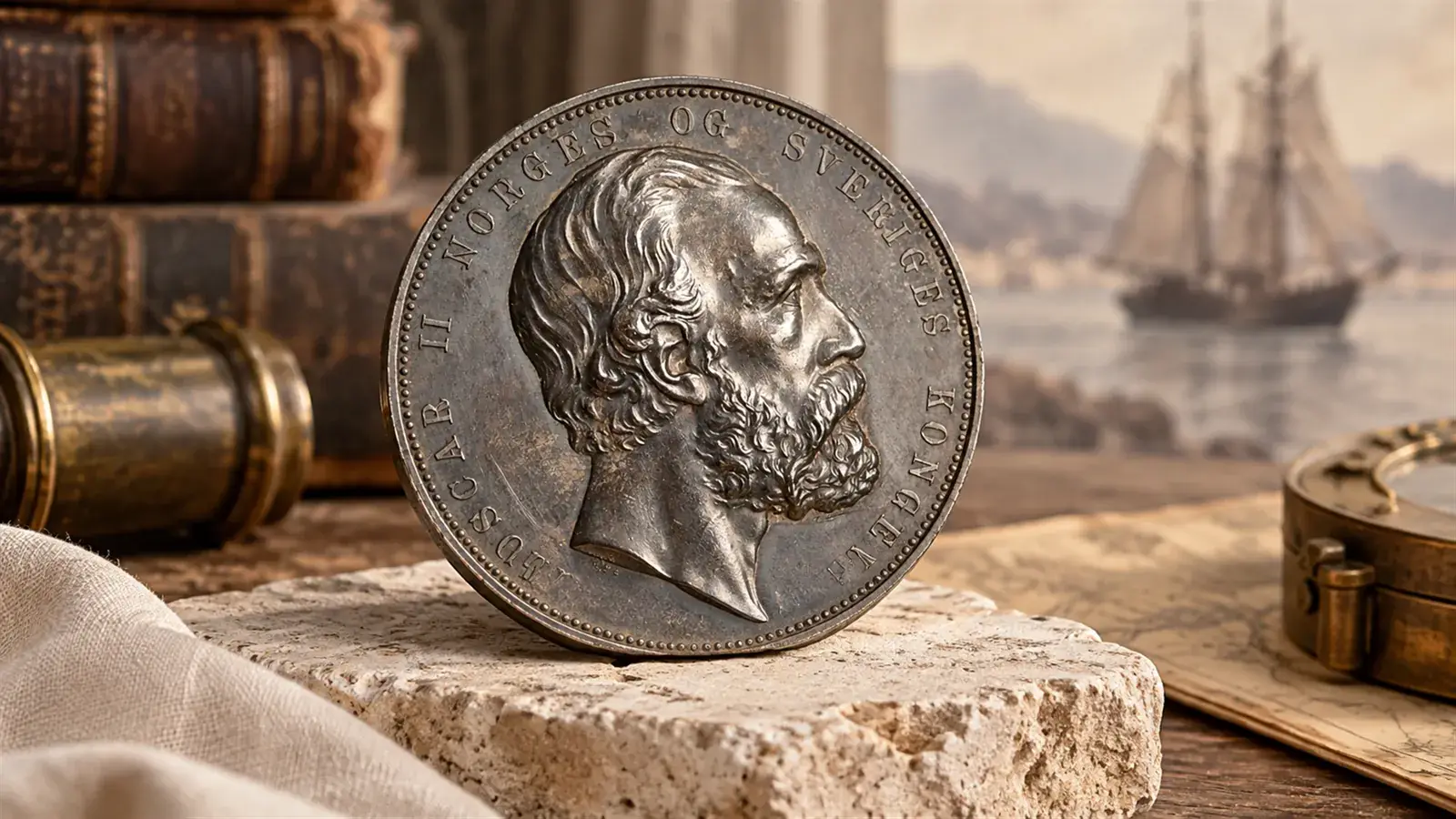
The new medal was divided into three classes: gold with crown as the first class, large silver with crown as the second, and small silver without crown as the third. With it, Norway gained a modern rescue medal that could honour Norwegians and foreigners alike for their efforts on land or at sea. The dies for the Oscar II version were cut by the medallist Ivar Throndsen. The Norway, Royal Medal for Heroic Deeds 1885-1905 shows how the medal looked during the union with Sweden.
A medal for the world’s oceans
Rescue work mattered in an age of ever-growing trade across every ocean. Without cooperation and agreements between the great seafaring nations, things could easily slide into anarchy. Whereas the Medal for Civic Deeds had gone to ship’s captains, the Medal for Heroic Deeds was given to ordinary crew members. They were to be rewarded for helping their foreign colleagues in distress.
The idea was to encourage civilised conduct at sea, so that everyone looked out for and helped one another. No ship was to be abandoned without a determined effort to save it and its crew. King Oscar II’s Medal for Heroic Deeds became an important mark of honour, and many Norwegian and foreign seamen received it. A considerable number of medals were also awarded for rescues on land.
A new king, a new medal
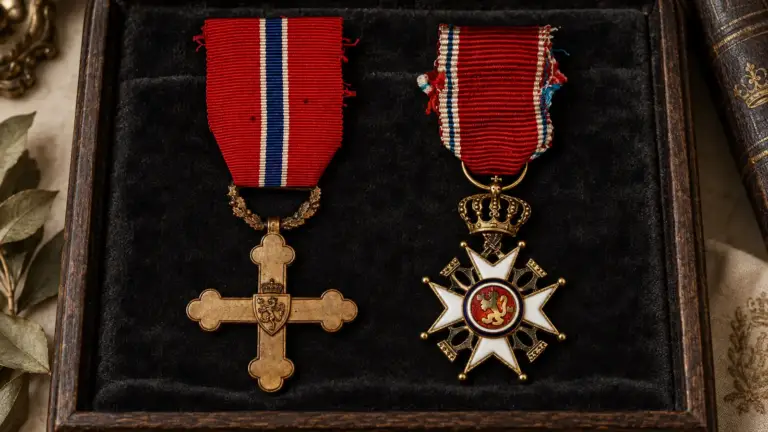
When Oscar II was deposed as King of Norway in 1905, the Medal for Heroic Deeds naturally had to be renewed. Under King Haakon VII it continued in two classes: first class in gold and second class in silver, both with a crown. Today the gold medal is reserved for exceptional rescues in which the rescuer’s own life was at risk, as the Wikipedia article on the medal explains. The criteria were otherwise much as before, but over time something interesting happened: far more gold medals were awarded than under Oscar II, and far more of them went to ordinary sailors.
The story of King Haakon’s medal has never been told in full. Here are two new contributions to its biography.
The proposed bronze medal
At one point there were firm proposals to bring back a third class, in the form of a bronze medal for less demanding rescues. This might cover situations in which the rescuer did not risk his own life. The idea was in line with other countries’ rescue medals, but it was never adopted in Norway.
Two engravers, one medal
The second new element is that the long-running conflict between the mint engraver Ivar Throndsen (1853–1932) and the engraver Herman Rudolf Bruun (1854–1929) came to include the Medal for Heroic Deeds too.
A bitter dispute over the Heroic Deeds medal
The conflict between Throndsen and Bruun was old and deeply felt on both sides. It was about how medals should be made, and about how an old craft adapted to modern inventions. The two men worked as medal engravers for roughly the same length of time, yet Throndsen produced many times more medals than Bruun. He was better at exploiting the technology of the day and turning it into business.
Throndsen was one of the engravers who quickly adopted the reducing machine. It allowed him to model a design at a large scale and let the machine transfer it to the die. This saved money and gave the medals a fresh new look. Bruun swore by cutting directly into the die, as engravers had done for centuries. For Bruun it was a matter of artistry; for Throndsen it was about turnover.
Throndsen’s letter of 1912
After the dissolution of the union, Bruun won the commission for the new Heroic Deeds medals. Throndsen did not give up. On 23 February 1912 he wrote to the ministry that he had heard there was dissatisfaction with the new portraits. The medal, he complained, had been taken from him because he had never imagined that new royal portraits could be given to the lowest bidder. He then offered to supply new dies free of charge, provided he received the contract for all future deliveries.
The king in civilian dress
Bruun’s medal was quite unusual for its time. Most decoration medals showed the monarch’s portrait cut off at the neck, but Bruun depicted King Haakon VII in a civilian suit. In a way this underlined that the medal was a civil decoration, and the portrait was kept despite Throndsen’s attempt to win back the contract. King Olav V and King Harald V have continued the tradition of a royal portrait in civilian dress.
New attempts in 1929 and 1936
Throndsen’s offer was rejected because there were plenty of Heroic Deeds medals in stock and no need to strike new ones. The decision therefore said nothing about the design itself. When the medals were to be struck by J. Tostrup in 1929, a proposal to change the design came up again. It was shelved, only to return with new force in 1936.
A memorandum written by the Director of Shipping, E. Bryn, circulated within the Ministry of Trade. It began by declaring that the Norwegian rescue medal was “not as pretty as foreign medals”. The director had already engaged J. Tostrup, who supplied drawings of a new medal that differed considerably from Bruun’s. Even the die-cutter had been chosen, though he did not know it yet: he would not be told until the King had approved the change. That approval evidently never came, and once again the medal stayed as it was.
Engraved names give each medal a story
Another feature that sets King Haakon VII’s Medal for Heroic Deeds apart from Oscar II’s is that the recipient’s name was engraved on the reverse. Some Oscar II medals do carry engraved names, but without exception these were added privately. Under King Haakon, the medals were delivered already engraved with the recipient’s name and the date of the rescue. Unengraved Haakon medals also appear on the collector market, but these may just as well be surplus pieces or medals used for purposes other than awards.
This small detail makes King Haakon’s medals a little more interesting than those awarded by King Oscar. Each medal can be researched, revealing more about both the medal and the rescue it rewarded. Kvist is in no doubt that medals with a concrete history, tied to real people, will be more sought after than those that could have gone to any of the many brave rescuers. You can find more Norwegian and foreign decorations among our medals.
This article is based on a text by Kjetil Kvist, numismatist and historian, first published by Denarius in 2019.