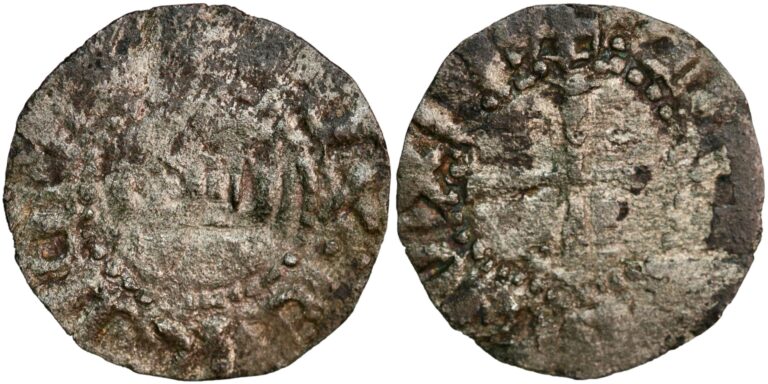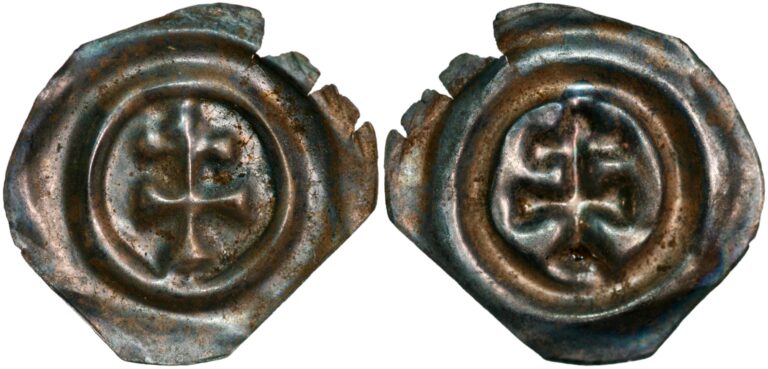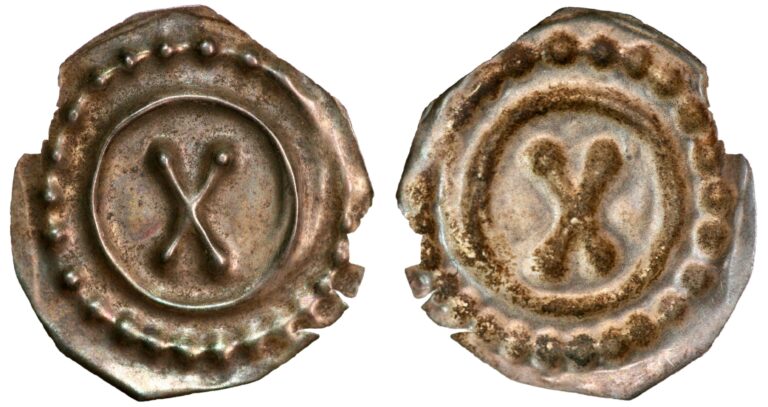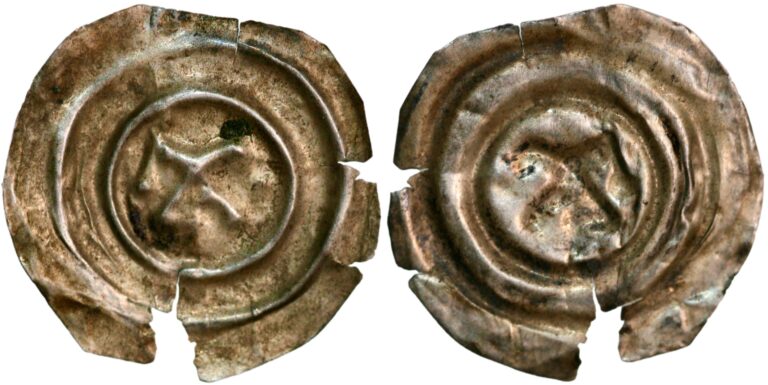
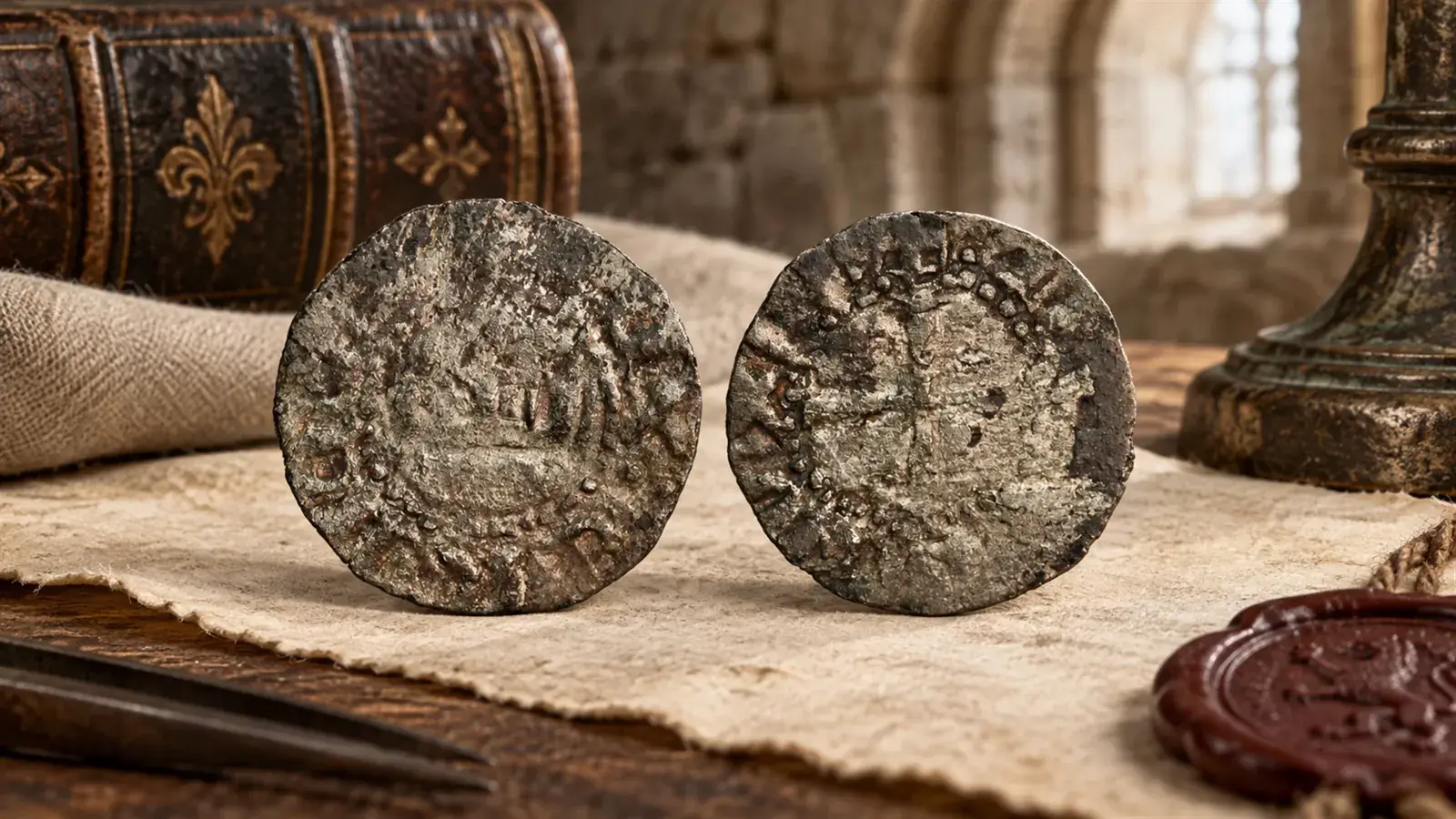
A bracteate is a thin medieval silver coin struck on one side only. The metal was so thin that the design shows through as a mirror image on the back. In Norway, bracteates were struck from around 1110, and apart from roughly 1280–1319 they were the most common form of coin from the early 12th century to the late 14th century.
In short
- A bracteate coin is struck on one side of a thin silver sheet. The name comes from Latin bractea, “thin sheet of metal”.
- Norway’s first bracteates appeared around 1110, and the last were struck for Archbishop Erik Valkendorf in 1510–1522.
- King Sverre Sigurdsson’s bracteates can weigh as little as 0.06 grams, among the lightest coins of medieval Europe.
- Gold bracteates from the Migration Period (about 400–570) are pendants, not coins.
- Common Sverre bracteates in good condition typically cost around NOK 9,000–15,000 today; rare types far more.
Contents
What is a bracteate coin?
Most medieval coins were struck between two dies, one for each side. A bracteate needed only one. The thin silver blank was laid on something soft, such as leather or lead, and when the die was struck the design was pushed right through the metal: raised on the front, sunken and reversed on the back.
The blanks could be as thin as 0.05–0.2 millimetres. In German, later and smaller bracteates are often called Hohlpfennige, “hollow pennies”.
Where the technique began is debated. The Norwegian encyclopaedia Store norske leksikon says the Norwegian bracteates from shortly after 1100 appear to be the very earliest bracteate coins, while the University of Oslo coin cabinet thinks the method probably started in German lands. Either way, bracteates from Saxony and Thuringia from around 1130 shaped how the coin type developed across Europe, spreading to Poland, Bohemia, Switzerland and Hungary.
Why were medieval coins made so thin?
Bracteates were cheap. One die instead of two, little silver per coin, and a simple striking process. Norges Bank points out that much of Europe faced a shortage of silver in the 12th century, and in Norway this was also the era of the civil wars.
In Germany, bracteates were also linked to renovatio monetae, the regular recall of coinage. The issuer declared old coins invalid, and people had to exchange them for new ones at a loss, which worked as a tax. Swedish economist Roger Svensson argues that thin, pliable coins suited this frequent re-minting well. How far the practice applied in Norway is less clear.
Bracteates in Norway: when and who?
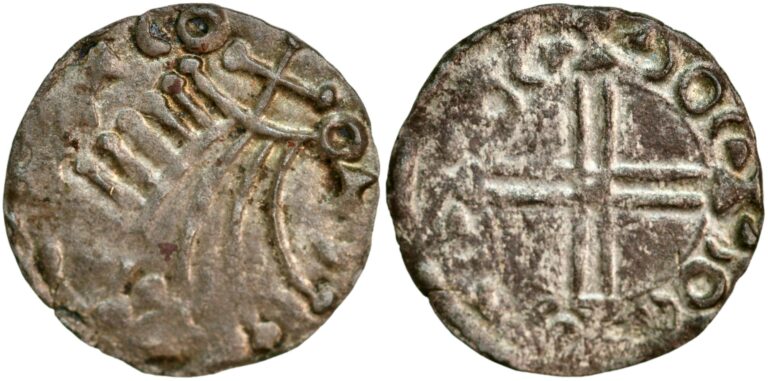
According to the University of Oslo coin cabinet, Norway’s first bracteates were struck around 1110, with Olav Magnusson the first king on its list of issuers. Store norske leksikon singles out Sverre Sigurdsson, Håkon Håkonsson and Magnus Lagabøte as the kings who struck bracteates in large numbers.
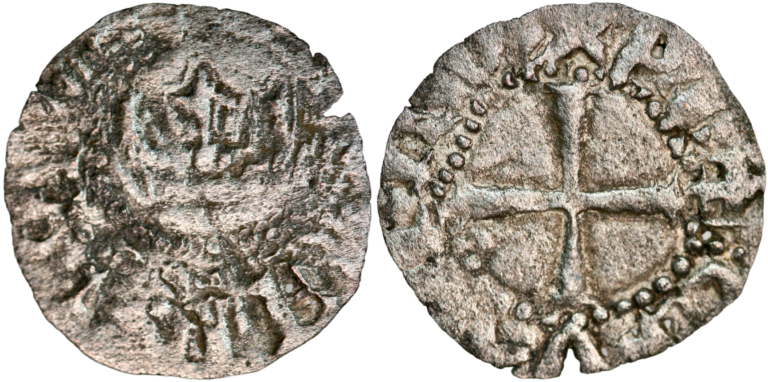
In the 13th century, the penny itself was two-sided while the quarter-penny was a bracteate, and from about 1280 to 1319 two-sided pennies took over entirely. At Denarius, a two-sided penny of 1280–1299 currently costs NOK 6,000 (protocol no. 5879). Bracteates later returned and were struck well into the 16th century, the last for Archbishop Erik Valkendorf in 1510–1522. Mints included Bergen, Nidaros (Trondheim) and Tunsberg.
King Sverre Sigurdsson (1177–1202)
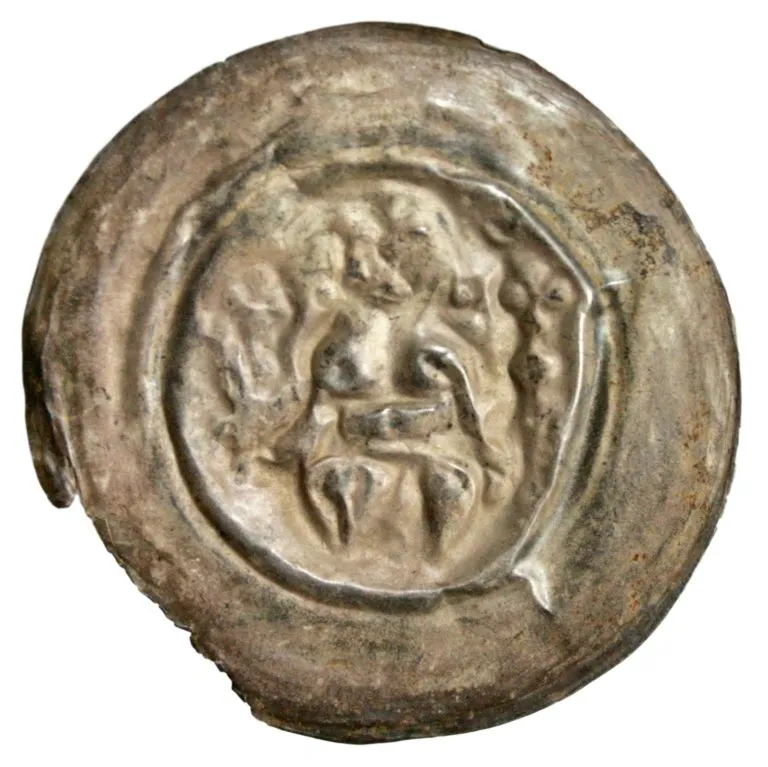
Sverre’s bracteates are the best-known Norwegian bracteates, and most of what we know about them comes from the Dæli hoard, found on a farm in Nes, Hedmark, in 1840. It held nearly 5,000 coins, including more than 4,000 bracteates, and is Norway’s largest medieval coin hoard. The bracteates carry no inscriptions and are attributed to Sverre by style and context.
A large group shows just a single letter, such as A, H, N, S or V, and no one has yet explained them all. The lightest weigh around 0.06 grams, which makes them some of the smallest coins of medieval Europe.
At Denarius, a Sverre bracteate with an “X”, ex Ahlström auction 1975, currently costs NOK 12,500 (protocol no. 4689). One in Norwegian grade 1+/01 with provenance from Myntgalleriet in 1995 costs NOK 14,500 (protocol no. 5618), and an “A” bracteate in grade 1+ with edge damage costs NOK 8,750 (protocol no. 5648).
The archbishops’ bracteates
The archbishops of Nidaros at times had their own right to mint and also issued bracteates, among them Jon Raude in the 13th century and Erik Valkendorf in the 16th. Late medieval Norwegian coins, including the archbishops’, are listed under Gaute Ivarsson and others.
German bracteates
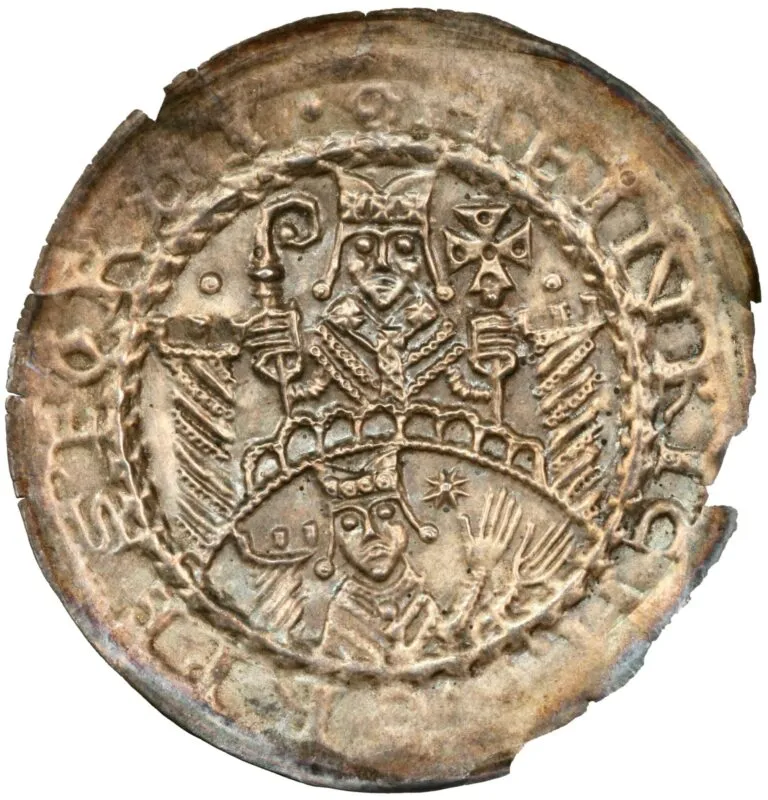
German bracteates of the 12th and 13th centuries are often much larger and more elaborate than Norwegian ones, showing saints, bishops, castles and rulers. At Denarius, a bracteate of Archbishop Heinrich I of Mainz (1142–1153), 43 millimetres across, currently costs NOK 14,500 (protocol no. 4456), while an impressive German bracteate of 1197–1221 costs NOK 2,200 (protocol no. 2168).
Bracteate coins vs gold bracteates
The word bracteate covers two very different things. Gold bracteates date from the Migration Period, about 400–570. They are round pendants of thin gold sheet, 3–12 centimetres across, with a loop for wearing around the neck. Store norske leksikon describes them as originally imitations of 4th-century Roman medallions, probably worn as amulets. Around 900 are known, most from southern Scandinavia.
Gold bracteates were never money. They share the name only because they are also thin and stamped on one side. In Norway, any found in the ground belong to the state, as do other loose antiquities older than 1537.
How do collectors judge a bracteate?
- Completeness: Cracks, edge damage and folds are common. An undamaged coin is worth more.
- Strike: A sharp, well-centred, legible design lifts the price.
- Type and rarity: Common letter types from the Dæli hoard are far cheaper than rare types. A very rare Sverre bracteate from Bergen was knocked down for NOK 110,000 (before buyer’s premium) at Oslo Myntgalleri in May 2023.
- Provenance: A known history, such as an older auction or collection, adds confidence and often value.
- References: Norwegian bracteates are identified using standard works such as Schive and Skaare. In Norwegian grading, 01 is roughly extremely fine and 1+ roughly very fine.
How should you store bracteates?
Bracteates are the most fragile coins you can collect. A few simple rules:
- Use a capsule or small box that fits, so the coin cannot slide or be squeezed.
- Avoid soft plastic flips containing PVC, which can damage silver over time.
- Handle as little as possible, lift it over a soft surface and never press on the centre.
- Never clean or polish a bracteate. The patina is part of its value, and the metal tolerates very little.
- Keep the collection dry and at an even temperature.
How much is a bracteate worth?
Guide prices as of October 2026. Auction results are hammer prices before buyer’s premium, from Oslo Myntgalleri’s auction 33 (6 May 2023) as recorded on Numista.
| Bracteate | Source | Price |
|---|---|---|
| Sverre Sigurdsson, letter or rosette, grade 01–1+ | Oslo Myntgalleri, May 2023 | NOK 12,000–13,000 |
| Sverre Sigurdsson, very rare Bergen type | Oslo Myntgalleri, May 2023 | NOK 110,000 |
| Sverre Sigurdsson, various types | Denarius | NOK 8,750–14,500 |
| German bracteates, 12th–13th century | Denarius | NOK 2,200–14,500 |
Frequently asked questions
What is a bracteate?
A bracteate is a thin medieval silver coin struck on one side only, with the design showing as a mirror image on the back. In Norway, bracteates were the most common coin for much of the period from the 12th to the 14th century.
Why are bracteates only struck on one side?
The silver sheet was so thin that a single die pressed into a soft backing was enough. That made the coins cheap to produce and used little silver, which suited a time of silver shortage.
Are gold bracteates coins?
No. Gold bracteates are Migration Period pendants from about 400–570, worn around the neck and probably used as amulets. They share the name because they are also thin and stamped on one side.
How much is a bracteate coin worth?
Common Norwegian bracteates of King Sverre in good condition usually sell for around NOK 9,000–15,000, while very rare types have passed NOK 100,000 at auction. German bracteates of the 12th and 13th centuries start at a couple of thousand kroner.
Which Norwegian kings struck bracteates?
The first Norwegian bracteates appeared around 1110 under Olav Magnusson. Sverre Sigurdsson, Håkon Håkonsson and Magnus Lagabøte struck them in large numbers, and the archbishops of Nidaros also issued bracteates, the last under Erik Valkendorf in 1510–1522.
How should I store bracteates?
Keep them in a capsule or box that fits, away from soft PVC plastic, in dry conditions with an even temperature. Handle them as little as possible, never press on the centre and never clean them.
See bracteates and other medieval coins at Denarius
Norwegian bracteates are listed under Sverre Sigurdsson and across Norway before 1814, while German bracteates are in Prussia, Germany and Austria. Every object is examined, photographed and described, and has its own protocol number. Denarius ships worldwide.