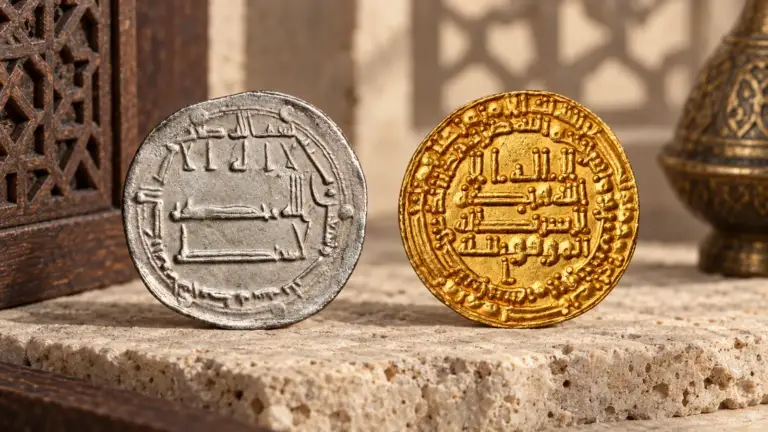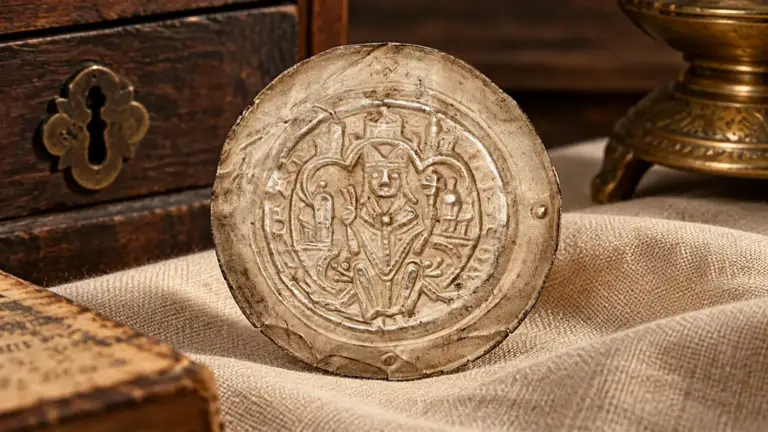
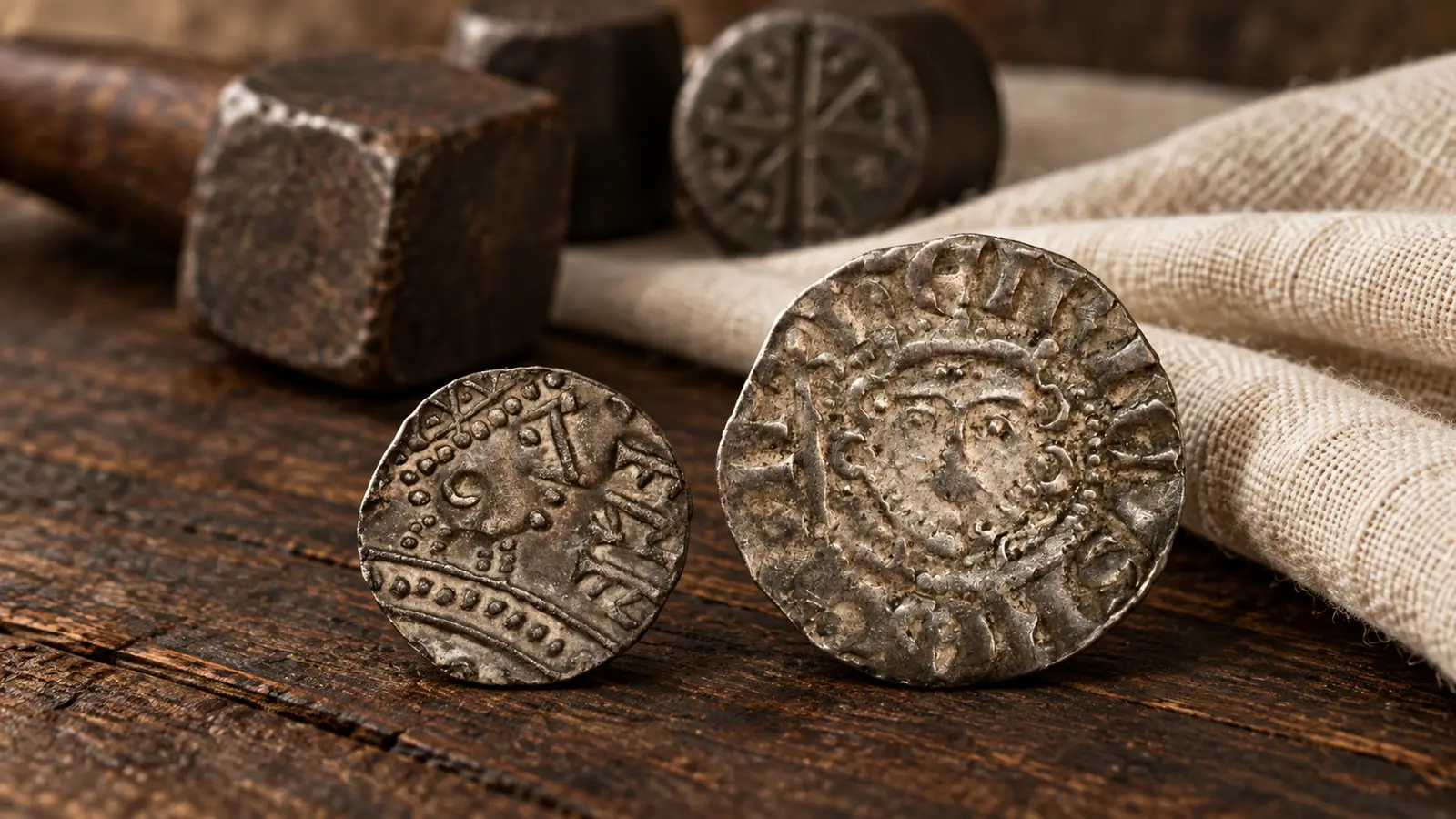
Medieval coins are the coins struck in Europe between roughly AD 500 and 1500. Most are small silver pieces, hammered by hand between two dies. The main coin was the silver penny, called a denier in France and a pfennig in Germany. From the 13th century larger silver coins such as the gros and the groat appeared, and from 1252 Western Europe struck its own gold again: the florin, ducat, écu, noble and gulden.
This guide explains the main types of medieval coins, how they were made, and what to look for when you buy one. The examples from Denarius are individual objects, each with its own protocol number.
In short
- The silver penny was the everyday coin of most of medieval Europe. Under the Carolingian system, 240 pennies made a pound.
- Medieval coins are hammered: a silver blank was placed between two dies and struck with a hammer. England only switched to machine-made coins in 1662.
- The French gros tournois arrived in 1266. The English groat of four pence became a permanent coin in 1351.
- Gold returned with the florin of Florence in 1252 and the ducat of Venice in 1284.
- At Denarius, 13th-century English pennies cost around NOK 875–1,750 at the time of writing. Medieval gold coins start at around NOK 8,000.
Contents
What are medieval coins?
After the fall of the Western Roman Empire, minting carried on at a smaller scale. Across much of Western Europe silver became the normal coin metal from around 700, and for several centuries there was essentially one denomination in circulation: the penny.
The foundations were laid by the Frankish kings in the 8th century. Pepin the Short and then Charlemagne reformed the coinage, and by the 790s the system was in place: 240 silver pennies (Latin denarii) to the pound. The pound and the shilling were units of account, not coins. Britain kept the same pounds, shillings and pence until 1971.
Norway used the same ratio, with 240 pennies to the mark. According to Norges Bank, each Norwegian penny held about 0.9 grams of silver. You can read more about Norway’s own medieval coins in our guide to bracteates, Norway’s thin medieval coins.
What is a hammered coin?
Medieval coins were made by hand. A silver blank was placed on a lower die fixed in a block. The moneyer held the upper die on top and struck it with a hammer, which gave the coin a design on both sides.
That method explains why medieval coins are rarely perfectly round. The design is often slightly off-centre, the edge can be irregular, and part of the legend may be missing. This is normal and seldom hurts the value much. A well-centred, clear strike is a bonus.
Collectors often call them hammered coins. In England, hammered coins were struck until 1662. From then on, all coins were machine-made.
English medieval coins: from sceatta to penny
Sceattas (c. 600–775)
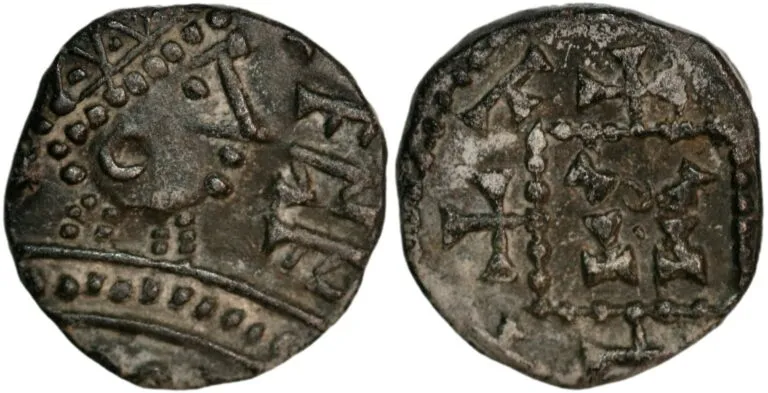
The earliest Anglo-Saxon silver coins are small and thick, and collectors call them sceattas. The name is a later label, used since the 17th century. People at the time probably just called them pennies. The Fitzwilliam Museum in Cambridge describes them as the predecessors of the penny. At Denarius, a sceatta of c. 600–775 costs NOK 3,500 at the time of writing (protocol no. 5830).
The penny becomes the standard
Towards the end of the 8th century a broader, thinner penny appeared, associated with King Offa of Mercia. It weighed about 1.3–1.5 grams of silver. The penny remained England’s main coin until the 14th century. In the Viking Age, large numbers of English pennies ended up in Scandinavia, as described in our guide to Viking coins.
The long cross penny of 1247
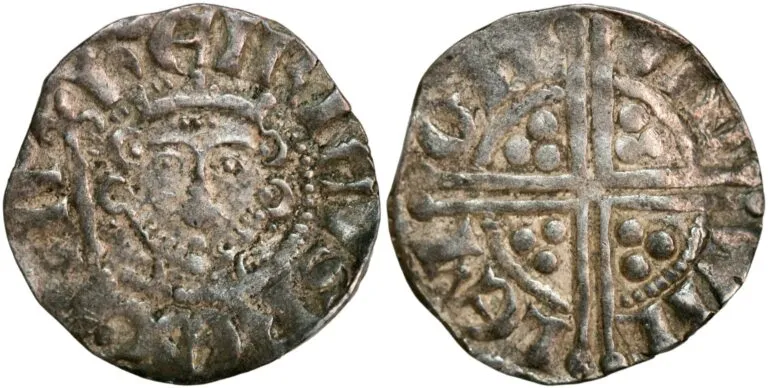
A major problem was clipping: people shaved silver from the edge before passing the coin on. In 1247 Henry III introduced a new penny with the reverse cross running right out to the edge, which made clipping easier to spot. A penny of 1247–1272 costs NOK 875 at Denarius (protocol no. 4409). In 1279 Edward I introduced a new penny with a solid cross, together with the halfpenny and the farthing.
Groats and gros: the large silver coins
Trade eventually needed coins larger than the penny. In 1266 the French king Louis IX introduced the gros tournois, worth 12 deniers. It was struck in almost pure silver and was copied across much of Europe.
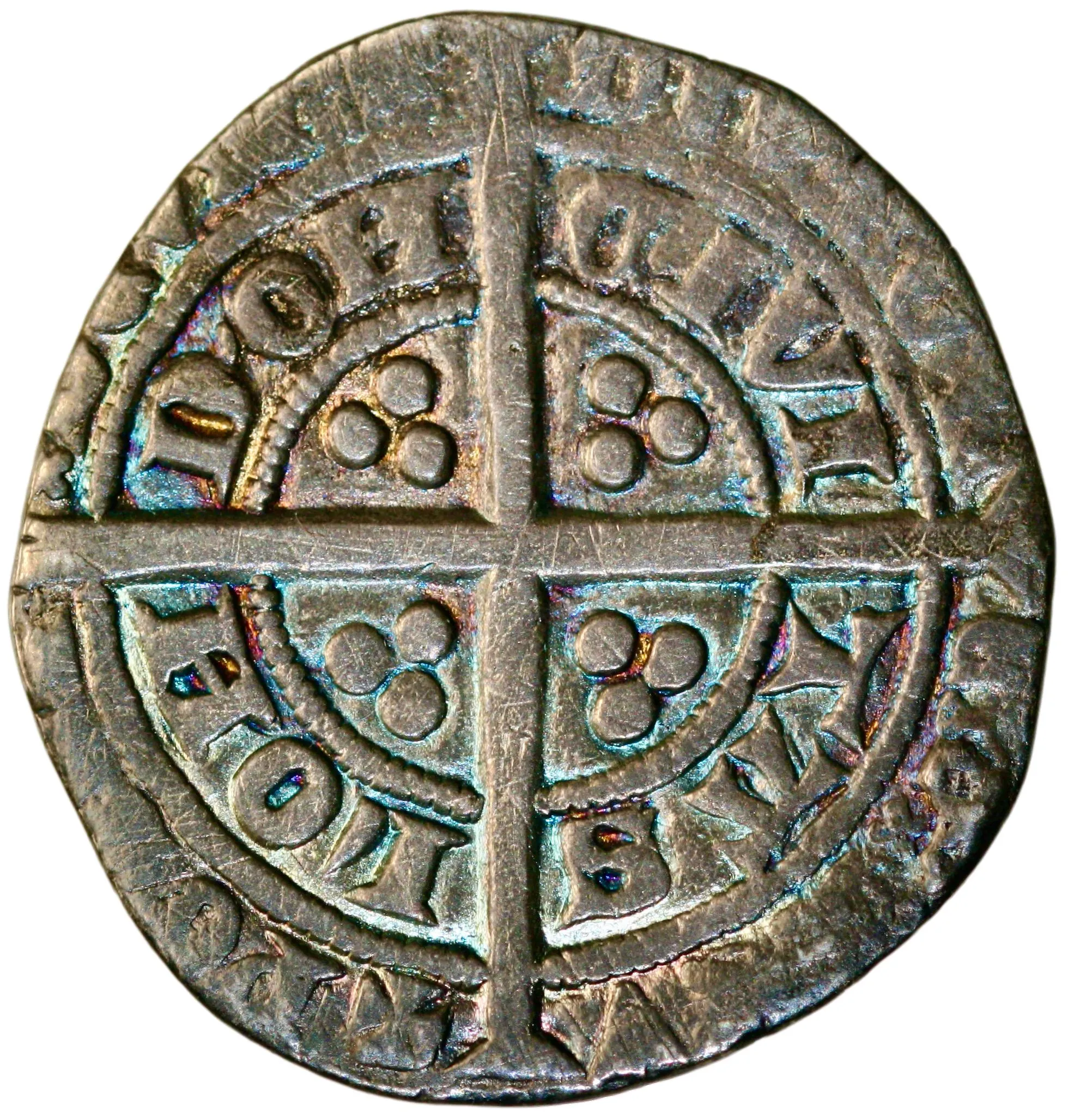
In England, Edward I tried a groat as early as 1279. Only in 1351, under Edward III, did the four-penny groat become a lasting part of the coinage. The obverse shows the crowned king facing. The reverse has a long cross and the legend POSVI DEVM ADIVTOREM MEVM, “I have made God my helper”. A groat of 1351–1352 costs NOK 1,000 at Denarius at the time of writing (protocol no. 2891).
Medieval gold coins: florin, écu, noble and gulden
For centuries, Western Europe struck almost no gold. That changed in 1252, when Florence introduced the florin, about 3.5 grams of nearly pure gold. Venice followed with the ducat in 1284. Both became international trade coins and were imitated widely.
France: the écu d’or à la chaise
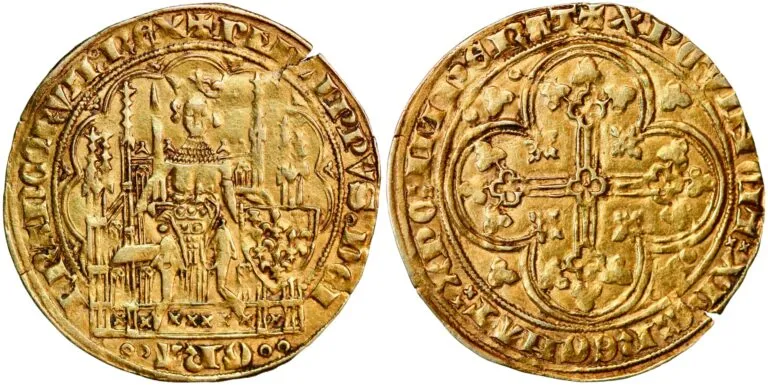
Philip VI introduced the écu d’or à la chaise in January 1337. It shows the king enthroned with a sword and the shield of France. It weighed about 4.5 grams and was copied from Spain to the Low Countries. At Denarius, an écu d’or of 1337 costs NOK 22,500 at the time of writing (protocol no. 5813).
England: the noble and quarter noble
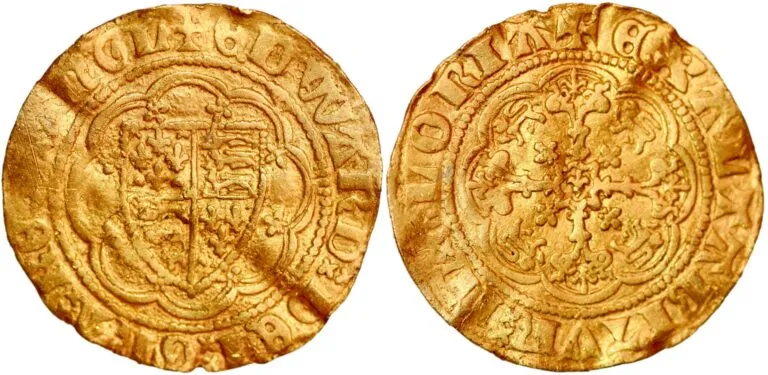
Henry III tried a gold penny in 1257, but it failed and is very rare today. Edward III created the first lasting English gold coin. The noble of 1344 was worth six shillings and eightpence and shows the king standing in a ship. The quarter noble, worth one shilling and eightpence, shows only the royal shield. A quarter noble of 1361–1369 costs NOK 14,000 at Denarius (protocol no. 5985).
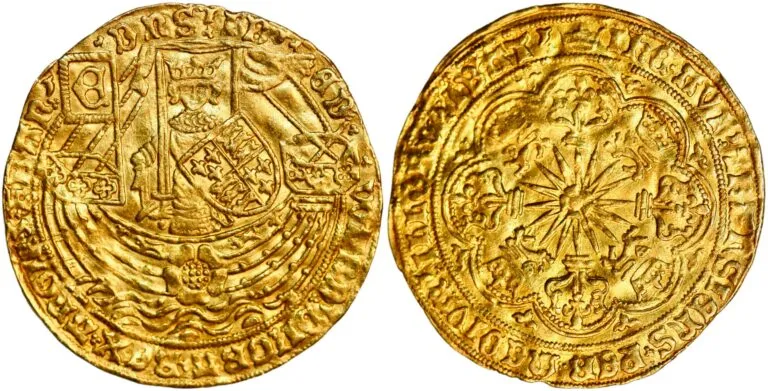
Under Edward IV, a new ten-shilling gold coin appeared in 1464–1465, the ryal or rose noble. The type lived on across the North Sea: in the 1580s several Dutch provinces struck their own rose nobles on the English model. One of 1583–1591 costs NOK 55,000 at Denarius (protocol no. 5794). Strictly speaking it is post-medieval, but the design is pure Middle Ages.
Germany: the Rhenish goldgulden
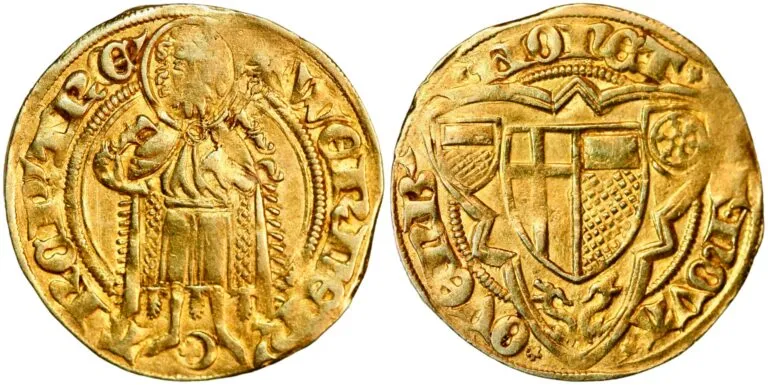
The archbishops of Trier and Cologne received the right to strike gold in 1346, and Mainz in 1354. The first gulden were copies of the florin. In the 1380s the three archbishops and the Count Palatine of the Rhine formed a coinage union with a shared gold and silver standard. The goldgulden became Germany’s leading gold coin, although it gradually lost nearly a quarter of its gold content. A goldgulden of 1388–1418 costs NOK 14,000 at Denarius at the time of writing (protocol no. 5724).
If you are thinking about gold, see our guide to buying gold coins as a collector.
What to look for when buying medieval coins
- Clipping and weight. Many silver coins are clipped or worn. A coin with a full edge and normal weight is more desirable.
- A readable legend. The ruler’s name and the mint let you identify the coin precisely.
- Strike and cracks. An off-centre strike is normal. Cracks in thin coins and harsh cleaning lower the value.
- Gold. Gold coins are often better preserved, but look out for bends, scratches and traces of jewellery mounts.
- References. Spink’s Coins of England, North’s English Hammered Coinage and Friedberg’s Gold Coins of the World are standard works.
Forgeries of medieval coins exist, especially of gold. Buy from a seller who guarantees authenticity. Denarius guarantees that everything it sells is genuine and as described.
Frequently asked questions
What are medieval coins?
Medieval coins are coins struck in Europe between roughly AD 500 and 1500. Most are small silver coins such as the penny, denier and pfennig, hammered by hand between two dies. Larger silver coins and gold coins appeared from the 13th century.
What is the difference between a penny and a groat?
The penny was the everyday silver coin of medieval England. The groat was a larger silver coin worth four pence, which became a permanent part of the English coinage in 1351 under Edward III.
Why are medieval coins often off-centre and irregular?
Medieval coins were hammered by hand. The blank was placed between two dies and struck with a hammer, so the design often landed slightly off-centre and the edge was uneven. This is normal and rarely affects the value much.
When did gold coins return in the Middle Ages?
Florence introduced the gold florin in 1252 and Venice the ducat in 1284. France, England and the Rhineland archbishops followed in the 14th century with the écu d’or, the noble and the goldgulden.
What is a sceatta?
A sceatta is a small, thick Anglo-Saxon silver coin of the 7th and 8th centuries. Collectors began using the name in the 17th century. The coins are regarded as the predecessors of the English penny.
How much are medieval coins worth?
It depends on type, rarity and condition. At Denarius, 13th-century English pennies cost around NOK 875–1,750 at the time of writing, while medieval gold coins start at around NOK 8,000.
Want to see more medieval coins? In the shop you will find English pennies, groats and sceattas under England, gold from the écu d’or to the goldgulden under Gold coins, and more German coins under Prussia, Germany and Austria. Every object has been examined, photographed and described, and most are one of a kind.